Share

“The Future of EV Industry 2026 ⚡ Non-Ferrous Metals — The Driving Force of the World | SO OK TRADING: Your Non-Ferrous Partner for the EV Era” : September 9
Last updated: 9 Sept 2026
1134 Views

“EV Industry 2026: Strategic Transition and the Future Role of Non-Ferrous Metals” SO OK TRADING — September 9, 2026

 
Introduction
The year 2026 marks a critical turning point for the electric vehicle (EV) industry both globally and in Thailand. After a period of rapid growth, the market is entering a “strategic adjustment phase” characterized by price competition, localization of production, and geopolitical pressures.

At the same time, demand for industrial and non-ferrous metals — Lithium, Nickel, Copper, Aluminium, and Cobalt — continues to rise. Each EV requires 3–6 times more minerals than a traditional internal combustion engine vehicle, making these resources indispensable.

 
Outlook and Future Directions
Global Market
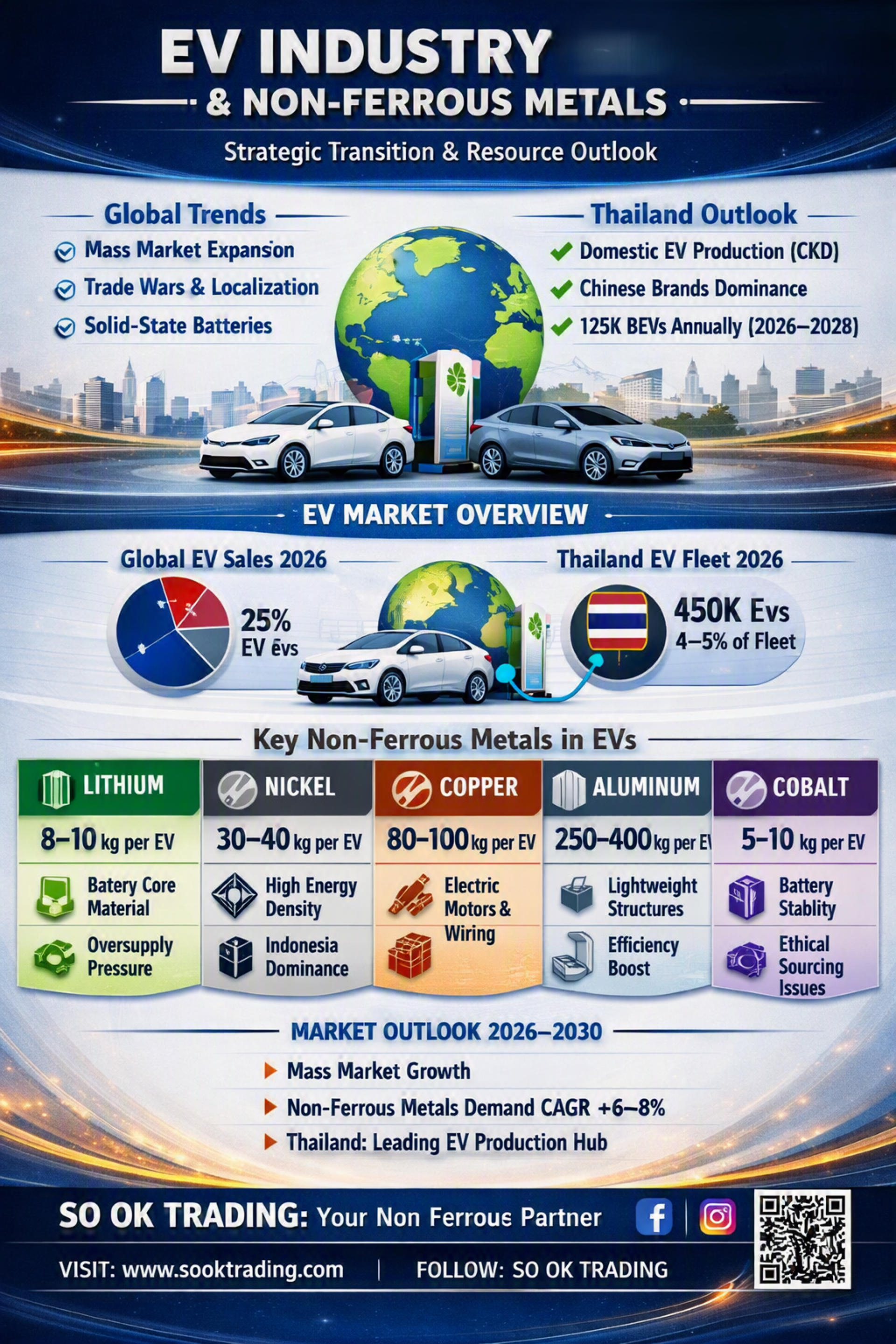
Shift to Mass Market: EV adoption is expanding from early adopters to mainstream consumers, driven by affordable EVs (<$25,000) and the commercialization of solid-state batteries.
Trade Wars & Localization: The U.S. and Europe have imposed high tariffs on Chinese EVs, prompting Chinese automakers to relocate production to Eastern Europe, Mexico, and Southeast Asia.
New Technologies: Solid-state batteries are entering production, while hybrids and plug-in hybrids regain popularity due to incomplete charging infrastructure.
Energy Pressure: EV growth is straining global power grids, leading many countries to invest in energy storage systems (BESS) and ultra-fast charging stations.
Thailand Market
Market Adjustment: After strong growth in 2023, the market slowed due to economic conditions and stricter credit policies. Consumers are concerned about resale value, insurance, and maintenance costs.
Domestic Production (CKD): Starting in 2026, automakers must produce EVs in Thailand under the 30@30 policy. Over 71% of Thai consumers prioritize locally assembled vehicles.
Chinese Brand Dominance: BYD, MG, NETA, DEEPAL, CHERY, and JAECOO continue to lead the Thai EV market.
Future Forecast (2026–2028): With domestic production and expanded charging infrastructure, annual BEV registrations are expected to average 125,000 units.
 
Vehicle Market Share
Thailand: Total vehicles ~44 million. ICE accounts for 93–94%, BEVs ~450,000 (4–5%), HEV/PHEV ~1%. However, in new car sales, BEV+HEV+PHEV already represent 60–67%.
Global: EVs (BEV+PHEV) account for ~5% of total vehicles, but 25% of new car sales, with China leading the market.
 
⚡ Non-Ferrous Metals and Their Role in EVs
Lithium: Core of NMC and LFP batteries. 8–10 kg per EV. Oversupply pressures prices but remains a long-term strategic resource.
Nickel: Enhances energy density in NMC batteries. 30–40 kg per EV. Indonesia’s massive production impacts global prices and ESG debates.
Copper: The “lifeblood” of electrical systems. 80–100 kg per EV, 2–4 times more than ICE vehicles. Used in motors, wiring, and charging systems.
Aluminium: Reduces vehicle weight and boosts efficiency. 250–400 kg per EV. Used in body structures, battery housings, and interior parts.
Cobalt: Improves battery stability and safety. 5–10 kg per EV. ESG concerns persist due to African mining practices.
Applications in EVs (Overview):

Battery: Lithium, Nickel, Cobalt, Aluminium
Electrical Systems & Motors: Copper, Aluminium
Lightweight Structures: Aluminium
Charging & Transmission: Copper
 
Outlook (2026–2030)
EV market will continue expanding at the mass-market level.
Demand for non-ferrous metals will grow at a CAGR of 6–8%, with copper and aluminium as primary drivers.
Thailand has the potential to become a leading EV production hub in ASEAN, provided infrastructure development and consumer confidence keep pace.
 
SO OK TRADING — Your Trusted Partner in Non-Ferrous Metals FAST | SHARP | RELIABLE

Visit us: www.sooktrading.com Facebook: SO OK TRADING

Related Content
Business Insight: Copper Reshaping Global Industry Competition – The Strategic Metal Driving EVs, AI, and Clean Energy of the Future SO OK TRADING | 14 AUG 2026
Business Insight: Copper in the Automotive Industry and Global Future (2026) SO OK TRADING | 14 AUG 2026 Copper has become a “strategic metal” driving the new era — from Electric Vehicles (EVs) to Renewable Energy and AI Data Centers. In 2026, global copper demand continues to surge, with prices reaching $11,000–13,500 per ton, forcing manufacturers worldwide to adapt strategies to maintain competitiveness.
14 Aug 2026
LME คือ อะไร และ ราคาเคลื่อนไหวอย่างไร และ คาดการณ์อย่างไร
คุณรู้หรือไม่ว่าโลหะ / อโลหะ ที่อยู่รอบตัวพวกเราชนิดอื่นๆ ราคาเดี๋ยวก็ขึ้นเดี๋ยวก็ลงไม่ต่างจากราคาทองเลย รวมถึงราคาของอลูมิเนียม , ทองแดง , สังกะสี , เหล็ก , ตะกั่ว ก็ด้วยเช่นกัน ทำไมราคาอโลหะ เช่น อลูมิเนียม ถึงปรับเปลี่ยนอยู่ตลอดเวลา SO OK อยากชวนคุณมาอ่านบทความนี้ เพื่อ Refresh ข้อมูล และ ทำความเข้าใจกับวงจรการเคลื่อนไหวราคา LME กัน ก่อนอื่นเราขอชี้ให้เห็นก่อนว่าอลูมิเนียม และถูกนำมาใช้ประโยชน์ในหลากหลายอุตสาหกรรม หากมองไปที่ของใช้ต่างๆ รอบตัว เชื่อว่าจะต้องมีหลายชิ้นที่มีส่วนประกอบของอลูมิเนียมแน่นอน เช่น กระป๋องบรรจุเครื่องดื่ม ชิ้นส่วนรถยนต์ กรอบประตูหน้าต่าง เครื่องใช้ไฟฟ้า อุปกรณ์ครัว เป็นต้น นั่นทำให้อลูมิเนียมเป็นที่ต้องการของภาคการผลิตตลอดเวลา ด้วยคุณสมบัติที่มีความแข็งแรงแต่น้ำหนักเบา นำความร้อนและความเย็นได้ดี ที่สำคัญสามารถรีไซเคิลเพื่อนำกลับมาใช้ประโยชน์ใหม่ได้เรื่อยๆ ไม่รู้จบ แต่นั่นก็ขึ้นอยู่กับความต้องการของตลาดและสถานการณ์ในแต่ละประเทศที่เกี่ยวข้องด้วยเช่นกัน จึงทำให้ ราคาอลูมิเนียม ขึ้นลงแปรผันตาม demand และ supply และสถานการณ์ต่างๆ ที่ส่งผลกระทบ แล้วปัจจัยอะไรที่ส่งผลต่อราคา อโลหะ , โลหะ SO OK จะขออนุญาติ ยกตัวอย่างจากสินแร่ อลูมิเนียม มาให้เห็ภาพ เราสามารถเช็กราคาอลูมิเนียมได้โดยอิงจากราคา LME แล้วราคา LME คืออะไร? LME หรือ London Metal Exchange เป็นตลาดแลกเปลี่ยนสินค้าเกี่ยวกับอโลหะ (ไม่รวมเหล็ก) ที่ใหญ่ที่สุดและเป็นที่ยอมรับมากที่สุดจากประเทศอังกฤษ โดยมีสัญญาซื้อขายล่วงหน้าและตัวเลือกต่างๆ สำหรับโลหะและสินค้าโภคภัณฑ์ คือ อลูมิเนียม ทองคำ ทองแดง เงิน โคบอลต์ และสังกะสี ซึ่งเมื่อเทียบราคาทองคำที่ขึ้นลงตลอดเวลาแล้ว ราคาของอลูมิเนียมก็ขึ้นลงไปต่างกัน แต่ก็ปรับตัวขึ้นจากปีก่อนๆ เยอะมาก โดยเมื่อย้อนดูราคาอลูมิเนียมตั้งแต่ต้นปี 2021 จนถึงตอนนี้ NOV 2025 ราคาอลูมิเนียมเคยมีราคาต่ำสุดที่ 1,953.80 ดอลลาร์สหรัฐ/ตัน สูงสุดที่4,300 ดอลลาร์สหรัฐ/ตัน และปัจจุบัน (NOV 2025) เฉลี่ยอยู่ที่ 2,823 ดอลลาร์สหรัฐ/ตัน สาเหตุที่ทำให้ราคาอลูมิเนียมปรับตัวสูงขึ้นในปัจจุบันและมีแนวโน้มสูงขึ้นต่อเนื่องในอีก นั่นก็เพราะว่าประชาชนมีกำลังซื้อมากขึ้นโดยเฉพาะเครื่องใช้ไฟฟ้า , รถไฟฟ้า EV, การใช้งานแบตเตอรี่ไฟฟ้า , บรรจุภัณฑ์ , สายไฟ ภาคอุตสาหกรรมจึงต้องเพิ่มจำนวนการผลิตให้เพียงพอกับความต้องการ ทำให้ผู้ผลิตต้องซื้อวัตถุดิบในตลาดโลกมากขึ้น ราคาวัตถุดิบในตลาดโลกจึงพุ่งสูงขึ้น ยิ่งไปกว่านั้น เทรนด์รักษ์โลกกับการใช้อลูมิเนียมยังมาแรงมากๆ ในปัจจุบัน “เทรนด์โลกกำลังมุ่งเน้นไปสู่เป้าหมายการสร้างความยั่งยืน SDGs ซึ่งมีผลต่อปริมาณความต้องการอลูมิเนียมสูงขึ้นในระยะยาว เพราะหลายประเทศหันมาใช้พลังงานจากแสงอาทิตย์ ซึ่งใช้อลูมิเนียมในการทำโซลาร์เซลล์ ทำให้ปริมาณการใช้อลูมิเนียมในอนาคตจะเพิ่มขึ้น 10 เท่าใน 10 ปี หรือเพิ่มจาก 1 ล้านตันในปี 2563 เป็น 4 ล้านตันในปี 2573” – นายธีรพันธุ์ พิมพ์ทอง ประธานกลุ่มอุตสาหกรรมอลูมิเนียม สภาอุตสาหกรรมแห่งประเทศไทย (ส.อ.ท.), ประชาชาติธุรกิจ, มิ.ย. 21 อ่านมาถึงตรงนี้ก็คงจะเห็นกันแล้วว่าอลูมิเนียม รวมถึงสินค้าโลหะ และ อโลหะอื่นๆ จึงเป็นวัตถุดิบที่มีค่ามากอย่างที่หลายคนคาดไม่ถึงกันเลยทีเดียว ราคาอลูมิเนียมจึงปรับขึ้นลงตลอดเวลา และยังมีแนวโน้มจะปรับตัวขึ้นไปในอนาคตอีกด้วย
29 Nov 2025
“Global Metals Shake! FED Rate Hike Looms, Strong Dollar Pressures LME — In‑Depth Analysis on 36‑Year Low Stocks by SO OK TRADING | Outlook 14–18 SEP 2026”
Industrial & Precious Metals Outlook A Week of Pressure from FED (High Probability of Rate Hike) and Strong Dollar | 14–18 September 2026 | SO OK TRADING Introduction This week, the industrial and precious metals markets are entering a phase of high volatility, driven by macroeconomic pressures. The key factors are the anticipated interest rate hike by the U.S. Federal Reserve (FED) and the strengthening U.S. dollar, both of which directly impact global commodity prices. At the same time, the market continues to be supported by structural demand from modern industries such as Electric Vehicles (EV), Data Centers, Renewable Energy, and China’s large-scale power grid projects. These forces help prevent a sharp decline in prices despite external pressures. Overall, major metals such as Copper, Aluminium, Zinc, and Tin remain in high trading ranges, supported by historically low stock levels. Meanwhile, Gold and Silver continue to move within narrow bands under the weight of interest rate expectations and dollar strength. Key Trends This Week
12 Sept 2026
This website uses cookies for best user experience, to find out more you can go to our Privacy Policy and Cookies Policy
Powered By MakeWebEasy Logo MakeWebEasy