Share

“Copper vs Aluminum: Dual Metal Power Driving Motors & Compressors Toward a Clean Energy Future — SO OK TRADING INSIGHT” : 29 AUG 2026
Last updated: 29 Aug 2026
66 Views

“Copper vs Aluminum: The Core of Motor & Air Compressor Industries Driving Toward a Clean Energy Future” | SO OK TRADING | 29 AUG 2026

 
Introduction In the modern industrial world, motors and air compressors are the beating heart of global manufacturing systems. From robotic arms in automotive assembly lines, to compressed air in food and pharmaceutical industries, and precision-driven electronics, every process relies on the “power of air” generated by high-performance machinery.

Behind this efficiency lies the choice of conductive and thermal metals. Among them, Copper and Aluminum stand as the two essential materials shaping the pillars of energy, efficiency, and sustainability in the clean energy era.

Copper delivers unmatched precision and stability, while Aluminum offers lightweight versatility and cost efficiency. Together, they play critical roles in motors and compressors — from internal windings to external structures — balancing energy, cost, and durability.

 
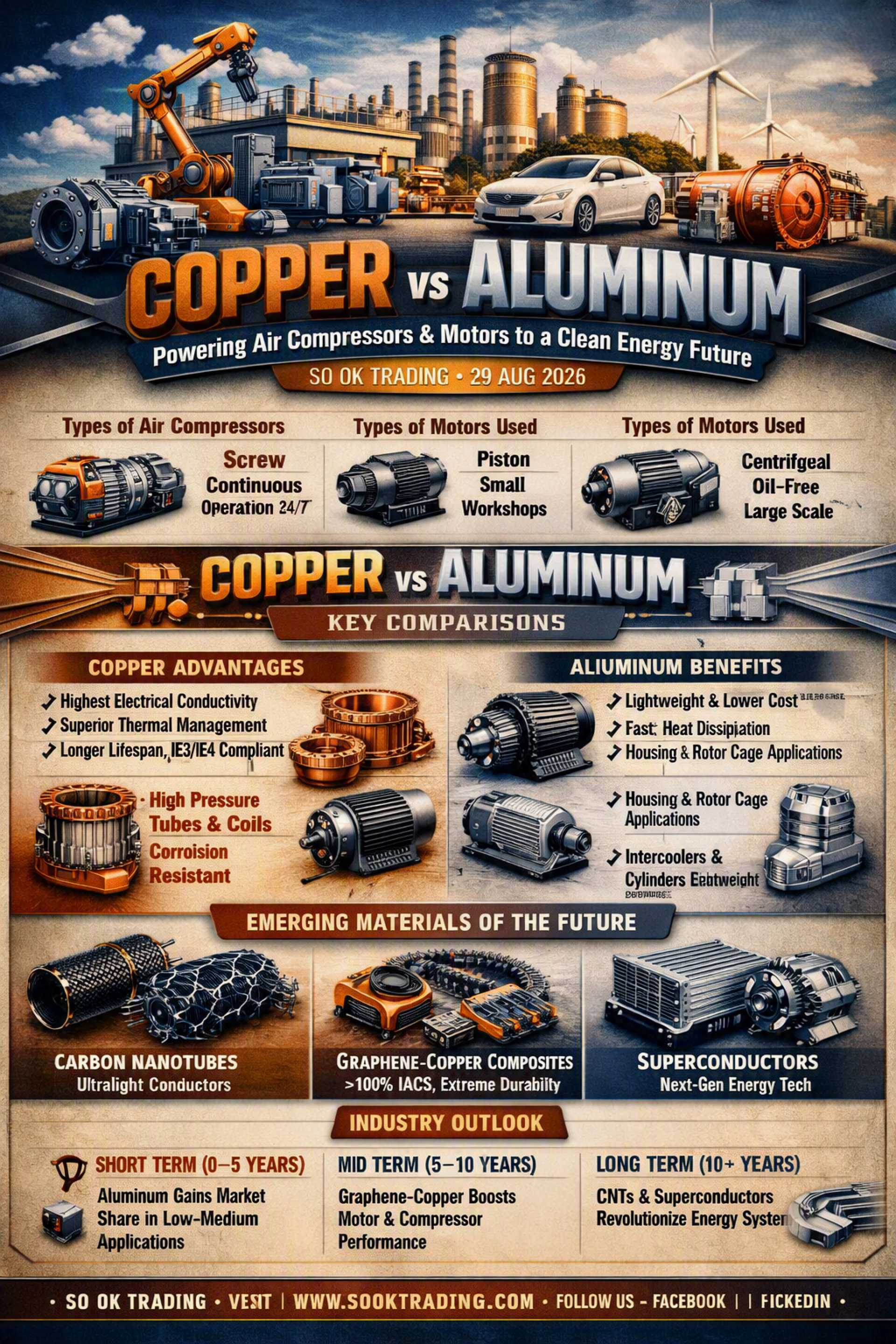
Types of Air Compressors (Copper & Aluminum Applications)
Screw Compressor: Continuous operation, ideal for 24/7 use
Piston Compressor: Common in small factories and automotive workshops
Centrifugal Compressor: Oil-Free, massive airflow, suited for power plants and chemical industries
 
Types of Motors (Copper & Aluminum Driven)
AC Induction Motor: Reliable, durable, easy maintenance
Inverter/VFD Motor: Variable speed, 30–50% energy savings
Permanent Magnet Motor: High efficiency, compact size, superior cooling
Standards in Thailand

TIS 812-2558: Safety standards for motor compressors
Efficiency Levels IE1–IE4: IE3–IE4 widely adopted to reduce long-term electricity costs
 
Copper vs Aluminum
In Motors

Copper: Excellent conductivity, reduced heat, long lifespan, essential for IE3–IE4 motors
Aluminum: Lightweight, fast cooling, cost-effective, suitable for housings and rotor cages
In Compressors

Copper: Tubes, coils, bushings → high pressure resistance, corrosion-free
Aluminum: Intercoolers, cylinders → rapid heat dissipation, reduced weight
 
Current Trend
Factories increasingly invest in pure copper-wound IE3/IE4 motors for long-term energy savings
Aluminum plays a growing role in structural components and cooling systems
 
Future Materials
Carbon Nanomaterials (CNT, Galvorn): 5–6 times lighter than copper, superior conductivity
Graphene-Copper Composites: Conductivity beyond 100% IACS, 3x corrosion resistance, applied in data centers and EVs
Superconductors & Advanced Semiconductors: Ruthenium, Tungsten, HTS → zero energy loss, next-gen chip and high-voltage transmission applications
 
Outlook: Future Direction of Copper & Aluminum in Industry
Short Term (0–5 years): Aluminum continues to gain market share in low-to-medium voltage applications such as wiring and air-conditioning coils
Mid Term (5–10 years): Graphene-Copper composites enhance durability and conductivity, complementing copper in high-performance applications
Long Term (10+ years): Carbon Nanotubes and Superconductors emerge as game changers in EVs and high-voltage infrastructure
Core Goal: Energy savings, cost reduction, and alignment with renewable energy and low-carbon economic transition
 
✨ SO OK TRADING — FAST • SHARP • RELIABLE Your trusted partner in driving Thai industries toward global standards.

Visit us: www.sooktrading.com Facebook: SO OK TRADING


Related Content
“The War That Shakes the Global Economy: Middle East Time Bomb — Energy, Inflation, and Risk — From Crisis to Opportunity, Thai Business Perspectives at the World’s Turning Point”: SO OK TRADING: May 11, 2026
中东与全球经济局势概览(2026年5月11日) SO OK TRADING : FAST • SHARP • RELIABLE 中东战争正逐渐成为全球必须关注的“经济定时炸弹”。每一次动向不仅震撼战场,也冲击能源市场、汇率以及全球民众的生活成本。 原油价格突破每桶100美元,霍尔木兹海峡依然是关键风险点。与此同时,泰国正面临能源成本压力以及出口额下降超过57%的挑战。 日本和韩国开始寻找新的石脑油进口来源,而全球正步入“滞胀”——高通胀、经济放缓以及长期的不确定性。 这就是“震撼全球经济的战争”的全貌,以及所有企业必须密切关注的影响。 SO OK TRADING 在瞬息万变的世界中,您的商业伙伴
11 May 2026
ทิศทางการใช้ อลูมิเนียมในอนาคต (ปี2026) , ทิศทางราคาอลูมิเนียม และ สถานะการณ์ Carbon Footprint
ทิศทางในอนาคตของอลูมิเนียมไทยมุ่งเน้น ความยั่งยืน (Sustainability) และ เทคโนโลยีขั้นสูง (Advanced Technology) โดยจะเน้น อลูมิเนียมคาร์บอนต่ำ และ อลูมิเนียมรีไซเคิล เพื่อตอบโจทย์อุตสาหกรรมยานยนต์ไฟฟ้า (EV) และการก่อสร้างที่เป็นมิตรต่อสิ่งแวดล้อม พร้อมพัฒนา การเคลือบผิวใหม่ๆ และระบบเศรษฐกิจหมุนเวียน (Circular Economy) เช่น โครงการ Aluminium Loop เพื่อลดต้นทุน เพิ่มมูลค่า และรักษาความสามารถในการแข่งขันในตลาดโลก. แนวโน้มสำคัญ: การเติบโตในอุตสาหกรรมยานยนต์ไฟฟ้า (EV): รถ EV ต้องการใช้อลูมิเนียมเพิ่มขึ้นมากเพื่อลดน้ำหนัก ช่วยประหยัดพลังงานและเพิ่มระยะทางวิ่ง. ความต้องการอลูมิเนียมคาร์บอนต่ำ (Low-Carbon Aluminium): ตอบสนองมาตรการสิ่งแวดล้อมทั่วโลก (เช่น EU CBAM) โดยเฉพาะการใช้อลูมิเนียมรีไซเคิลสูง ซึ่งลดการปล่อยคาร์บอนได้มาก. เศรษฐกิจหมุนเวียน (Circular Economy): โครงการอย่าง "Aluminium Loop" ขับเคลื่อนการรีไซเคิลบรรจุภัณฑ์อลูมิเนียมครบวงจร เพื่อลดขยะและสร้างมูลค่า. นวัตกรรมการเคลือบผิว (Coating Innovations): การเคลือบผิวแบบใหม่ๆ เพื่อเพิ่มฟังก์ชัน เช่น ป้องกันแบคทีเรีย (Anti-microbial) ทำความสะอาดง่าย (Easy-to-clean) สร้างผิวสัมผัสใหม่. การก่อสร้างแบบสำเร็จรูปและโมดูลาร์ (Modular Construction): ใช้อลูมิเนียมมากขึ้นในการผลิตชิ้นส่วนสำเร็จรูปนอกสถานที่ เพื่อความแม่นยำและลดของเสีย. การบูรณาการพลังงานหมุนเวียน (Renewable Energy): ใช้อลูมิเนียมในโครงสร้างรองรับแผงโซลาร์เซลล์ และระบบพลังงานสะอาดอื่นๆ. ความท้าทาย: ต้นทุนพลังงาน & ห่วงโซ่อุปทาน: ความผันผวนของราคาพลังงานและความท้าทายในห่วงโซ่อุปทาน. การแข่งขัน: ประเทศคู่แข่งเร่งพัฒนาเทคโนโลยีรีไซเคิล ทำให้ไทยต้องพัฒนาต่อเนื่องเพื่อรักษาผู้นำ. โอกาส: ไทยมีศักยภาพด้านแรงงานฝีมือ และอุตสาหกรรมต้นน้ำ-กลางน้ำ-ปลายน้ำที่ครบวงจร. การปรับตัวสู่การผลิตคาร์บอนต่ำสร้างโอกาสทางธุรกิจใหม่ๆ โดยเฉพาะการเป็นผู้นำด้านอลูมิเนียมรีไซเคิล. สรุป: อลูมิเนียมไทยจะก้าวสู่ยุคใหม่ที่เน้น "เขียว" (Green) และ "ฉลาด" (Smart) โดยการรีไซเคิลและเทคโนโลยีจะเป็นหัวใจสำคัญในการสร้างการเติบโตและความยั่งยืน.
16 Dec 2025
“Recycled Aluminum: From Scrap to Global Standard – Circular Economy Reshaping Industry with Aluminum Remelt – Remelt Revolution: Transforming the Metal Industry for Net Zero”
Recycled Aluminum: From Scrap to the New Global Standard As industries worldwide accelerate toward Net Zero and embrace the Circular Economy, Aluminum Remelt Ingots are no longer just an “alternative material.” They are becoming the main driver that every nation relies on for sustainability and economic competitiveness. With outstanding properties—lightweight, strong, corrosion-resistant, and excellent thermal and electrical conductivity—remelt ingots are now essential across diverse industries: automotive, construction, electronics, and packaging, all of which demand high-quality, eco-friendly materials. Most importantly, recycling aluminum consumes up to 95% less energy than producing primary aluminum, dramatically reducing both costs and carbon footprints. At the same time, global demand continues to rise, especially for ADC12, which is highly sought after in China, Japan, and Thailand, along with A356 and AC4B for automotive and high-strength applications. Global Shifts in 2025–2026 - China: Expanding production capacity to support electric vehicle (EV) manufacturing and construction, with stricter import standards for scrap aluminum. - United States: The world’s highest remelt usage (81%), driven by energy efficiency and carbon reduction, reinforced by strict tariffs under Section 232 (raised to 50%). - Japan: Fully dependent on imports and recycling, leveraging advanced sorting technologies and increasing the use of green aluminum in high-end automotive manufacturing. - Thailand: Rising as ASEAN’s scrap hub, exporting heavily to China and the U.S., with an aluminum can recycling rate of 86% and new circular economy initiatives such as the Aluminium Loop. From Scrap → To the Hero of Tomorrow Aluminum Remelt Ingots are rapidly evolving into the new global standard across industries. For those in the metals and manufacturing sectors, now is the time to adapt and seize opportunities in the global market.
21 Feb 2026
This website uses cookies for best user experience, to find out more you can go to our Privacy Policy and Cookies Policy
Powered By MakeWebEasy Logo MakeWebEasy