“Rare Earths: China’s Secret Weapon Reshaping the Global Balance of EVs and Chips” SO OK TRADING: 27 AUG 2026
Rare Earths: China’s Secret Weapon Shaking the Global EV & Chip Industry
SO OK TRADING | 27 AUG 2026
Strategic Objectives
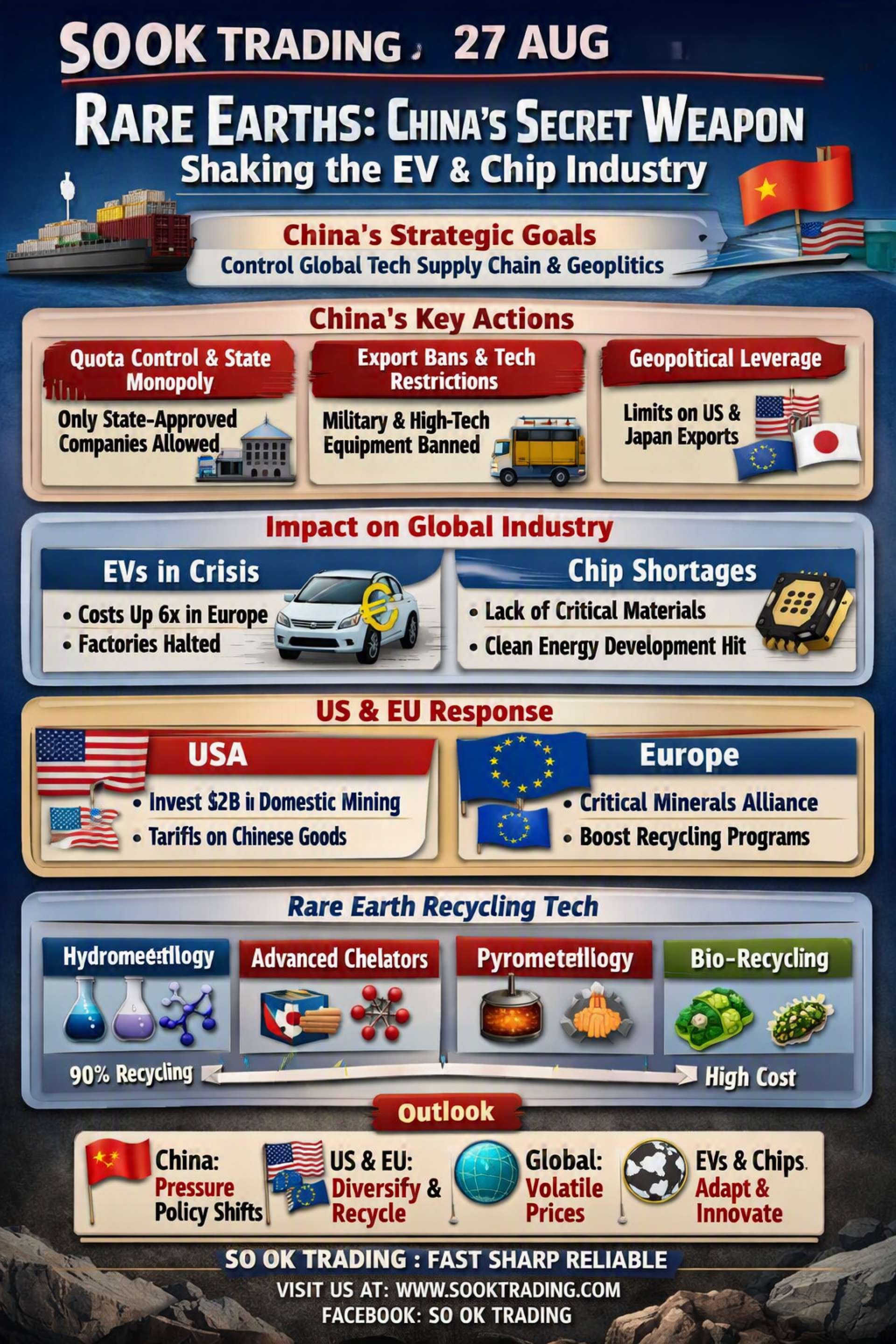
China is leveraging rare earths as a powerful tool to control the global supply chain of advanced technologies. From mining to refining and export restrictions, strict policies are enforced to strengthen its geopolitical bargaining power.
China’s Key Measures
Quota Control & State Monopoly: Only state-approved companies are allowed to mine and refine rare earths.
Export Restrictions & Technology Bans: Military-related exports and advanced mining equipment are prohibited.
Diplomatic Leverage: Export limits imposed on rival nations such as the United States and Japan.
Impact on Global Industries
Electric Vehicles (EVs)
Costs in Europe have surged more than sixfold.
Manufacturers are forced to redesign motors without Chinese rare earths, resulting in heavier vehicles and shorter driving ranges.
Some European factories have halted production due to shortages.
Semiconductors
Shortages of polishing materials and specialized coatings critical for advanced chip production.
Clean energy technology development slowed.
US & EU Countermeasures
United States
Allocated over $2 billion to stockpile rare earths.
Threatened tariffs of up to 100% on Chinese goods.
Investing in domestic mining and building new alliances.
European Union
Partnered with the US under the Critical Minerals Partnership.
Fast-tracking mining projects across Europe.
Enforcing laws to recycle rare earths from electronic waste.
Rare Earth Recycling Technologies
Hydrometallurgy: Acid-based dissolution and separation.
Advanced Chelators: New agents for precise separation of Nd and Dy.
Pyrometallurgy: High-temperature molten salt extraction.
Bio-Recycling: Microorganisms producing organic acids for recovery.
Current recovery rates reach up to 90%, but costs remain higher than new mining.
Key Challenges
Products are not designed for recycling.
Waste collection and sorting systems remain insufficient.
Prices fluctuate due to China’s quota policies.
Traditional recycling methods still cause pollution.
Outlook
China: Will continue using rare earths as leverage, adjusting policies based on global political and economic conditions.
US & EU: Accelerating alliances, domestic mining, and recycling efforts despite high costs.
Global Market: Prices remain volatile; investment in recycling technology is crucial for long-term stability.
EV & Semiconductor Industries: Must adapt through redesigns, alternative materials, and innovation to reduce rare earth dependency.
Conclusion
China remains the dominant force monopolizing the global rare earth market, directly impacting EV and semiconductor industries. Meanwhile, the US and EU are racing to build resilience through new mining projects and recycling initiatives. Despite high costs and significant obstacles, recycling stands out as the most strategic path to reduce reliance on China.
SO OK TRADING: Your Business Partner in Non-Ferrous Metals FAST • SHARP • RELIABLE www.sooktrading.com Facebook: SO OK TRADING