“RDF 3 — Clean Energy from Old Shoes, Igniting Thailand’s Circular Economy and Driving the Future of Green Fuels — SO OK TRADING : 23 AUGUST 2026”
RDF 3 from Old Shoes: Clean Energy for the Circular Economy
SO OK TRADING : August 23, 2026
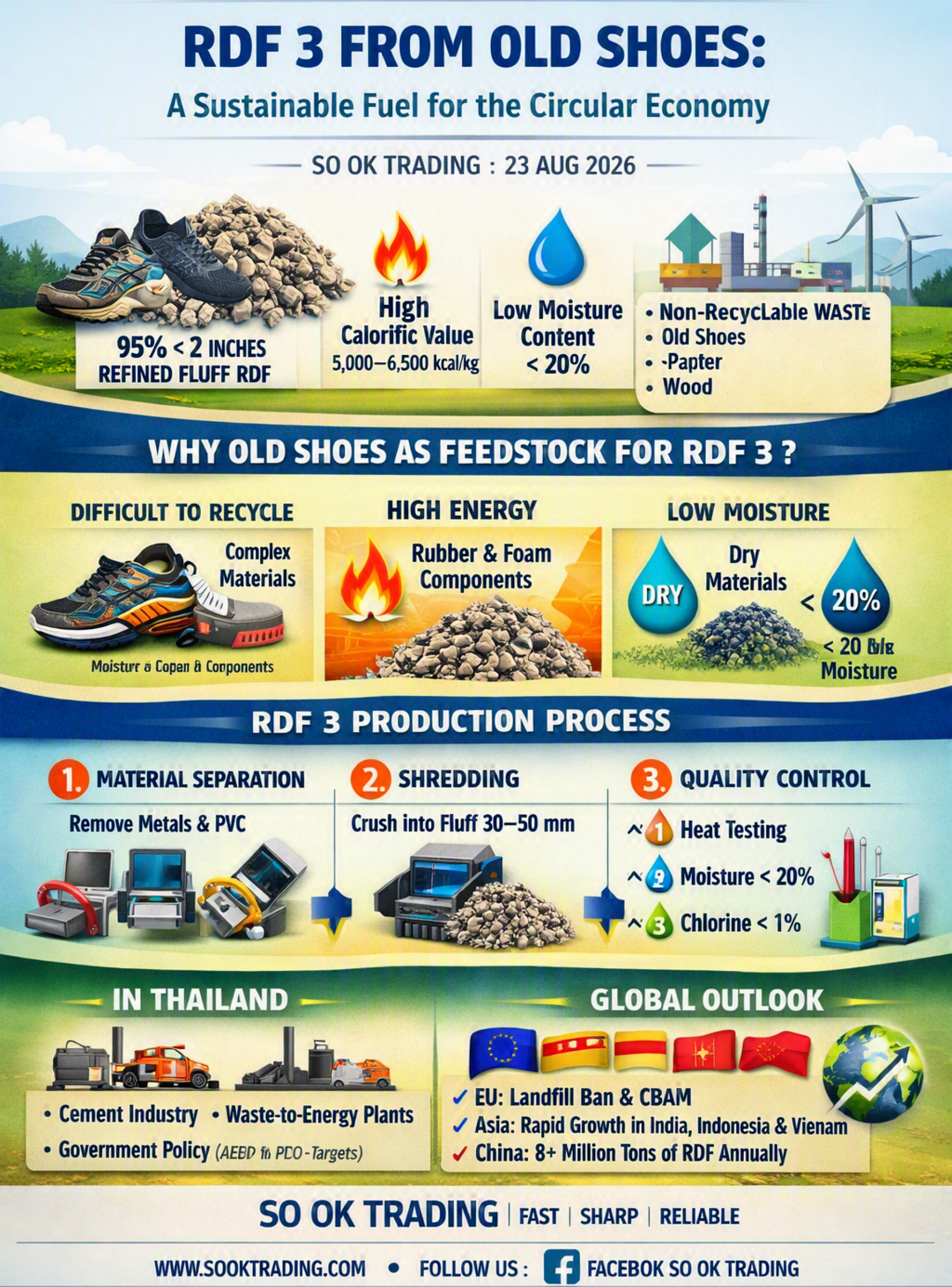
RDF 3 (Refuse-Derived Fuel 3) or Fluff RDF is a waste-derived fuel that has been sorted and shredded so that 95% of the material is smaller than 2 inches. With high calorific value and low moisture content, it is becoming a key alternative fuel driving Thailand’s Net Zero and Circular Economy goals.
Key Characteristics of RDF 3
Raw materials: Non-recyclable waste such as plastic wrappers, wood scraps, and paper waste
Form: Small loose pieces, not compressed into pellets
Properties: High calorific value, low moisture, suitable for combustion in heavy industries
Applications of RDF 3 in Thailand
Cement industry – Co-firing with coal in kilns
Waste-to-Energy power plants – Used as a primary fuel
Why Old Shoes Are Ideal for RDF 3
Hard to recycle: A pair of shoes is made of multiple materials bonded tightly with adhesives, making disassembly costly
High energy yield: Rubber, foam, and fabric in shoes provide 5,000–6,500 kcal/kg, nearly double that of typical municipal waste
Low moisture: Ensures efficient combustion and higher energy output
Production Process of RDF 3 from Old Shoes
Remove contaminants – Extract metals, separate PVC and high-chlorine plastics
Shredding into Fluff RDF – 95% of particles reduced to 30–50 mm
Quality control – Check calorific value (5,000–6,500 kcal/kg), moisture (<20%), chlorine (<1%)
Market and Opportunities in Thailand
Industrial waste: Rubber and foam scraps from shoe factories sent directly to processing plants
Municipal waste: Old shoes from households supplied to cement factories
Government policy: AEDP and PDP plans aim to raise clean energy share to 60–70%, with RDF 3 as a key fuel
International pressure: EU’s CBAM mechanism forces Thai factories to adopt clean energy to remain competitive
RDF 3 Pricing in Thailand
Average price: 1,000–1,900 THB per ton (municipal waste starts at 500–1,200 THB per ton)
Price drivers
Higher calorific value → better price
Moisture below 20% → higher price
Chlorine below 1% → accepted by factories
Trend
Rising demand from waste-to-energy plants
Prices likely to increase further, benchmarked against imported coal
Outlook for RDF 3 in Thailand
Growth: Market expected to grow 15% annually, especially in power and cement sectors
Investment: More spending on drying machines and sorting systems to produce premium-grade RDF 3
Policy: Government promoting RDF 3 via FiT incentives and expanded waste-to-energy quotas
Challenges: Incomplete waste segregation at source keeps production costs for high-quality RDF 3 elevated
Global Outlook for RDF 3
Europe (EU): Leading RDF/SRF market with Landfill Ban and CBAM driving industrial adoption
Developing Asia: India, Indonesia, and Vietnam pushing RDF 3 to tackle urban waste and reduce CO₂ emissions
China: Expanding RDF 3 production capacity by over 8 million tons annually
Global market: Valued at USD 5.8 billion (2026), projected to reach USD 12–15 billion (2035) with CAGR of 6–8%
Innovation: Advances in co-firing, pyrolysis, gasification, and carbon capture will enable RDF 3 to be converted into syngas, bio-oil, or even hydrogen in the future
Conclusion
Transforming old shoes into RDF 3 not only reduces waste but also adds value to Thailand’s circular economy. Shoe waste is a premium-grade feedstock with high calorific value and low moisture, ideal for cement kilns and waste-to-energy plants. If Thailand can strengthen its supply chain and enforce strict quality control, RDF 3 will become a strategic fuel driving Carbon Neutrality 2050 and Net Zero 2065, while linking to the rapidly growing global market.
SO OK TRADING : Your Business Partner SO OK TRADING : FAST , SHARP , RELIABLE
VISIT US AT : WWW.SOOKTRADING.COM FACEBOOK : SO OK TRADING
Interested in high-quality RDF3 with high calorific value? Please contact SO OK TRADING. Thank you very much.