Share

“KOSPI Collapse: South Korea’s Greatest Financial Tragedy — When Leverage Became a Time Bomb, Wiping Out Portfolios and Shaking Asia’s Economy”
Last updated: 3 Aug 2026
2134 Views

 South Korea Stock Market Crisis (KOSPI) 2026 – The Greatest Financial Tragedy
SO OK TRADING : 3 AUGUST 2026

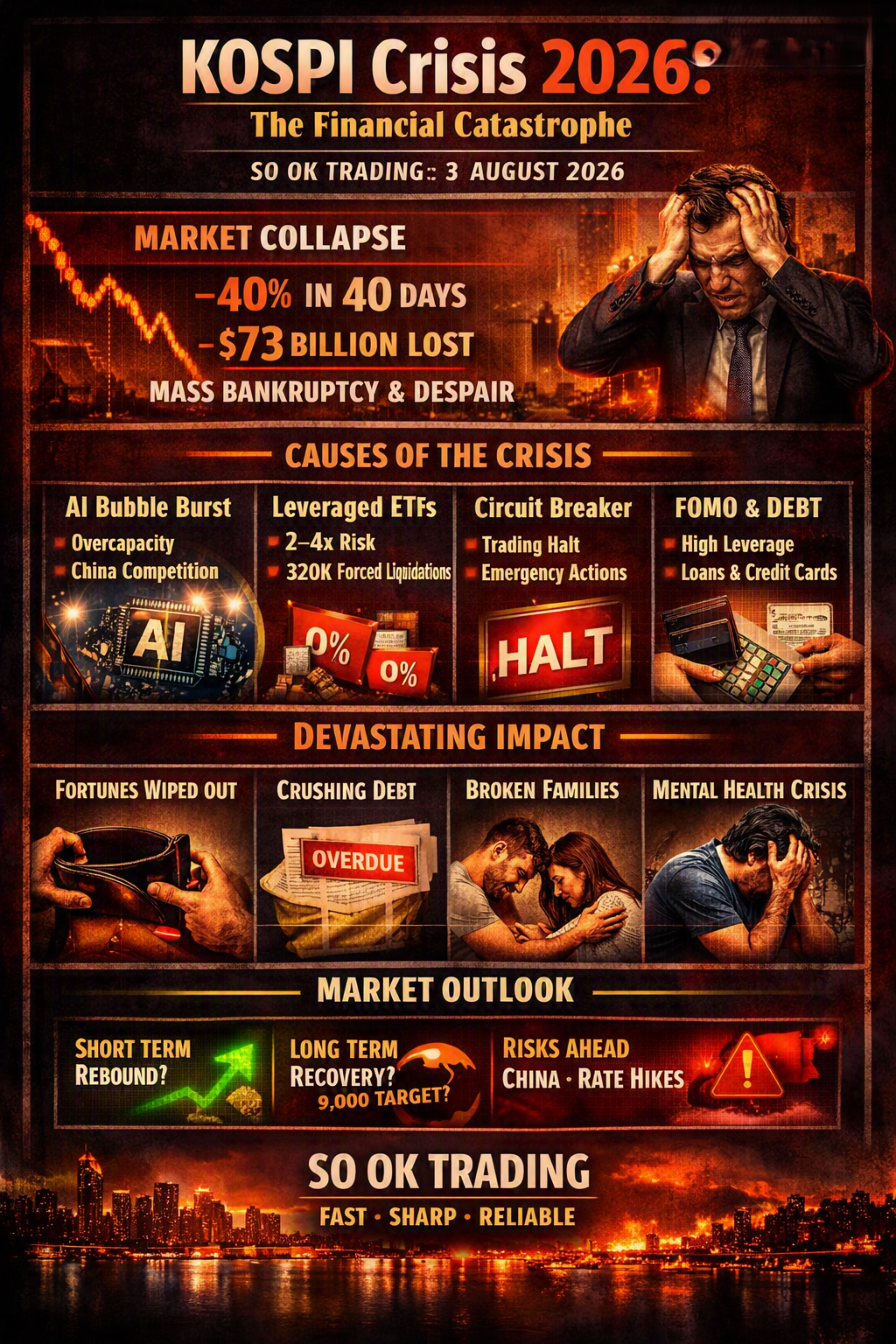
South Korea’s stock market has just faced the most severe correction in its history. The KOSPI index plunged more than 40% within only 40 days, wiping out over 3.1 trillion won (approximately 73 trillion baht) in market value. This loss is not just red numbers on a screen — it is a financial catastrophe that left countless families bankrupt, erased lifelong savings, and pushed many into complete ruin.

 
Key Causes of the Crisis
AI Chip Bubble Burst

Semiconductor and HBM stocks soared far beyond fundamentals due to speculation.
Concerns about overcapacity and China’s ability to produce its own chips triggered heavy sell-offs in giants like Samsung and SK Hynix.
Single-stock Leveraged ETFs: A Double-edged Sword

Allowed investors to leverage individual stocks by 2–4 times.
A mere 10% drop in stock prices wiped out 30–40% of investors’ capital instantly.
Over 320,000 accounts were forced into liquidation, creating a domino effect that dragged the market down further.
Government Measures and Circuit Breakers

Trading was halted for two consecutive days to curb panic.
Emergency measures included suspending new leveraged ETFs, banning high-leverage product advertising, and tripling minimum deposits for new investors.
FOMO and Debt-fueled Trading

Many believed AI stocks were the “shortcut to wealth.”
Investors not only used savings but also borrowed through bank loans, personal credit, and credit cards.
When portfolios collapsed, debts remained, driving many into bankruptcy.
 
Real-life Impact
From Riches to Zero: Portfolios worth hundreds of millions of won were liquidated to nothing.
Crushing Debt: Some investors not only lost their capital but also owed additional debt from leveraged ETFs.
Broken Families: Wedding funds, home down payments, and children’s education savings were wiped out.
Mental Health Crisis: Reports of depression and acute stress surged dramatically.
 
Market Outlook (August 2026)
Short Term: After leveraged accounts were cleared, government stimulus through the Sovereign Wealth Fund and insider stock purchases fueled a rebound.
Medium to Long Term: Institutions like Morgan Stanley and Goldman Sachs see potential recovery to 9,000 points, citing continued demand for AI chips.
Risks: Extreme volatility, China’s semiconductor advances, and possible interest rate hikes by the Bank of Korea.
 
Lessons the World Must Remember
Leverage is the Executioner of Finance

It multiplies gains in bull markets but destroys lives in downturns.
Don’t Forget Valuation Amid Growth

Even good companies can become dangerous when overpriced.
Forced Sales Trigger a Domino Collapse

Margin calls can wipe out portfolios and accelerate market crashes.
FOMO and Debt are Traps

Borrowing to invest hands control of your life to the market.
Cold Money is the Best Shield

Only invest with money you can afford to lose.
 
Conclusion
The KOSPI crisis of 2026 was not just a market correction but a national financial tragedy, proving that: “When financial innovation combines with greed and debt, the wealth of the people can be destroyed in an instant.”

 
SO OK TRADING : Your Trusted Business Partner SO OK TRADING : FAST • SHARP • RELIABLE VISIT US AT : WWW.SOOKTRADING.COM FACEBOOK : SO OK TRADING

Related Content
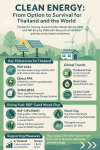
Clean Energy Milestones: From Choice to Survival for Thai Industry — Fuel Switching to Net Zero, Unlocking Tax Benefits, Carbon Credits, and ESG with Biomass
Clean Energy Milestones: From “Choice” to “Survival” for Thai Industry Thailand is moving forward into a major energy transition. The clear national targets are Carbon Neutrality by 2050 and Net Zero by 2065. This is not only about reducing greenhouse gas emissions, but also about building new competitiveness for the Thai economy in the global market. Today, “clean fuels” such as RDF-3 and Wood Chips are becoming the core drivers of this transition. Whether replacing coal in cement factories, exporting to Japan and South Korea, or generating new income through Carbon Credits, these fuels are reshaping the energy landscape. Fuel switching is not just about energy — it is about strategic value: - Reducing taxes through BOI incentives - Avoiding the EU’s CBAM (Carbon Border Adjustment Mechanism) - Creating new revenue streams from Carbon Credits - Strengthening ESG and sustainability branding
20 Feb 2026
“SO OK TRADING In-Depth Analysis: USD Weakness – THB Strength Reflecting Global Currency Outlook, August–September 2026”   (August 21, 2026)
“USD Weakness – THB Strength: Global Currency Outlook : SO OK TRADING : August 22, 2026” In August, global financial markets are closely watching the weakening of the U.S. dollar (USD). This trend is driven by multiple pressures: the Federal Reserve’s (Fed) inclination toward rate cuts, the surge in U.S. public debt, and capital flows shifting toward regions with faster economic recovery such as Europe and Asia. As a result, the Thai baht has continued to strengthen, reaching 32.68 per USD, its highest level in two months. Meanwhile, gold prices have surged, and Thai investors are facing risks of FX losses despite positive momentum in overseas equities. This analysis by SO OK TRADING provides an in-depth outlook on global currencies for August–September 2026, covering major currencies (USD, EUR, GBP, JPY, CNY, SGD, AUD, KRW) and comparing monetary policy directions between the Bank of Japan (BOJ) and the European Central Bank (ECB) — both of which are becoming pivotal forces in shaping global market dynamics. Additionally, we highlight strategies for risk management and investment positioning during the upcoming “September Cluster” — a critical period marked by three major central bank meetings (ECB, Fed, BoE) that will set the tone for currency markets in the final quarter of the year.
22 Aug 2026
“OUTLOOK Global Scrap Market 2026: The Turning Point of Aluminum Recycling (Remelt) — Strategic Resource for the Net Zero Era”  SO OK TRADING : September 6, 2026
2026 marks a true “turning point for scrap metals” — especially in the global market for aluminum recycling and remelting (Remelt Aluminum), which has become one of the hottest sectors in decades. “Aluminum scrap” is no longer just leftover material; it has evolved into a strategic resource that nations fiercely compete for to secure industrial and environmental stability. Remelt has been elevated beyond conventional recycling, becoming the core of the circular economy and a critical driver in achieving Net Zero goals. With the ability to save up to 95% of energy compared to primary aluminum production and drastically reduce carbon footprints, Remelt has become the “lifeline” of global industries in an era where Europe’s CBAM (Carbon Border Adjustment Mechanism) is being strictly enforced. This year, SO OK TRADING, as a leading non-ferrous metals trader from Thailand, presents a comprehensive outlook on both global and ASEAN markets — highlighting how scrap and aluminum recycling are reshaping the industrial landscape worldwide.
6 Sept 2026
This website uses cookies for best user experience, to find out more you can go to our Privacy Policy and Cookies Policy
Powered By MakeWebEasy Logo MakeWebEasy