Share

“Thailand’s Metal Recycling Revolution — Copper & Aluminum Driving the Green Economy, Positioning Asia’s Circular Hub, and Leading the Global Decarbonization Future”
Last updated: 29 Jul 2026
148 Views

Copper & Aluminum Recycling Industry in Thailand
The Core of Circular Economy and Global Market Outlook 2026–2032
Article by SO OK TRADING — The True Expert in Thailand’s Non‑Ferrous Business (July 29, 2026)

 
Introduction
The recycling industry for copper and aluminum is a pillar of the circular economy, as both metals can be infinitely reused without losing their physical properties. Recycling also saves up to 95% of energy compared to producing metals from virgin ore, making this industry not only an economic driver but also a key mechanism for environmental sustainability and carbon reduction.

 
Supply Chain Structure
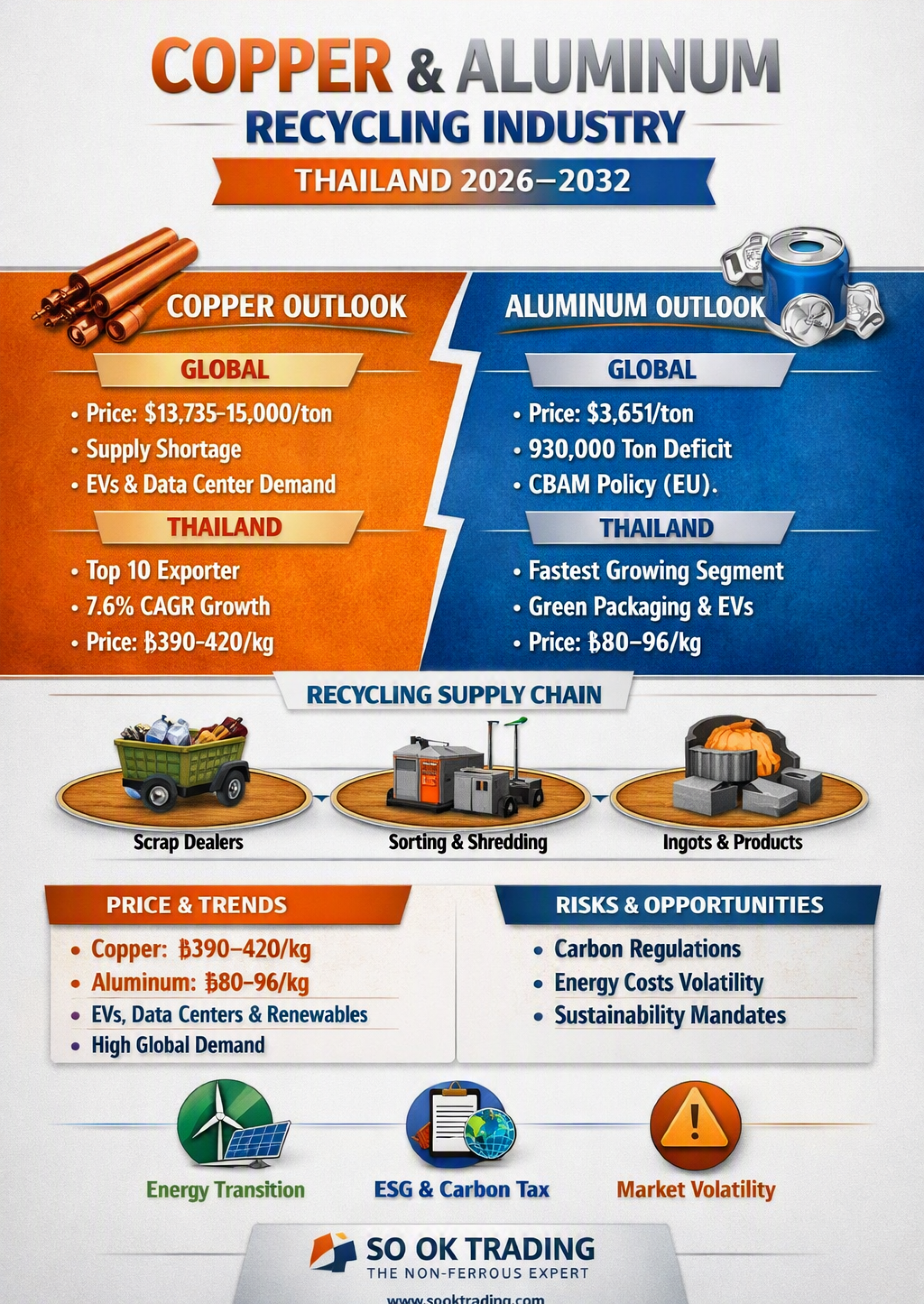
Upstream: Scrap collectors, local junk shops, and industrial auctions for waste materials such as wires, air‑conditioning pipes, and beverage cans. Factories also consolidate copper and aluminum scrap for remelting.
Midstream: Sorting and compression plants (e.g., Wongpanit) that strip wires, separate aluminum grades, and compress scrap for transport.
Downstream: Smelting and processing plants producing ingots, aluminum rolls, and copper wires, supplying industries such as automotive, packaging, and electronics.
 
Pricing and Product Differentiation
Copper: High value (hundreds of THB/kg), fluctuating with LME market prices. The most expensive grade is “premium stripped copper wire” (~390–420 THB/kg).
Aluminum: Mid‑range value (tens of THB/kg). For example, aluminum cans ~80–82 THB/kg; aluminum profiles ~85–96 THB/kg.
 
Opportunities and Challenges
Opportunities: Strong demand from Europe and the U.S., where export products must include recycled materials and demonstrate reduced carbon footprints.
Challenges: Contamination during sorting, global price volatility, rising energy costs, and stricter environmental regulations.
 
Market Outlook 2026–2032
Copper Scrap

Global Outlook: LME prices projected at $13,735–15,000/ton, driven by tight supply and demand from EVs, data centers, and renewable energy.
Thailand Outlook: Domestic copper scrap market expected to grow at 7.6% CAGR. Thailand ranks among the world’s Top 10 exporters, with China as the primary destination. Domestic prices average 390–400 THB/kg.
Aluminum Scrap

Global Outlook: Prices peaked at $3,651/ton in 2026 (highest in four years). Supply shortfall of 930,000 tons due to China’s environmental policies. EU’s CBAM regulation accelerates recycled aluminum demand.
Thailand Outlook: Fastest‑growing segment in the recycling industry, especially in green packaging and lightweight automotive components. Domestic prices range from 80–96 THB/kg.
 
Driving Forces and Risks
Drivers: Energy transition, ESG mandates, carbon taxes, demand from EVs and data centers.
Risks: High energy costs, strict environmental laws, global market volatility.
 
Strategic Outlook
Copper: Remains a “strategic metal” for power grids and EVs. Thailand has the potential to become a regional hub for high‑quality copper scrap exports.
Aluminum: Positioned as the “rising star metal,” with rapid growth in eco‑friendly packaging and lightweight automotive industries.

 
Conclusion
Thailand’s copper and aluminum recycling industry is entering a structural uptrend, supported by global energy transition and environmental policies. Despite market volatility, companies that can deliver value‑added processes, traceability, and closed‑loop recycling will secure long‑term competitiveness and sustainable growth.

 
SO OK TRADING: Your Trusted Business Partner SO OK TRADING: FAST SHARP RELIABLE Visit us at: www.sooktrading.com Facebook: SO OK TRADING SO OK TRADING — The True Expert in Thailand’s Non‑Ferrous Industry

Related Content
ALUMINUM SCRAP THAILAND SUMMARY
Thailand presents significant aluminum scrap opportunities due to its role as a major ASEAN processing hub, high import volumes (especially from the US), strong local manufacturing demand (automotive, electronics), and a growing focus on recycling for sustainability, with potential for suppliers in UBCs, wheels, and industrial scrap, though regulations are tightening. Key opportunities lie in supplying raw scrap to domestic smelters for ADC12 alloy production, catering to the automotive sector, and leveraging Thailand's strategic location for regional trade, but expect strict quality control and compliance. Key Opportunities Processing Hub: Thailand is a leading scrap processing center in ASEAN, transforming scrap into valuable alloys like ADC12 for industries. High Demand: Significant import volumes indicate massive local consumption, especially from the US, driven by manufacturing. Industry Focus: Strong demand from automotive, electronics, and construction sectors for recycled aluminum. Strategic Location: Ideal for refining and re-exporting, serving as a hub replacing China's role in US scrap trade. Recycling Growth: Government support and consumer interest in recycling create a robust supply chain for materials like aluminum cans (UBCs). Types of Scrap in Demand UBCs (Used Beverage Cans): High demand for clean, sorted UBC scrap. Auto Parts: Wheels, extrusions, and other aluminum components from the thriving auto industry. Industrial Scrap: Extrusion scrap, sheet scrap, and general factory offcuts.
26 Dec 2025
“RDF Transforms Waste into Thailand’s Clean Energy Future — Igniting the Economy and Driving the Transition to Renewable Power”   SO OK TRADING: June 13, 2026
RDF – Waste-Derived Fuel and the Future of Renewable Energy in Thailand By SO OK TRADING | June 13, 2026 ♻️ Waste is no longer just “garbage” — it has become the energy of the future! RDF (Refuse-Derived Fuel) is fuel produced from municipal solid waste, carefully sorted and processed to make it suitable for combustion, generating sustainable heat and electricity. As the world moves toward Net Zero Carbon, and industries adapt to Europe’s CBAM regulations, RDF has emerged as Thailand’s new energy solution — cutting costs while reducing dependence on coal.
13 Jun 2026
เกร็ดความรู้ COPPER CATHODE และการใช้งานในภาคอุตสาหกรรม
แคโทดทองแดง (Copper Cathode) คือแผ่นทองแดงความบริสุทธิ์สูงที่ได้จากกระบวนการกลั่นด้วยไฟฟ้า (electrolysis) มีความบริสุทธิ์ตั้งแต่ 99% ขึ้นไป และใช้ผลิตเป็นสายไฟคุณภาพสูง ผลิตภัณฑ์ไฟฟ้า หรือโลหะผสมต่างๆ กระบวนการผลิต แผ่นทองแดงที่ไม่บริสุทธิ์จะถูกใช้เป็นขั้วบวก (anode) ในเซลล์อิเล็กโทรไลต์ที่ประกอบด้วยสารละลายกรดซัลฟูริกและคอปเปอร์ซัลเฟต แผ่นทองแดงที่บริสุทธิ์จะถูกใช้เป็นขั้วลบ (cathode) เมื่อกระแสไฟฟ้าไหลผ่าน แร่ธาตุที่ไม่บริสุทธิ์จะละลายและกลายเป็นไอออนเข้าสู่สารละลาย จากนั้นไอออนทองแดงจะเคลื่อนที่ไปที่ขั้วลบและตกตะกอนลงบนแผ่นทองแดงบริสุทธิ์ สิ่งเจือปนที่มีค่าต่ำกว่าทองแดง เช่น เหล็กและสังกะสี จะละลายไปพร้อมกับทองแดง แต่สิ่งเจือปนที่มีค่าสูงกว่า เช่น ทองคำและเงิน จะตกตะกอนลงที่ก้นถัง ทำให้ได้ทองแดงบริสุทธิ์สูง คุณสมบัติและประโยชน์ ความบริสุทธิ์สูง: มีความบริสุทธิ์สูงถึง 99.99% ทำให้มีการนำไฟฟ้าได้ดีเยี่ยม นำไฟฟ้าได้ดี: ใช้เป็นตัวนำไฟฟ้าในสายไฟ สายเคเบิล และอุปกรณ์ไฟฟ้าต่างๆ ยืดหยุ่นและทนทาน: สามารถนำไปรีดเป็นเส้นลวดบางๆ หรือแผ่นฟอยล์ได้โดยไม่เปราะขาดง่าย ทนความร้อน: สามารถนำกระแสไฟฟ้าได้เต็มพิกัดโดยไม่เกิดความร้อนสูงเกินไป ใช้สร้างโลหะผสม: สามารถนำไปผสมกับโลหะอื่นเพื่อสร้างโลหะผสม เช่น ทองเหลือง (ทองแดง + สังกะสี) และทองสำริด (ทองแดง + ดีบุก) ทำผลิตภัณฑ์อื่นๆ: ใช้ผลิตเค้กทองแดง แผ่นทองแดง หรือวัสดุอื่นๆ
28 Nov 2025
This website uses cookies for best user experience, to find out more you can go to our Privacy Policy and Cookies Policy
Powered By MakeWebEasy Logo MakeWebEasy