Share

“Outlook of Thailand’s Seafood & Beverage Industry 2026: Economic Perspectives and Thailand’s Role in the Global Market”
Last updated: 19 Jul 2026
2061 Views

 Overview of Thailand’s Seafood & Beverage Industry 2026
Article by SO OK TRADING | July 19, 2026

In 2026, Thailand’s seafood and beverage industries stand at a critical turning point. These two pillars remain vital to the nation’s economy, yet they face mounting challenges from a slowing global economy, intensifying trade barriers, and shifting consumer behavior toward health and sustainability.

 
Seafood Industry: From Ocean to Sustainable Transformation
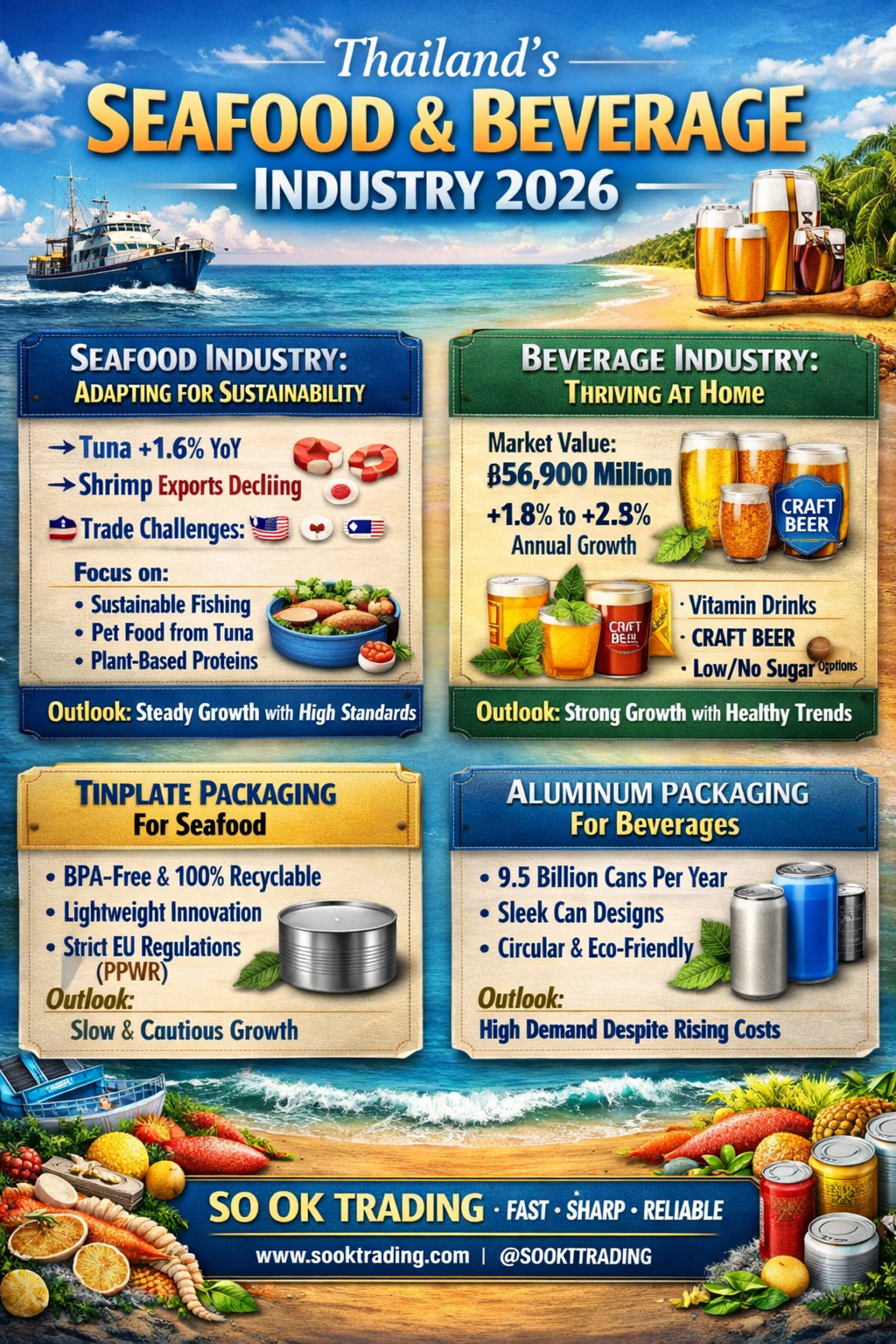
Thailand’s seafood exports are under heavy pressure. Demand in key markets such as the U.S., Japan, and China has weakened, while import tariffs add further strain. Shrimp, once Thailand’s flagship product, has lost cost competitiveness to Ecuador and India. Canned tuna, however, still shows modest growth at around +1.6% YoY.

Major players like Thai Union are adapting by strengthening sustainability standards and developing high‑value products such as tuna‑based pet food and plant‑based protein alternatives. This reflects a shift: the future of Thai seafood will not be about price competition, but about creating new value aligned with global health and environmental priorities.

Outlook: Growth will be modest, but if Thailand can firmly establish sustainability and innovation, it will continue to play a significant role in the global market as a trusted, high‑standard producer.

 
Beverage Industry: Domestic Market Remains Strong
In contrast to seafood, Thailand’s beverage industry shows brighter prospects, particularly in the domestic market driven by tourism and health trends. Modern consumers increasingly choose vitamin‑infused water, alkaline water, and reduced‑sugar sodas. Alcoholic beverages are also rebounding alongside the recovery of services and entertainment, with craft beer and local spirits gaining popularity.

Although exports to CLMV markets have slowed, domestic demand continues to grow. The market value has surpassed THB 56.9 billion, with an expected average annual growth of 1.8%–2.8%.

Outlook: Thai beverages will remain a growth sector, especially products that meet health and convenience demands. Producers who can adjust formulas to comply with sugar taxes and manage rising packaging costs will maintain their competitive edge.

 
Metal Packaging: A Critical Transition
Tinplate — Seafood Packaging
Canned seafood products such as tuna and sardines still rely on Tinplate/TFS as the primary material. However, usage is slowing in line with declining exports. Producers must comply with international regulations such as the EU’s PPWR, which requires cans to be BPA‑free and 100% recyclable. Research into lightweight packaging is underway to reduce transport costs and carbon footprints, but volatile raw material prices remain a major challenge.

Outlook Tinplate: The seafood packaging market will remain fragile with slow growth. Thailand can preserve its export markets by meeting safety and environmental standards, but future expansion will depend more on value creation than price competition.

Aluminum — Beverage Packaging
The beverage can market is more promising. Aluminum meets modern consumer preferences for “on‑the‑go” convenience and aligns with circular economy principles, being infinitely recyclable. Thailand’s aluminum packaging market exceeds 9.5 billion cans annually, expanding with the popularity of craft beer, sugar‑free sodas, and ready‑to‑drink coffee. A new trend, Sleek Cans with direct printed designs, is gaining traction and helping reduce mixed plastic waste.

The key challenge is soaring aluminum prices due to supply constraints and geopolitical tensions, which significantly raise production costs.

Outlook Aluminum: Despite high costs, aluminum will remain the dominant material in beverage packaging. Effective cost management and packaging innovation will be crucial for securing long‑term competitive advantage.

 
Conclusion
In 2026, Thailand’s seafood and beverage industries face major challenges. Overall export growth is expected to slow to just 1.3%–2.0% (valued at approximately USD 36.09 billion). Yet the most significant shift is the move away from price competition toward value creation — through health‑oriented products, premium offerings, and environmentally friendly packaging.

This transition is critical. If Thailand adapts successfully, these industries will remain strong pillars of the economy and resilient against the rapidly changing global landscape.

 
SO OK TRADING — FAST • SHARP • RELIABLE Your trusted partner in Tinplate & Aluminum packaging www.sooktrading.com Facebook: SOOK TRADING

With over 15 years of expertise, we are the true specialists in Thailand’s metal and aluminum packaging industry.


Related Content
LME คือ อะไร และ ราคาเคลื่อนไหวอย่างไร และ คาดการณ์อย่างไร
คุณรู้หรือไม่ว่าโลหะ / อโลหะ ที่อยู่รอบตัวพวกเราชนิดอื่นๆ ราคาเดี๋ยวก็ขึ้นเดี๋ยวก็ลงไม่ต่างจากราคาทองเลย รวมถึงราคาของอลูมิเนียม , ทองแดง , สังกะสี , เหล็ก , ตะกั่ว ก็ด้วยเช่นกัน ทำไมราคาอโลหะ เช่น อลูมิเนียม ถึงปรับเปลี่ยนอยู่ตลอดเวลา SO OK อยากชวนคุณมาอ่านบทความนี้ เพื่อ Refresh ข้อมูล และ ทำความเข้าใจกับวงจรการเคลื่อนไหวราคา LME กัน ก่อนอื่นเราขอชี้ให้เห็นก่อนว่าอลูมิเนียม และถูกนำมาใช้ประโยชน์ในหลากหลายอุตสาหกรรม หากมองไปที่ของใช้ต่างๆ รอบตัว เชื่อว่าจะต้องมีหลายชิ้นที่มีส่วนประกอบของอลูมิเนียมแน่นอน เช่น กระป๋องบรรจุเครื่องดื่ม ชิ้นส่วนรถยนต์ กรอบประตูหน้าต่าง เครื่องใช้ไฟฟ้า อุปกรณ์ครัว เป็นต้น นั่นทำให้อลูมิเนียมเป็นที่ต้องการของภาคการผลิตตลอดเวลา ด้วยคุณสมบัติที่มีความแข็งแรงแต่น้ำหนักเบา นำความร้อนและความเย็นได้ดี ที่สำคัญสามารถรีไซเคิลเพื่อนำกลับมาใช้ประโยชน์ใหม่ได้เรื่อยๆ ไม่รู้จบ แต่นั่นก็ขึ้นอยู่กับความต้องการของตลาดและสถานการณ์ในแต่ละประเทศที่เกี่ยวข้องด้วยเช่นกัน จึงทำให้ ราคาอลูมิเนียม ขึ้นลงแปรผันตาม demand และ supply และสถานการณ์ต่างๆ ที่ส่งผลกระทบ แล้วปัจจัยอะไรที่ส่งผลต่อราคา อโลหะ , โลหะ SO OK จะขออนุญาติ ยกตัวอย่างจากสินแร่ อลูมิเนียม มาให้เห็ภาพ เราสามารถเช็กราคาอลูมิเนียมได้โดยอิงจากราคา LME แล้วราคา LME คืออะไร? LME หรือ London Metal Exchange เป็นตลาดแลกเปลี่ยนสินค้าเกี่ยวกับอโลหะ (ไม่รวมเหล็ก) ที่ใหญ่ที่สุดและเป็นที่ยอมรับมากที่สุดจากประเทศอังกฤษ โดยมีสัญญาซื้อขายล่วงหน้าและตัวเลือกต่างๆ สำหรับโลหะและสินค้าโภคภัณฑ์ คือ อลูมิเนียม ทองคำ ทองแดง เงิน โคบอลต์ และสังกะสี ซึ่งเมื่อเทียบราคาทองคำที่ขึ้นลงตลอดเวลาแล้ว ราคาของอลูมิเนียมก็ขึ้นลงไปต่างกัน แต่ก็ปรับตัวขึ้นจากปีก่อนๆ เยอะมาก โดยเมื่อย้อนดูราคาอลูมิเนียมตั้งแต่ต้นปี 2021 จนถึงตอนนี้ NOV 2025 ราคาอลูมิเนียมเคยมีราคาต่ำสุดที่ 1,953.80 ดอลลาร์สหรัฐ/ตัน สูงสุดที่4,300 ดอลลาร์สหรัฐ/ตัน และปัจจุบัน (NOV 2025) เฉลี่ยอยู่ที่ 2,823 ดอลลาร์สหรัฐ/ตัน สาเหตุที่ทำให้ราคาอลูมิเนียมปรับตัวสูงขึ้นในปัจจุบันและมีแนวโน้มสูงขึ้นต่อเนื่องในอีก นั่นก็เพราะว่าประชาชนมีกำลังซื้อมากขึ้นโดยเฉพาะเครื่องใช้ไฟฟ้า , รถไฟฟ้า EV, การใช้งานแบตเตอรี่ไฟฟ้า , บรรจุภัณฑ์ , สายไฟ ภาคอุตสาหกรรมจึงต้องเพิ่มจำนวนการผลิตให้เพียงพอกับความต้องการ ทำให้ผู้ผลิตต้องซื้อวัตถุดิบในตลาดโลกมากขึ้น ราคาวัตถุดิบในตลาดโลกจึงพุ่งสูงขึ้น ยิ่งไปกว่านั้น เทรนด์รักษ์โลกกับการใช้อลูมิเนียมยังมาแรงมากๆ ในปัจจุบัน “เทรนด์โลกกำลังมุ่งเน้นไปสู่เป้าหมายการสร้างความยั่งยืน SDGs ซึ่งมีผลต่อปริมาณความต้องการอลูมิเนียมสูงขึ้นในระยะยาว เพราะหลายประเทศหันมาใช้พลังงานจากแสงอาทิตย์ ซึ่งใช้อลูมิเนียมในการทำโซลาร์เซลล์ ทำให้ปริมาณการใช้อลูมิเนียมในอนาคตจะเพิ่มขึ้น 10 เท่าใน 10 ปี หรือเพิ่มจาก 1 ล้านตันในปี 2563 เป็น 4 ล้านตันในปี 2573” – นายธีรพันธุ์ พิมพ์ทอง ประธานกลุ่มอุตสาหกรรมอลูมิเนียม สภาอุตสาหกรรมแห่งประเทศไทย (ส.อ.ท.), ประชาชาติธุรกิจ, มิ.ย. 21 อ่านมาถึงตรงนี้ก็คงจะเห็นกันแล้วว่าอลูมิเนียม รวมถึงสินค้าโลหะ และ อโลหะอื่นๆ จึงเป็นวัตถุดิบที่มีค่ามากอย่างที่หลายคนคาดไม่ถึงกันเลยทีเดียว ราคาอลูมิเนียมจึงปรับขึ้นลงตลอดเวลา และยังมีแนวโน้มจะปรับตัวขึ้นไปในอนาคตอีกด้วย
29 Nov 2025
“Gold & Silver Shake the World! Rebound or Dive? The Great Investment Game-Changer of 2026” SO OK TRADING | 25 JUNE 2026
Gold & Silver: Rebound or Dive? A New Game in the Global Metals Market SO OK TRADING | 25 JUNE 2026 The global precious metals market is heating up!
25 Jun 2026
“China Transforms the World, Thailand Reshapes the Economy – Mid‑2026 From the World’s Factory to the Innovation Hub, New Opportunities Await Thailand and the Global Stage”
China’s Role in the Global Economy & Thailand – Mid‑2026: The Crossroads of Global Shifts and New Opportunities Article by SO OK TRADING : June 21, 2026 In the second half of 2026, the world is closely watching China’s economic transformation — from being “the world’s factory” to becoming “a hub of innovation and advanced technology.” For the first time in three decades, China has lowered its GDP growth target below 5%, signaling a clear shift from quantity-driven growth to quality-driven development, with a strong focus on AI, clean energy, and future industries. China’s stable slowdown does not mean stagnation, but rather a recalibration of the global economy. While facing tariff pressures from the U.S. and Europe, China is strengthening ties with ASEAN and the Global South, building new trade networks under the Belt & Road Initiative (BRI). For Thailand, this moment represents a strategic global connection point and a golden opportunity: Expanding premium agricultural exports Integrating into high‑tech supply chains Attracting Chinese investment into the Eastern Economic Corridor (EEC) At the same time, Thailand must prepare for challenges such as the influx of low‑cost Chinese goods, currency volatility, and rising competition in advanced technologies. China is transforming the world — Thailand must reshape its economic game to keep pace! Read the full analysis in the complete article by SO OK TRADING. SO OK TRADING : FAST • SHARP • RELIABLE
21 Jun 2026
This website uses cookies for best user experience, to find out more you can go to our Privacy Policy and Cookies Policy
Powered By MakeWebEasy Logo MakeWebEasy