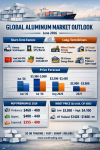
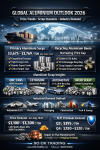
“Global Aluminum Market After the Peace Accord – A Turning Point Toward New Balance in Price and Supply”
Global Aluminum Market After the Peace Accord – In‑Depth Outlook Price and Supply Analysis · June 20, 2026 By SO OK TRADING
Following the landmark peace agreement between the U.S. and Iran and the reopening of the Hormuz Strait, the global metals market reacted instantly. Aluminum prices, which had surged past $3,700/MT, dropped sharply to $3,400/MT within a week — a classic “knee‑jerk drop” reflecting the disappearance of the geopolitical risk premium.
Yet this is not a permanent downturn. The market is entering a phase of “adjustment toward a new balance”, where short‑term pressures coexist with strong long‑term drivers.
⚡ Short‑Term Price Pressures
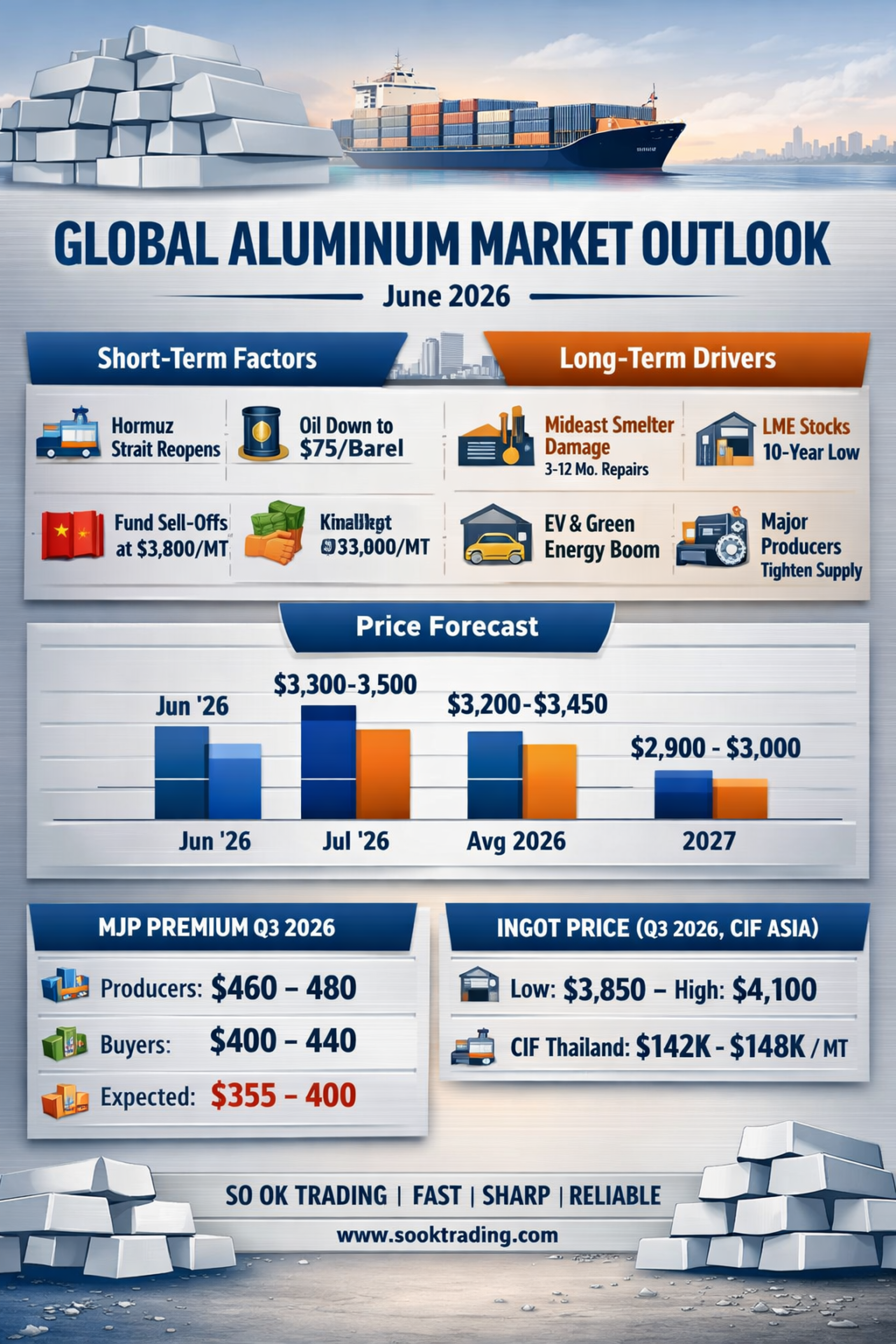
Shipping lanes reopened → Hormuz Strait unlocked aluminum exports from Gulf nations (≈9% of global supply).
Energy costs fell → Oil prices dropped from $100/barrel to $75/barrel, reducing power‑intensive smelting costs.
Fund profit‑taking → Investors sold off after prices hit a 4‑year high of $3,800/MT.
China boosted exports → Chinese aluminum ingots filled supply gaps, easing short‑term shortages.
Medium‑ to Long‑Term Supporting Factors
Mideast smelter damage → ALBA and EGA facilities require 3–12 months for recovery.
Global inventories at historic lows → LME warehouse stocks at their lowest in a decade.
Megatrend demand remains strong → EVs, AI infrastructure, and clean energy continue to drive consumption.
Major producers ramping up → Portland, Tomago, and RUSAL increase output to offset Middle East disruptions.
Price Forecast
June 2026: $3,300 – $3,500 / MT → Market consolidation
July 2026: $3,200 – $3,450 / MT → Limited downside with buying support
2026 Average: $3,000 – $3,400 / MT → Higher than 2025’s $2,635 average
2027 Outlook: $2,900 – $3,000 / MT → Balance restored as India & Indonesia add new capacity
MJP Premium Q3/2026
Producers’ offers: $460 – $480 / MT (Rio Tinto, South32)
Buyers’ counter‑offers: $400 – $440 / MT (Japan + ASEAN)
Expected settlement: $355 – $400 / MT → Above Q2’s $350 – $353, marking an 11‑year high
Ingot 99.7% (Q3/2026, CIF Asia)
Low range: $3,850 / MT
High range: $4,100 / MT
Thailand delivery (CIF Laem Chabang + Local Premium):
Low: $3,850 ≈ THB 142,000 / MT (excl. VAT)
High: $4,100 ≈ THB 148,000 / MT (excl. VAT)
Delivery timeline: August 2026
Business Strategy
Sellers:
Secure forward contracts based on MJP premiums at $370 – $380 / MT.
Avoid fixed LME pricing; adopt floating formulas tied to shipment month.
Buyers:
If LME dips to $3,200 – $3,300 / MT in late June–July, lock in contracts or call options immediately.
$3,200 – $3,350 / MT is the “safe buying zone.”
The global aluminum market is not in a bear market but in a “transition toward new equilibrium.” The $3,200 – $3,350 / MT range is the critical level for buyers to secure cost stability in Q3.
SO OK TRADING – FAST | SHARP | RELIABLE www.sooktrading.com Facebook: SO OK TRADING