Share

Aluminium Knowledge: The Strategic Metal of the Future — Transforming Industries into the EV & Clean Energy Era SO OK TRADING : 19 JUNE 2026
Last updated: 19 Jun 2026
1449 Views

Aluminium Knowledge : SO OK TRADING : 19 JUNE 2026

 
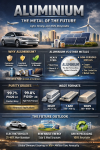
✨ Aluminium: The Lightweight Metal Transforming the Future

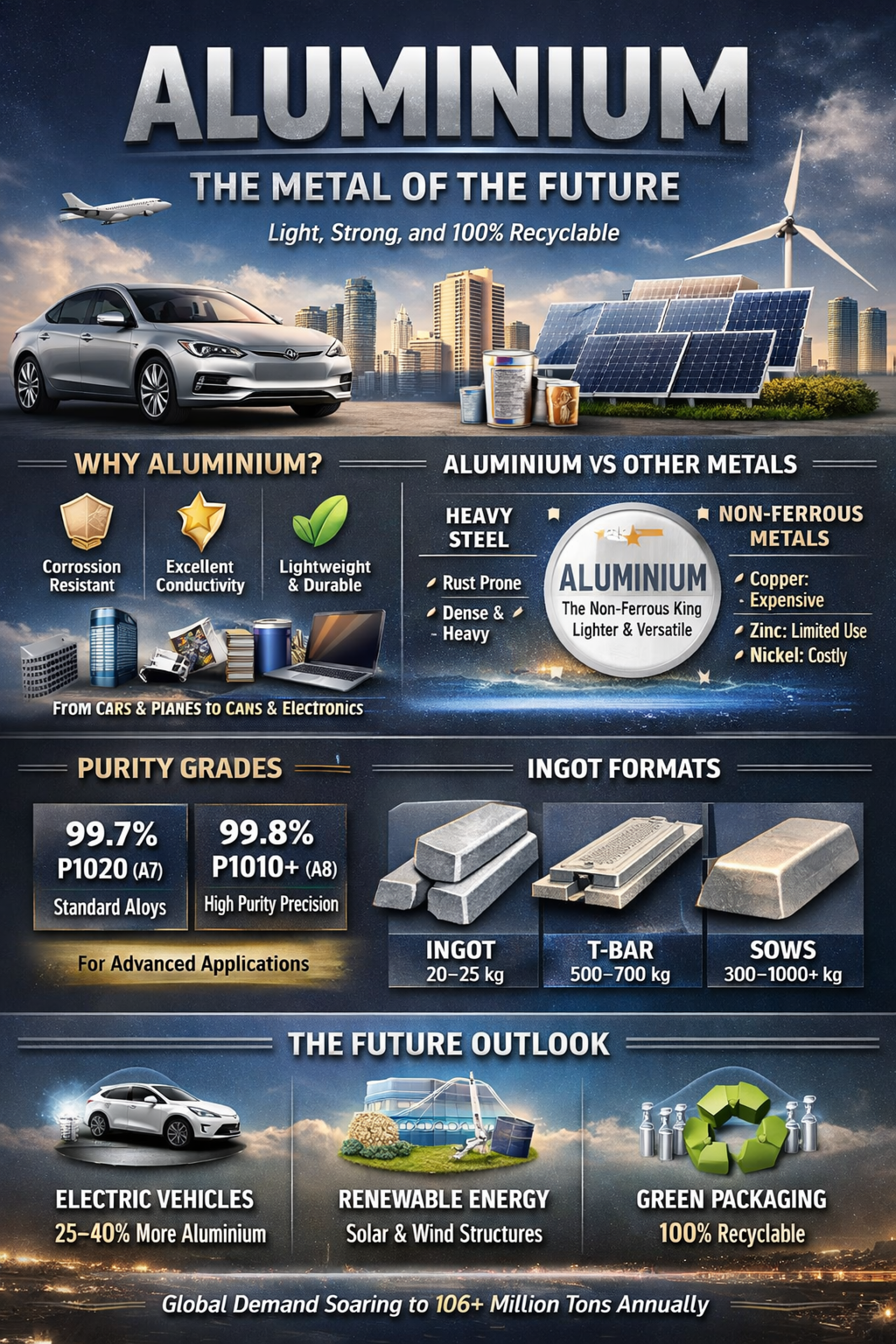
Imagine the industrial world stepping into a new era where everything must be lighter, more flexible, and environmentally friendly… The hero of this story is none other than Aluminium — a silver metal that is one-third the weight of steel, yet strong, durable, and infinitely recyclable.

 
Key Features Driving Global Use
Aluminium resists rust thanks to its natural oxide film, conducts electricity and heat efficiently, is easy to shape, and safe for food and industrial applications. This is why it is chosen for everything from building structures, cars, and airplanes to beverage cans and computer components.

 
Aluminium vs Steel and Other Metals (Ferrous – Non-Ferrous)
Steel remains the “giant” of the world, with over 1.8 billion tons used annually. But it is heavy and requires anti-rust coating. Aluminium, though used in smaller volumes (70–106 million tons annually), is growing rapidly because it meets the modern demand for lightweight and clean energy solutions.

Copper conducts electricity better but is heavier and more expensive. Zinc is mostly limited to anti-rust coating, and Nickel is used mainly in stainless steel and EV batteries. Compared to them, Aluminium is the “King of Non-Ferrous Metals,” dominating the market with versatile applications.

 
Deep Dive into Aluminium Grades (Base Metal – Highest Purity)
99.7% P1020 (A7) → Global standard grade, most widely used. Commonly alloyed for doors, windows, and packaging.
99.8% P1010+ (A8) → Higher purity premium grade. Ideal for high-voltage cables, precision casting, and electronics.
Though the price difference is small, the choice depends on specifications. For maximum purity, 99.8% is the answer.

 
Physical Forms: Ingot, T-Bar, Sows
Ingot (20–25 kg) → Small, easy to handle, suitable for general foundries.
T-Bar (500–700 kg) → Large T-shaped bars, stable for transport, ideal for rolling and extrusion plants.
Sows (300–1000+ kg) → Largest blocks, minimal melting loss, best for large-scale remelting facilities.
The difference lies not in the metal itself, but in convenience and factory requirements.

 
Aluminium Outlook for the Future
Electric Vehicles (EVs) → Each EV uses 25–40% more aluminium than a conventional car.
Renewable Energy → Solar panel frames, wind turbines, and high-voltage transmission lines all rely on aluminium.
Packaging → Beverage and food containers, 100% recyclable, eco-friendly (Green Business / Circular Economy).
This is why aluminium consumption is soaring past 106 million tons annually — with no signs of slowing down.

 
Key Message
Aluminium is not just a lightweight metal — it is a “metal transforming the world,” writing a new chapter for clean energy and electric vehicle industries. Those who understand the differences in grades and forms can craft smarter purchasing strategies and gain an edge in a rapidly growing market.

 
Interested in Aluminium products? We supply Aluminium Scrap, Aluminium Remelt, ADC12, P1010, P1020, A7, A8, and more — high-quality products at competitive prices, ready to serve your needs. Thank you for your trust.

 
SO OK TRADING Your Business Partner — FAST • SHARP • RELIABLE www.sooktrading.com Facebook: SO OK TRADING


Related Content
Copper Scrap: Strategic Resource for a Green Future, Driving Net Zero and Powering the Booming AI–EV Era” SO OK TRADING: 13 SEP 2026
Copper Scrap: Strategic Resource in the Circular Economy Era In today’s world, where clean energy and advanced technologies are driving the global economy, copper scrap has transformed from what was once considered mere recyclable waste into a strategic resource. It plays a vital role in future industries — from electric vehicles (EVs) and artificial intelligence (AI) to data centers and renewable energy. With the unique property of being 100% recyclable without losing its physical or chemical qualities, copper scrap has become the backbone of the Circular Economy and the Green Supply Chain. Globally, it is recognized as an essential resource for building a sustainable economy and reducing carbon footprints across every stage of production.
13 Sept 2026
“Naphtha: The Lifeblood of Global Industry — From Byproduct to Strategic Material, Driving Plastics, EVs, and a Sustainable Future”   SO OK TRADING | 2 May 2026
Naphtha: From Byproduct to Strategic Material of Global Industry SO OK TRADING | 2 May 2026 Once seen as a mere byproduct of crude oil refining, Naphtha has now become the strategic feedstock driving the world’s transformation — from petrochemicals and packaging to electric vehicles and circular innovation. Light Naphtha fuels the production of ethylene and propylene, forming the backbone of plastics and synthetic rubber. Heavy Naphtha powers aromatics and engineering polymers, shaping textiles, automotive parts, and high-performance materials. As global industries shift toward EV lightweighting, chemical recycling, and bio-based feedstocks, Naphtha stands at the crossroads of energy, sustainability, and technology. Demand continues to rise across Asia, while supply faces pressure from geopolitical risks and China’s capacity surge — redefining market balance and competitiveness. ✨ Naphtha is no longer just fuel — it’s the foundation of the next industrial revolution. SO OK TRADING — FAST • SHARP • RELIABLE
2 May 2026
“RDF 3 — Clean Energy from Old Shoes, Igniting Thailand’s Circular Economy and Driving the Future of Green Fuels — SO OK TRADING : 23 AUGUST 2026”
RDF 3 from Old Shoes: Clean Energy for the Circular Economy SO OK TRADING : 23 August 2026 Old shoes that have reached the end of their life are no longer just “waste.” They can be transformed into clean energy that truly drives Thailand’s circular economy. RDF 3 (Refuse-Derived Fuel 3), also known as Fluff RDF, is a waste-derived fuel refined so that 95% of particles are smaller than 2 inches. With high calorific value and low moisture content, it is ideal for use in cement kilns and waste-to-energy plants — key solutions for reducing coal consumption and carbon emissions. Old shoes are considered premium feedstock for RDF 3. Their main components — rubber, foam, and fabric — deliver calorific values of 5,000–6,500 kcal/kg with moisture levels below 20%, ensuring complete combustion and environmental safety. Thailand is advancing toward Carbon Neutrality by 2050 and Net Zero by 2065, with RDF 3 positioned as one of the alternative fuels supporting this sustainable green transition.
23 Aug 2026
This website uses cookies for best user experience, to find out more you can go to our Privacy Policy and Cookies Policy
Powered By MakeWebEasy Logo MakeWebEasy