Share

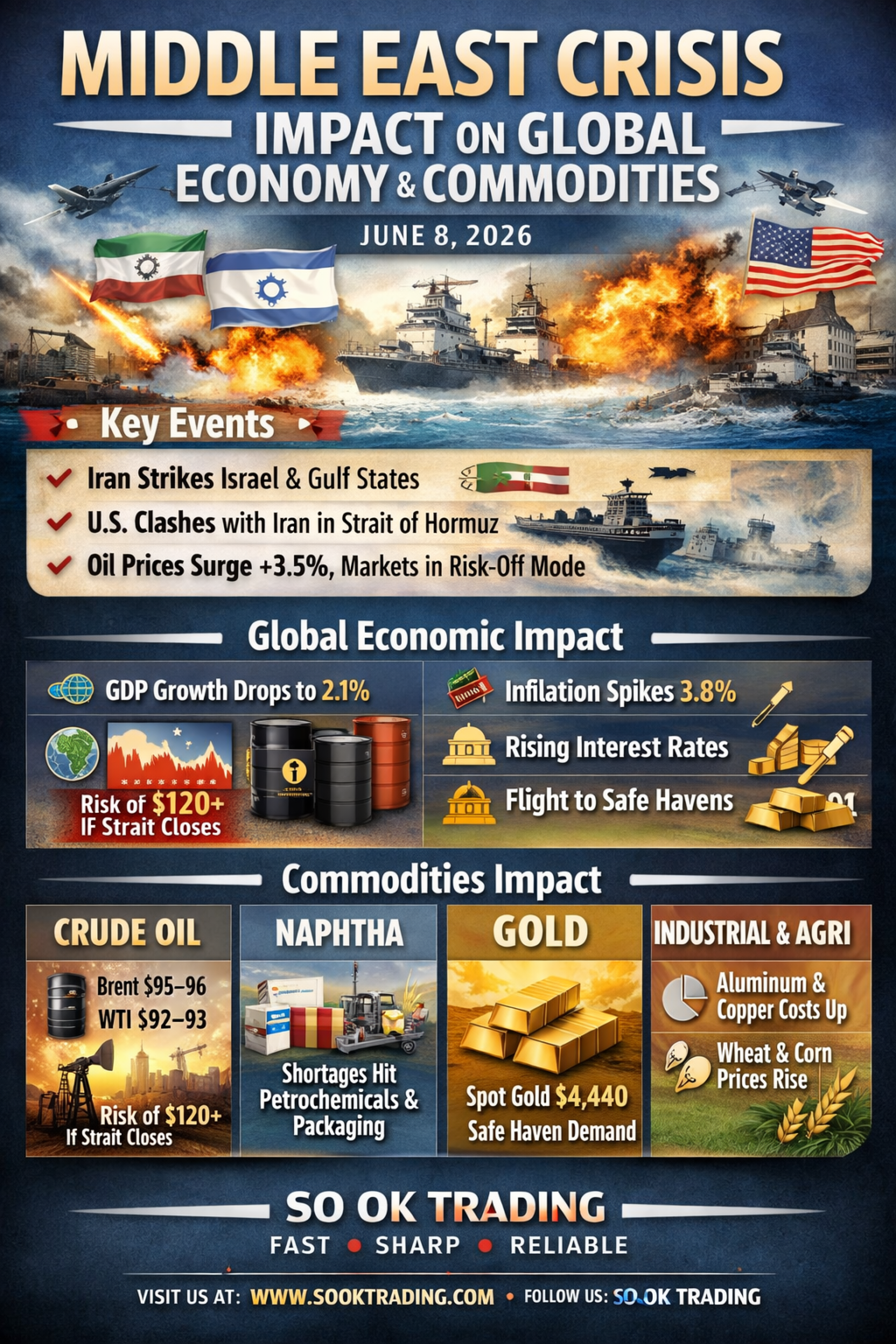
“Fierce War Shakes the World — 100 Days of Conflict Middle East Crisis 2026: Geopolitics Disrupting Global Economy & Key Commodities SO OK TRADING | June 8, 2026”

Last updated: 8 Jun 2026
1664 Views

Middle East Crisis – June 8, 2026: War Shakes the Global Economy and Key Commodities
The Middle East has once again erupted in conflict! Iran launched missiles at Israel, while the U.S. clashed with Iran in the Strait of Hormuz. Oil prices surged, global stock markets tumbled, and supply chains for critical commodities were severely disrupted.

Global Economy Slows – OECD warns world GDP growth may drop to just 2.1%, the weakest in decades Inflation Rises – Energy and shipping costs spike immediately ️ Oil & Naphtha Surge – Severe shortages hit petrochemicals and packaging industries

Related Content
ALUMINUM PRICE TREND 2026
An analysis of the aluminum market in 2026 indicates a likely continued market deficit and upward price pressure, driven by constrained supply and resilient demand from green energy sectors. However, significant volatility is expected due to policy uncertainties and the potential for new Indonesian supply to eventually balance the market. Key Drivers and Projections for 2026 Supply Side Analysis Capacity Constraints: China's primary aluminum output is approaching its self-imposed 45 million-tonne capacity cap, limiting global supply growth. Power Challenges: Smelters outside of China face intense competition for power from energy-intensive sectors like AI data centers, which are willing to pay higher prices for long-term contracts. This has kept significant capacity offline in Europe and the US. Production Disruptions: Outages and potential shutdowns at existing smelters in Iceland and Mozambique further tighten the market. Scrap Supply Pressure: The EU's planned implementation of the Carbon Border Adjustment Mechanism (CBAM) and potential scrap export tariffs in spring 2026 are expected to impact global scrap flows, creating regional shortages and price volatility. New Capacity: Indonesia is a key source of new supply, with several projects in the pipeline. However, analysts suggest the pace of the ramp-up may be slower than expected due to infrastructure and policy challenges, meaning it is unlikely to fully offset near-term tightness. Demand Side Analysis Green Transition Demand: Demand from "green" sectors such as solar panels, new energy vehicles, and energy transition infrastructure remains strong, providing fundamental support for the market. Substitution Effect: Aluminum's wide price discount relative to copper has encouraged substitution in electrical applications, acting as a tailwind for demand and prices. Construction and Automotive: The construction and automotive industries continue to be major consumers, with growing demand for lightweight, low-carbon aluminum products. Price Forecasts and Volatility The market is expected to remain in a deficit in 2026, with estimates ranging from 200,000 to 600,000 tonnes. This structural tightness is leading most analysts to forecast sustained or rising prices. Bullish Views: Analysts at Bank of America project prices of $3,000/tonne as early as 2026. J.P. Morgan also expects prices to approach $3,000/tonne in Q1 2026. ING forecasts an average price of $2,900/tonne for the year. Bearish/Conservative Views: Goldman Sachs is an outlier, forecasting prices to decline to $2,350/tonne by Q4 2026, anticipating a market surplus later in the year. SMM forecasts a "high first, then lower" pattern, with prices finding equilibrium in the $2,700–$2,800/tonne range by year-end. Premiums: Regional premiums, particularly the US Midwest premium, are expected to remain high and volatile due to tariffs and regional supply dynamics, creating a disconnect from the LME benchmark price. In essence, 2026 is projected to be a year of high volatility where participants need to focus on scenario readiness rather than relying on a single price forecast, as geopolitical and energy policies significantly influence regional supply and costs
31 Dec 2025
“Opening the Middle Eastern Market: New Pathways & Trends for Thai Agricultural Products in 2026 — Rising Stars of Trade by SO OK TRADING”   15 August 2026
Golden Opportunities for Thai Agricultural Products in the Middle East: Rising Stars & Challenges in 2026 SO OK TRADING | 15 August 2026 In 2026, the Middle Eastern market remains a treasure trove of opportunities for Thai agricultural products. With 80–90% of food consumption dependent on imports due to limited arable land, the region’s demand for food security continues to surge, positioning Thailand as a key supplier. At the same time, geopolitical conflicts, regional instability, and strict sustainability standards have emerged as critical challenges, requiring Thai exporters to adapt quickly and strategically. This article explores: Thai agricultural products gaining strong momentum in Middle Eastern markets Key opportunities Thailand can leverage in 2026 Risk factors that demand close attention And the Outlook for five major agricultural products, reflecting the “Rising Stars & Declining Players” of this challenging year From tapioca pellets, now a rising star in Saudi Arabia, to sugar, which remains a staple across the region, and the shifting fortunes of Thai rice, molasses, and corn, each product faces unique opportunities and obstacles. SO OK TRADING stands ready as your trusted partner, helping you clearly identify market trends and build confident export strategies for 2026. SO OK TRADING — FAST • SHARP • RELIABLE
15 Aug 2026
“Lead Bullion: Powering Batteries, Forging the Green Energy Future — An Article by SO OK TRADING, April 7, 2026”
Lead Bullion & Battery Market: The Metal Power Driving the New Energy World In an era of rapid change in energy and technology, lead remains at the heart of the global battery industry. Especially Lead Bullion (crude lead), refined from Galena ore (PbS) through sintering and blast furnace smelting, then purified to 99.97% pure lead under ASTM B29 standards. This refined lead is essential for producing lead-acid batteries widely used in automobiles, backup power systems (UPS), and energy infrastructure. With global energy prices and shipping costs surging, the Lead Bullion market has regained attention. Particularly in battery production and recycling, recycled lead can reduce energy consumption by up to 75% compared to primary smelting, aligning with the principles of the Circular Economy and ESG standards valued worldwide. Between 2025–2030, the world is entering the era of Secondary Lead — high-quality, environmentally friendly recycled lead expected to account for 60–70% of global demand. This opens new opportunities for Thai manufacturers to build Closed-loop Systems, ensuring long-term sustainability and resilience.
7 Apr 2026
This website uses cookies for best user experience, to find out more you can go to our Privacy Policy and Cookies Policy
Powered By MakeWebEasy Logo MakeWebEasy