Share

“FERROUS & NON FERROUS 2026: Metals on Fire, Prices Soar and Shake the Global Economy – Energy Wars and Strategic Metals Rock the World” : SO OK TRADING : May 2, 2026
Last updated: 2 May 2026
1767 Views

“Boiling Metals, Soaring Prices, Shaking the World – When Energy and Geopolitics Become the Key Variables” (FERROUS, NON-FERROUS): Metals and Non-Metals Rock the World: SO OK TRADING: May 2, 2026

 
2026 is no ordinary year for the metals market. Every price chart has become the “storyline” of the most intense global economic drama in years — a chapter filled with volatility, tension, and pressure from all directions.

 
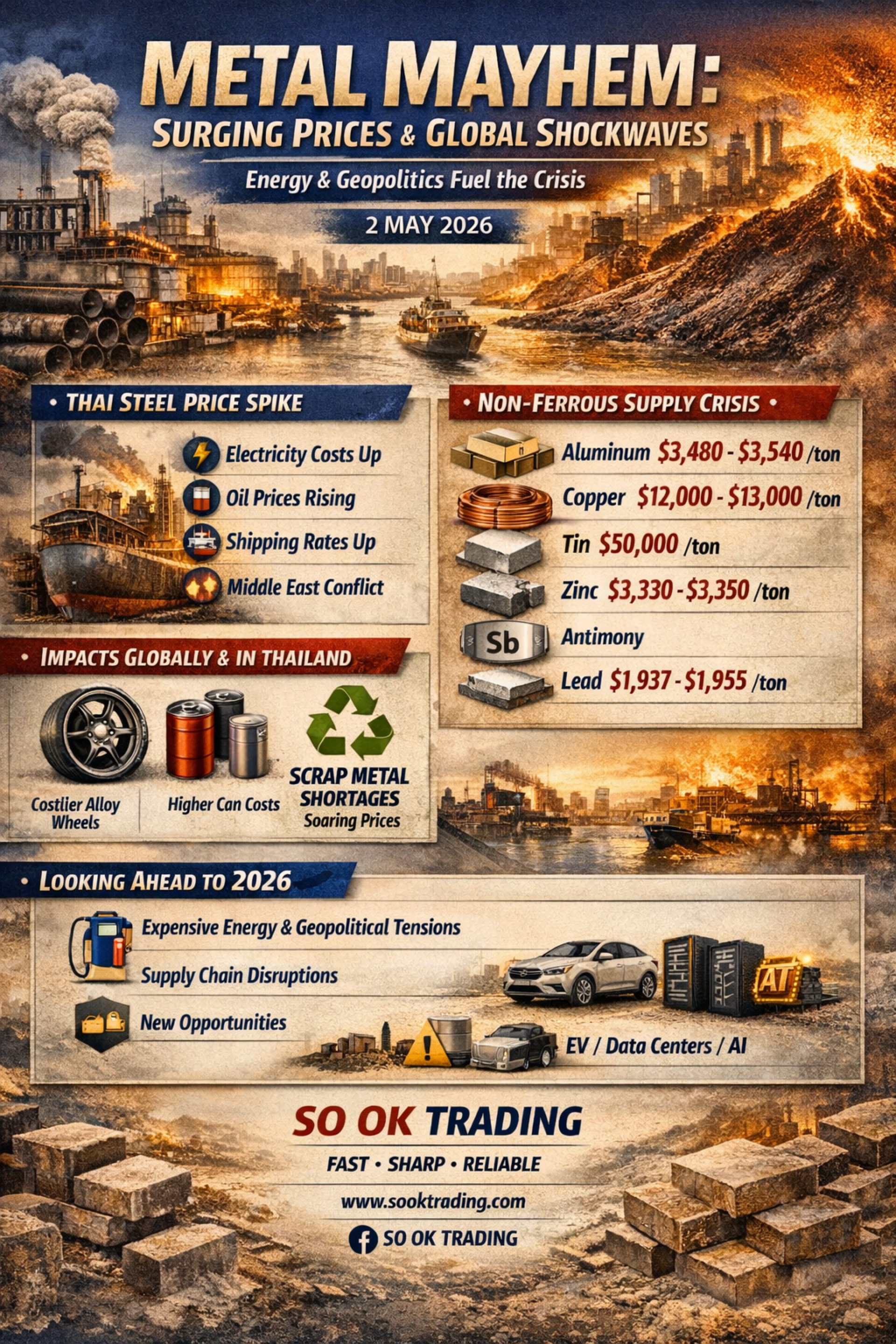
Thai Steel and the Unbearable Cost Burden In April, Thai steel producers announced price increases of 10–15%, with signals of further hikes in May. Construction rebar has risen to 22–23 THB/kg, while structural steel stands at 26–30 THB/kg.

 
The Four Pressures Driving Steel Prices Higher

Rising electricity costs
Expensive oil and transportation
Surging freight rates due to geopolitical crises
Middle East war tightening steel supply
This scene reflects clearly that energy costs are the main driver pushing steel prices upward.

 
Non-Ferrous Metals and the Supply Crisis If steel is a “life drama,” non-ferrous metals are an “action movie” — full of intensity.

Aluminum: Prices surged to $3,480–3,540/ton after Middle Eastern smelters were attacked, cutting supply by 9%. EV and solar demand continue to push prices higher.
Copper: Holding high at $12,000–13,000/ton due to mine shortages in Chile and Indonesia. Demand from data centers and the clean energy transition remains a strong support.
Tin: Exploded past $50,000/ton as Indonesia restricted exports and AI chips/semiconductors drove demand.
Zinc: At $3,330–3,350/ton, with tightness from low inventories, though large mines returning may ease pressure in the second half.
Antimony: Prices have eased from peaks but remain historically high, used in PV glass and strategic weaponry.
Lead: Stable at $1,937–1,955/ton, supported by lead-acid batteries for data centers and backup power systems.
These figures show that non-ferrous metals are strategic resources the world cannot live without, and every supply crisis is fuel for price surges.

 
Impact on the World and Thailand

Alloy wheel and aluminum parts manufacturers raised prices immediately.
Beverage industry faces pressure from rising aluminum can costs.
Non-ferrous and ferrous recycling markets are tight, as primary resources are unavailable.
 
Conclusion: The Metals World in 2026 Expensive energy, heated geopolitics, and new technology demand are the three forces keeping prices high.

Lessons for producers and consumers:

Accelerate procurement before the next price hike
Watch supply crises that can shake the market in a single day
Seek opportunities in new industries using strategic metals — EVs, data centers, AI
✨ This article is not just a price report but a story of “boiling metals,” showing that in 2026, metals are no longer just commodities — they are the driving force of the future economy.

 
SO OK TRADING: Your Business Partner SO OK TRADING: FAST • SHARP • RELIABLE

VISIT US AT: WWW.SOOKTRADING.COM FACEBOOK: SO OK TRADING

Related Content
“War Shakes the Global Packaging Industry: Supply Chain Disruption, Plastic Shortage & Aluminum Squeeze – From Crisis to New Business Opportunities” Article by SO OK TRADING | March 26, 2026
“War Reshapes the Packaging Industry – Plastic Stumbles, Aluminum Faces Shortages” The Middle East conflict has severely disrupted global supply chains, striking hardest at petrochemicals and packaging. Plastic packaging is in critical shortage, while aluminum has been pulled in as the substitute material—only to face its own supply squeeze. Both stockpiling and new production are under pressure, especially in food and beverage packaging. This article by SO OK TRADING dives deep into the cascading impacts of war on the packaging industry, and highlights strategies and opportunities to pivot toward recycled packaging and innovative solutions in 2026.
26 Mar 2026
HNY 2026 with a First Analysis on Thai Baht Value
he Thai baht in Q1 2026 is expected to strengthen against the US dollar, driven primarily by a weaker dollar globally, a seasonal tourism boost, and expectations of US Federal Reserve rate cuts. This strength is occurring despite a weak domestic economic outlook and the Bank of Thailand's (BoT) likely continued easing of its policy rate. Exchange Rate Drivers and Forecast External Factors: The primary driver for the strengthening baht is external, mainly the broad weakness of the US dollar as global markets price in expected Fed rate cuts. The baht is also correlated with global gold prices, which have been climbing. Tourism High Season: The period extending into Q1 2026 is the high season for tourism, which typically brings in foreign currency and supports the baht's value. Policy Divergence: The BoT is expected to continue its easing cycle, potentially cutting the policy rate further to 1.00% by Q1 2026 to stimulate the sluggish domestic economy. This divergence from a potentially less aggressive US Fed in Q1 could support the baht in the short term, though some analysts warn the currency could weaken later in 2026. Forecasts: Projections for 2026 generally place the baht in a range of 30.80–33.00 per US dollar. Some models estimate it could trade around 31.06 by the end of Q1. A persistently strong baht below 31 per US$ is seen as a significant risk to the Thai export and tourism sectors. Key Economic Context Weak Growth: Thailand's economy is expected to slow down to a 5-year low growth rate of around 1.6-1.8% in 2026, pressured by US tariffs, global trade tensions, and high household debt. The central bank chief expects an improvement in Q1 2026 after a weak second half of 2025. Political Uncertainty: A general election expected in February 2026 could also introduce volatility, though some historical trends suggest the baht may strengthen following the formation of a new government. Low Inflation: Headline inflation is projected to remain subdued or even negative, providing the central bank with justification for further rate cuts to stimulate demand. In summary, Q1 2026 is characterized by a strong and volatile baht driven by external factors, contrasting sharply with a weak domestic economy and accommodative monetary policy.
1 Jan 2026
This website uses cookies for best user experience, to find out more you can go to our Privacy Policy and Cookies Policy
Powered By MakeWebEasy Logo MakeWebEasy