“Deep Dive into Thailand’s Aluminum Packaging Market: From SMEs to Mega‑Volume — A New Era of Value, Premium Design, and Cost‑Game Strategies” SO OK TRADING | 30 MAY 2026
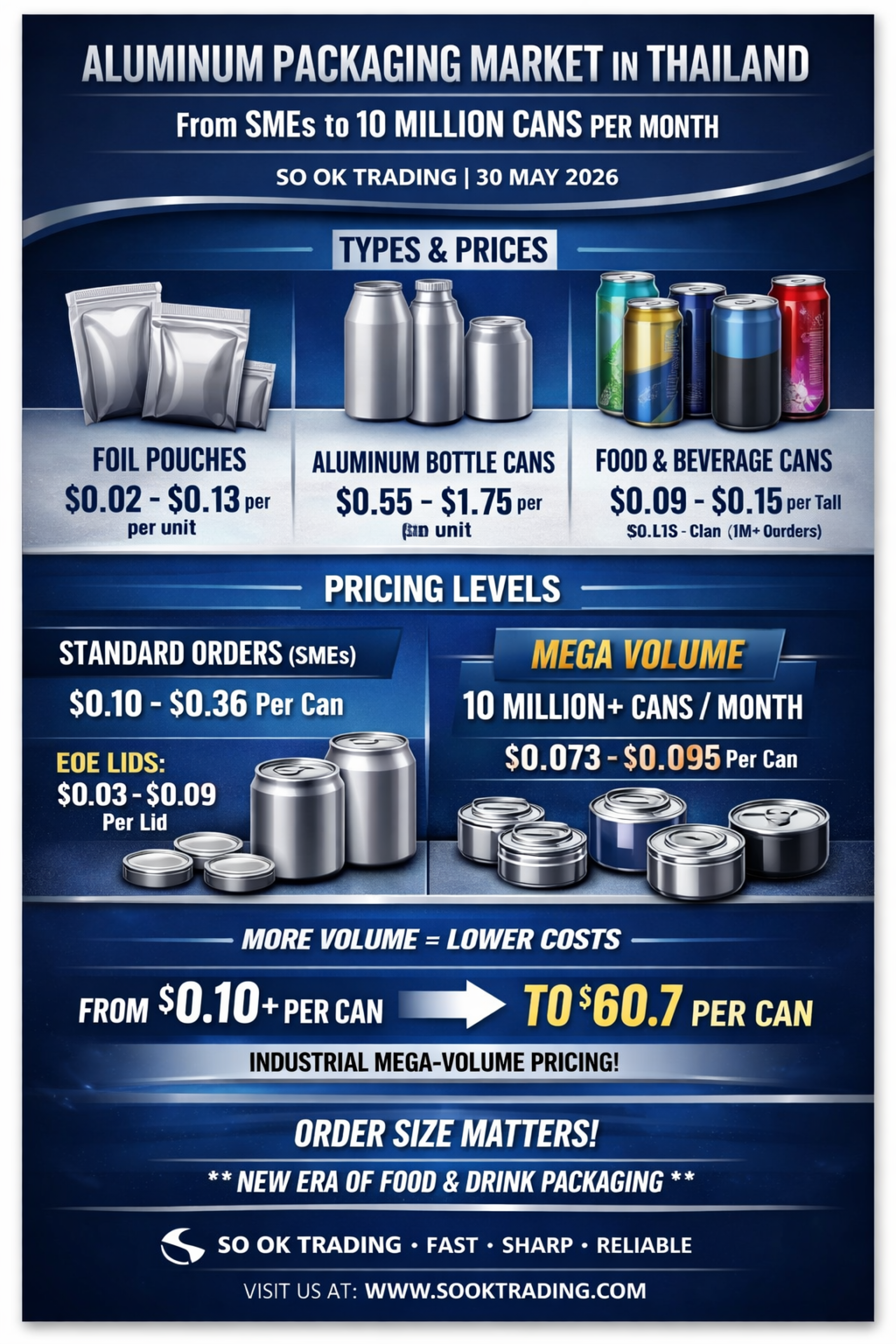
Deep Dive into Thailand’s Aluminum Packaging Market: Beverage Cans, Food Cans, and Easy Open Ends (EOEs)
From SME Transactions to 10 Million Cans per Month Article by SO OK TRADING | 30 MAY 2026
Market Overview
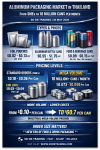
Thailand’s aluminum packaging market is expanding rapidly and becoming highly competitive in terms of price, quality, and brand image. Prices range from 0.75 THB to over 60 THB per unit, depending on type, size, and order volume. The larger the order, the lower the unit cost — with design formats, production schedules, and delivery times also playing a key role.
Types of Aluminum Packaging and Prices
Foil Pouches
Ideal for food, snacks, pharmaceuticals, and cosmetics
Small size (5×7 cm): 0.75 THB/unit
Stand‑up pouch with zipper (10×15 cm): 2.80 THB/unit
Custom printed (MOQ 10,000 units): 4.80 THB/unit
Aluminum Bottle Cans
Popular for beverages, chemicals, and cosmetics
Drinking water bottle 350 ml: 20.06 THB/bottle
Chemical bottle 1,000 cc: 57.75 THB/bottle
Lab bottle 500 ml: 65.00 THB/bottle
Aluminum Jars / Cans
Cream jars 10g–50g: 3.50–8.00 THB/unit
Beverage cans 250–325 ml: bulk orders 3.00–5.00 THB/can, million‑unit scale 2.80 THB/can
Beverage Can Highlights and Prices (1M+ units/month)
Sleek Can (330 ml) → Premium, modern look: 3–3.5 THB/can
Slim Can (250 ml) → Portion control: 3–3.35 THB/can
Stubby Can (250 ml) → Classic, rare in Thailand: 3–3.35 THB/can
Tall Can (500 ml) → Big size, value: 3.8–4.25 THB/can
Standard Can (330 ml) → Traditional wide‑mouth: 3.25 THB/can
Key Pricing Factors
Global LME Aluminum Price → fluctuates in real time, monthly averages used for calculations
MOQ (Minimum Order Quantity) → larger orders = lower unit cost
Shape & Size → Sleek, Slim, Stubby, Tall each carry different design premiums
EOE 202 Lids → small orders 1.00–2.50 THB/unit, million‑unit scale 0.33–0.90 THB/unit
Brand Printing & Annual Contract Examples
Large factories → MOQ 100,000–300,000 cans, including lids & printing: 3.50–5.00 THB/unit
SMEs → MOQ 1,000–5,000 cans, printing adds 2.00–4.50 THB/unit, total 9.50–13.00 THB/unit
Annual contracts (1M+ cans) → Sleek Can average 3.60–3.90 THB/unit
Mega‑Volume (10M/month) → Sleek Can drops to 2.60–2.90 THB/unit
Example Pricing at 12 Million Cans per Month
At 12M cans/month (144M/year), pricing enters the Industrial Mega‑Volume Tier, approaching raw metal cost using the LME + Premium Formula (aluminum cost + production).
Sleek Can 330 ml → 2.50–2.80 THB/unit → monthly 30–33.6M THB, annual 360–403M THB
Standard Can 330 ml → 2.30–2.60 THB/unit → monthly 27.6–31.2M THB, annual 331–374M THB
Slim Can 250 ml → 2.20–2.40 THB/unit → monthly 26.4–28.8M THB, annual 317–346M THB
Tall Can 500 ml → 3.70–4.00 THB/unit → monthly 44.4–48M THB, annual 533–576M THB
EOE 202 lids → reduced to 0.30–0.45 THB/unit (included above)
Conclusion: Order Size Matters
At 12M cans/month, buyers reach Tier 1 Mega‑Volume, gaining maximum bargaining power. Unit prices approach true raw material costs, enabling transparent negotiations through Open Book Pricing.
Aluminum Packaging: The New Era of Food, Beverage, and Beyond
SO OK TRADING: Your Business Partner FAST • SHARP • RELIABLE www.sooktrading.com Facebook: SO OK TRADING