Share

“Middle East War US–IRAN: Global Markets Shaken from Hormuz to Wall Street — Gold Surges, Stocks Fall, Currencies Swing” Situation Assessment: March 30 – April 3, 2026 By SO OK TRADING
Last updated: 29 Mar 2026
2367 Views


“Middle East War US–IRAN: Stocks, Currencies, Gold & Commodities — A Decisive Week for Global Markets”
March 30 – April 3, 2026
By SO OK TRADING

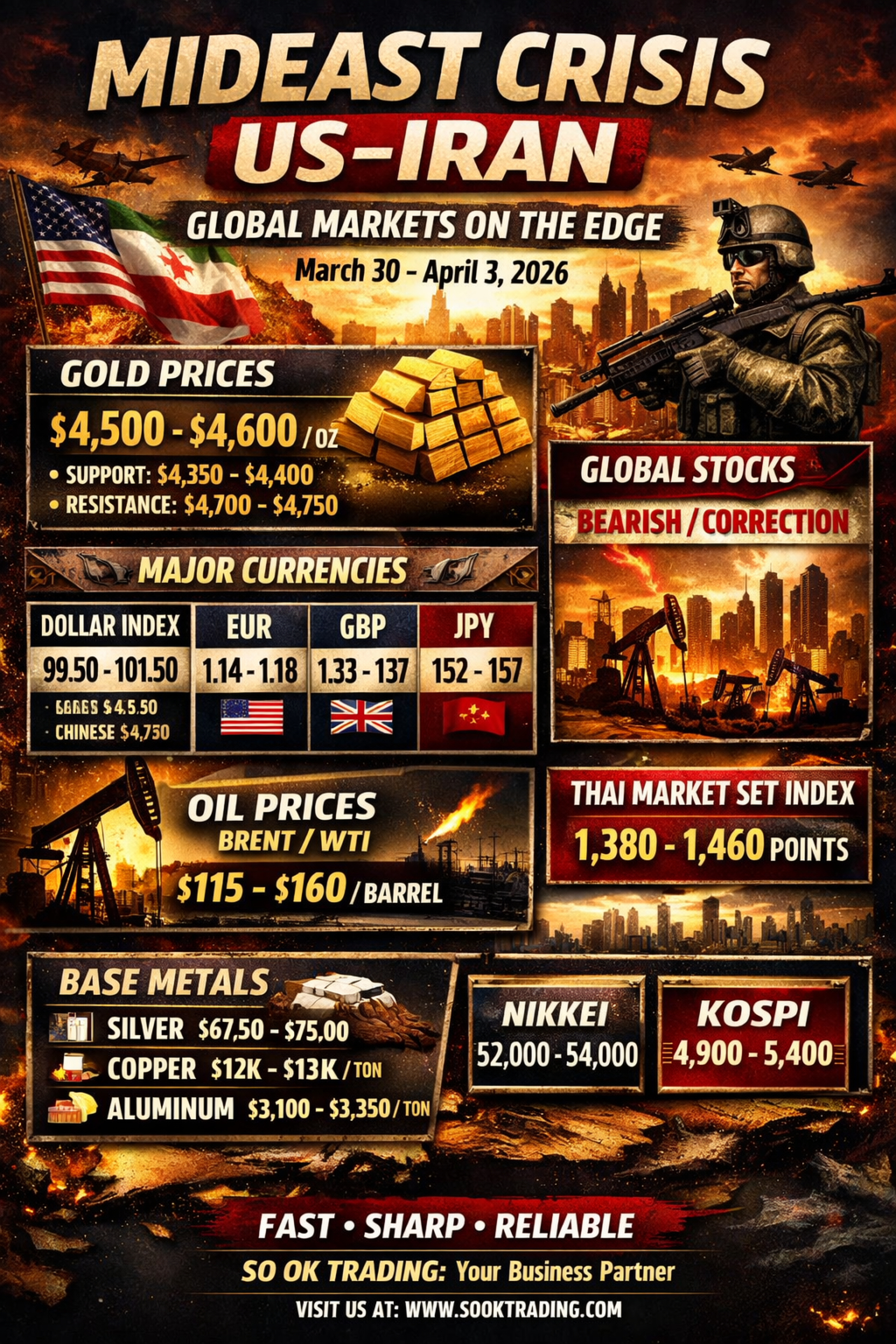
 Gold — The Safe Haven Still Burning Bright

Trend: Bullish Volatility
Forecast Range: $4,500 – $4,600 per ounce
Key Support: $4,350 – $4,400
Key Resistance: $4,700 – $4,750
Analysis: If US–Iran talks fail (high probability), gold may break above $4,700. If signs of easing emerge, prices could retreat to test $4,400.
 

Global Stock Markets

Trend: Bearish / Correction
S&P 500 and Nasdaq have fallen for 5 consecutive weeks
Main Concern: Stagflation driven by soaring energy costs
Asian markets, including Thailand, remain fragile in line with global sentiment
 

Major Currencies

US Dollar (USD / DXY): 99.50 – 101.50 points
Support: 99.00 / Resistance: 101.80
Euro (EUR): 1.14 – 1.18 USD 37.40 – 38.20 THB
British Pound (GBP): 1.33 – 1.37 USD 43.20 – 44.10 THB
Japanese Yen (USD/JPY): 152 – 157 JPY 0.20 – 0.21 THB
Chinese Yuan (USD/CNY): 6.84 – 6.87 CNY
Thai Baht (USD/THB): 32.80 – 33.40 THB
Support: 32.70 / Resistance: 33.25
 

️ Oil Prices

Trend: Bullish / Supply Shock
Brent and WTI surged over 40% in March
If the Strait of Hormuz is blocked → $115–160 per barrel
Extreme scenario: prices could reach $200 per barrel
 

Thai Stock Market (SET Index)

Trend: Sideway Down
Support: 1,380–1,420 points
Resistance: 1,450–1,460 points
Beneficiaries: Energy & Refining (PTTEP, PTT)
Vulnerable: Construction, Healthcare, Aviation
Positive Note: Thai equities remain a value play with low P/E and high dividend yield
 

Asian Market Outlook

Japan (Nikkei 225): 52,000–54,000 points
South Korea (KOSPI): 4,900–5,400 points
Hong Kong (Hang Seng): Undervalued → could rebound quickly if peace signals emerge
 

⚙️ Base Metals & Silver

Aluminum: $3,100 – $3,350 per ton → Bullish, tracking energy costs
Copper: $12,000 – $13,000 per ton → Sideways, dependent on China’s stimulus policies
Silver: $67.50 – $75.00 per ounce → Sideways, bargain levels may attract speculative buying
 

Key Events This Week

March 30: Jerome Powell speech → Dollar may strengthen further
April 1: ADP & ISM data → Reflecting oil price impact
April 3: Good Friday / US Non-Farm Payrolls → Weak data = bullish for gold
 

Weekly Summary (March 30 – April 3, 2026)

Gold remains the ultimate safe haven, with support at $4,400 and resistance at $4,700. Major currencies reflect war risks and US monetary policy: dollar strong, euro and yen weak, yuan and baht pressured by high energy costs. Investors must closely watch peace negotiations and US economic data — both will define global market direction this week.


SO OK TRADING — FAST • SHARP • RELIABLE
Your Business Partner
www.sooktrading.com

Related Content
“Baht Weak, Dollar Strong – The Shaken Global Financial Game”: SO OK TRADING: 15 MAY 2026
This May, the “Global Financial Game” heats up once again — the US dollar surges strong while the Thai baht continues to weaken, moving within the 32.30–32.65 THB/USD range. Strong US economic growth, soaring oil prices, and falling gold have drained the baht’s momentum. For businesses and investors, this is the time to “Think Fast, Adapt Quickly” to navigate global market volatility. SO OK TRADING FAST • SHARP • RELIABLE
15 May 2026
“Energy Pulse 2026: Naphtha Recovery – Positive Signals from the Global Energy Crisis Toward a New Market Balance” Article by SO OK TRADING | May 18, 2026
Naphtha Crisis 2026 – Latest Situation Update Positive Outlook | SO OK TRADING Since the outbreak of the Middle East conflict in late February, the global energy market has been shaken dramatically. Crude oil prices surged past $150 per barrel, driving Asian naphtha prices to nearly double. By mid‑May, prices corrected to $897 per ton, though still 62.54% higher than last year. Even as prices begin to ease, supply chain “lag effects” remain — shipping delays of 15–20 days and congested ports due to competition for raw material shipments from the Middle East continue to pressure industries across Asia. In Thailand, SCGC declared force majeure and temporarily shut down the Rayong Olefins plant, while PTTGC and SCGC are studying the establishment of a joint venture to enhance flexibility and reduce long‑term costs. In Japan, leading snack brand Calbee announced a packaging strategy shift, reducing color printing on 14 products to black‑and‑white to cope with ink and resin shortages — reflecting the rising trend of “minimalist design” during the crisis. At the same time, recovery signals are emerging: Naphtha prices dropped from the peak of $1,020 → $897 per ton Spreads rebounded: Ethylene–Naphtha +250–280 / Propylene–Naphtha +310–330 Plastic prices remain high but show signs of stabilization If the Middle East situation does not flare up again, this crisis is expected to ease by late June – early July 2026. SO OK TRADING FAST • SHARP • RELIABLE Your Trusted Business Partner
18 May 2026
SOOK ขอเสนอการข้อมูลการใช้งานสายไฟฟ้า ทองแดง และ อลูมิเนียม รวมทั้งสายไฟรถ EV เกร็ดความรู้
เกร็ดความรู้เรื่องสายไฟ โดยมากสายไฟที่พูดถึงนั้นเป็นสายไฟที่ทำจาก ทองแดง (Copper) และ อะลูมิเนียม (Aluminum) โดยมีคุณสมบัติที่แตกต่างกัน เช่น สายทองแดงนำไฟฟ้าได้ดีกว่า มีความทนทานและอายุการใช้งานยาวนานกว่า แต่น้ำหนักมากและมีราคาสูงกว่า ในขณะที่สายอะลูมิเนียมมีน้ำหนักเบาและราคาถูกกว่า แต่ต้องใช้ขนาดใหญ่กว่าทองแดงสำหรับกระแสไฟเท่ากัน และมีความปลอดภัยในจุดต่อมากกว่า สายไฟทองแดง (Copper) คุณสมบัติ: การนำไฟฟ้า: สูงมาก ความปลอดภัย: เสถียรกว่าและร้อนน้อยกว่า ความทนทาน: ไม่เกิดสนิมและอายุการใช้งานยาวนาน การใช้งาน: นิยมใช้ในอาคารและใต้ดิน เนื่องจากสามารถนำมาทำเป็นเส้นลวดขนาดเล็กได้ง่าย ข้อจำกัด: น้ำหนักมากและราคาสูงกว่า สายไฟอะลูมิเนียม (Aluminum) คุณสมบัติ: น้ำหนัก: เบากว่าทองแดงประมาณ 30-50% ราคา: ถูกกว่าทองแดง การนำไฟฟ้า: นำไฟฟ้าได้ดี แต่ต้องใช้ขนาดสายใหญ่กว่าทองแดงสำหรับกระแสไฟเท่ากัน การใช้งาน: นิยมใช้กับสายส่งไฟฟ้าแรงดันสูงที่ต้องแขวนลอยในอากาศ หรือในงานที่ต้องการความยืดหยุ่นและทนความร้อนได้สูง ข้อจำกัด: มีโอกาสเกิดสนิม (ออกไซด์) และความปลอดภัยที่จุดต่อต้องควบคุมให้แน่นหนา สรุป ทองแดง เหมาะสำหรับงานภายในอาคารที่ต้องการความปลอดภัยและความเสถียรสูง อะลูมิเนียม เหมาะสำหรับงานที่ต้องการประหยัดต้นทุนและน้ำหนัก เช่น สายส่งไฟฟ้าแรงดันสูง
3 Dec 2025
This website uses cookies for best user experience, to find out more you can go to our Privacy Policy and Cookies Policy
Powered By MakeWebEasy Logo MakeWebEasy