Share

“Aluminum Remelt Revolution – Transforming Scrap into the Power of Tomorrow, in the Era of Circular Economy & Net Zero” SO OK TRADING · 23 MAY 2026
Last updated: 23 May 2026
948 Views

 Aluminum Remelt – Transforming Scrap into the New Power of Industry in the Era of Circular Economy & Net Zero By SO OK TRADING | May 23, 2026

 
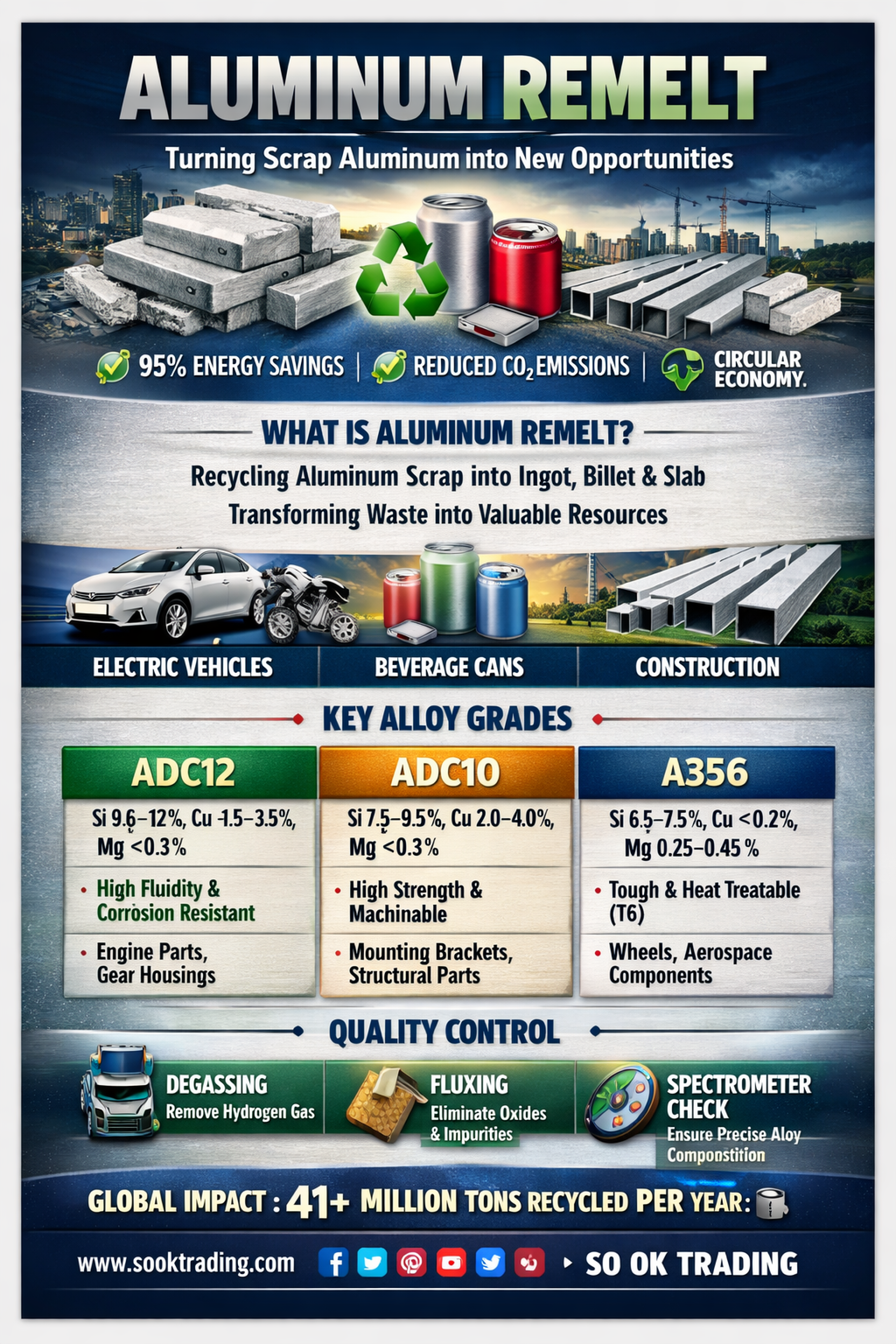
♻️ What is Aluminum Remelt? Aluminum Remelt is the process of taking aluminum scrap from production or end‑of‑life products, re‑melting it, improving its properties, and casting it into ingots, billets, or slabs to be reused by industries. The highlight: it saves up to 95% of energy compared to primary aluminum production, while reducing carbon emissions — directly supporting Circular Economy and Net Zero goals.

 
Main Industrial Applications
Automotive: ADC12 and ADC10 grades are used for high‑pressure die casting of engine covers, gear housings, and structural components. These alloys can be recycled repeatedly, and demand will rise further with the growth of EVs, which rely heavily on aluminum for body frames, wheels, and battery housings.
Packaging: Slabs are rolled into beverage cans, which can be recycled endlessly.
Construction: Billets are extruded into lightweight yet durable building structures — recycled aluminum can be used infinitely in this sector.
 
⚙️ Alloy Specifications
ADC12 (JIS Standard)

Composition: Si 9.6–12.0%, Cu 1.5–3.5%, Mg <0.3%
Properties: Excellent fluidity, corrosion resistance, high mechanical strength
Applications: Engine covers, gear housings, electrical and electronic casings
Highlight: The most versatile and widely used die‑casting grade
ADC10 (JIS Standard)

Composition: Si 7.5–9.5%, Cu 2.0–4.0%, Mg <0.3%
Properties: Higher strength and tensile resistance than ADC12, but slightly less fluidity and corrosion resistance
Applications: Engine mounts, high‑stress components, parts requiring additional machining
Highlight: Ideal for applications needing strength and impact resistance
A356 (ASTM/AA Standard)

Composition: Si 6.5–7.5%, Cu <0.2%, Mg 0.25–0.45%
Properties: High toughness and impact resistance, can be heat‑treated (T6) for enhanced strength
Applications: Alloy wheels, suspension components, aircraft parts, hydraulic pumps
Highlight: Perfect for safety‑critical structural components
 
Quality Enhancement Techniques
Degassing: Removes hydrogen gas to prevent porosity
Fluxing: Eliminates oil residues and oxide films
Spectrometer Check: Ensures precise Si, Cu, Mg ratios to meet alloy standards
 
Global and Thai Market
Global: Over 41 million tons/year of recycled aluminum are used, projected to reach 51 million tons by 2031
Thailand: Annual demand of 3.5–4 million tons, with a market value of USD 8.23 billion. Automotive and packaging lead the way, with aluminum can recycling rates as high as 78%, among the highest in ASEAN.
 
Demand Drivers
CBAM Policies (EU & US): Mandating low‑carbon aluminum in exports
EV Boom: Lightweight yet strong aluminum structures are increasingly essential
 
Conclusion
Aluminum Remelt is not just recycling — it is the creation of new value from scrap metal. It delivers both environmental and economic advantages, giving industries a competitive edge in sustainability and global market access.

SO OK TRADING — Your Business Partner FAST | SHARP | RELIABLE www.sooktrading.com Facebook: SO OK TRADING


Related Content
Lead ฺBullion &amp; Circular Economy – Toward a Sustainable Future with Recycled Lead: Primary Energy Supporting the Industry’s Future BY SO OK TRADING
Lead Bullion – Primary Energy Driving the Industrial World Lead Bullion is a heavy metal raw material with unique properties. It has high density, effectively shielding against X-rays and radiation; it is soft and malleable, making it easy to process into various components; it has a low melting point, helping to reduce production costs; and it is 100% recyclable, supporting the circular economy and ESG standards. For these reasons, Lead Bullion plays a central role in the battery industry, radiation protection, construction, and alloy manufacturing. Market trends for 2026 indicate that global demand is expected to continue rising, with prices remaining stable or increasing to USD 2,050–2,200 per metric ton (LME). The proportion of recycled lead continues to grow, becoming an essential part of global ESG initiatives. SO OK TRADING is committed to supplying high-quality Lead Bullion, reliably supporting the future of energy and industry.
16 Jan 2026
HNY 2026 with a First Analysis on Thai Baht Value
he Thai baht in Q1 2026 is expected to strengthen against the US dollar, driven primarily by a weaker dollar globally, a seasonal tourism boost, and expectations of US Federal Reserve rate cuts. This strength is occurring despite a weak domestic economic outlook and the Bank of Thailand's (BoT) likely continued easing of its policy rate. Exchange Rate Drivers and Forecast External Factors: The primary driver for the strengthening baht is external, mainly the broad weakness of the US dollar as global markets price in expected Fed rate cuts. The baht is also correlated with global gold prices, which have been climbing. Tourism High Season: The period extending into Q1 2026 is the high season for tourism, which typically brings in foreign currency and supports the baht's value. Policy Divergence: The BoT is expected to continue its easing cycle, potentially cutting the policy rate further to 1.00% by Q1 2026 to stimulate the sluggish domestic economy. This divergence from a potentially less aggressive US Fed in Q1 could support the baht in the short term, though some analysts warn the currency could weaken later in 2026. Forecasts: Projections for 2026 generally place the baht in a range of 30.80–33.00 per US dollar. Some models estimate it could trade around 31.06 by the end of Q1. A persistently strong baht below 31 per US$ is seen as a significant risk to the Thai export and tourism sectors. Key Economic Context Weak Growth: Thailand's economy is expected to slow down to a 5-year low growth rate of around 1.6-1.8% in 2026, pressured by US tariffs, global trade tensions, and high household debt. The central bank chief expects an improvement in Q1 2026 after a weak second half of 2025. Political Uncertainty: A general election expected in February 2026 could also introduce volatility, though some historical trends suggest the baht may strengthen following the formation of a new government. Low Inflation: Headline inflation is projected to remain subdued or even negative, providing the central bank with justification for further rate cuts to stimulate demand. In summary, Q1 2026 is characterized by a strong and volatile baht driven by external factors, contrasting sharply with a weak domestic economy and accommodative monetary policy.
1 Jan 2026
SO OK INSIGHT: Global Economy &amp; Inflation Turning Point 2026 – A New Perspective as the Baht Strengthens and Inflation Returns (April 10, 2026)
Global Economy & Inflation with Currency Trends – A Critical Turning Point in April 2026 Following the positive news of a “temporary ceasefire between the U.S. and Iran,” global financial markets have shifted from tension to renewed optimism. Capital is flowing back into risk assets, while currencies and inflation worldwide are entering a decisive phase that investors and businesses must closely monitor. Dollar weakness, Euro strength, and Baht appreciation reflect the market’s transition from “fear” to “confidence.” Thailand itself stands at a crucial juncture, with the Baht strengthening and inflation expected to turn positive in April. Discover in‑depth analysis from SO OK TRADING to gain fresh perspectives on global economic and currency directions, and seize the business opportunities emerging during this recovery phase. SO OK TRADING FAST • SHARP • RELIABLE www.sooktrading.com
10 Apr 2026
This website uses cookies for best user experience, to find out more you can go to our Privacy Policy and Cookies Policy
Powered By MakeWebEasy Logo MakeWebEasy