Share

“Aluminum Remelt Revolution – Transforming Scrap into the Power of Tomorrow, in the Era of Circular Economy & Net Zero” SO OK TRADING · 23 MAY 2026
Last updated: 23 May 2026
140 Views

 Aluminum Remelt – Transforming Scrap into the New Power of Industry in the Era of Circular Economy & Net Zero By SO OK TRADING | May 23, 2026

 
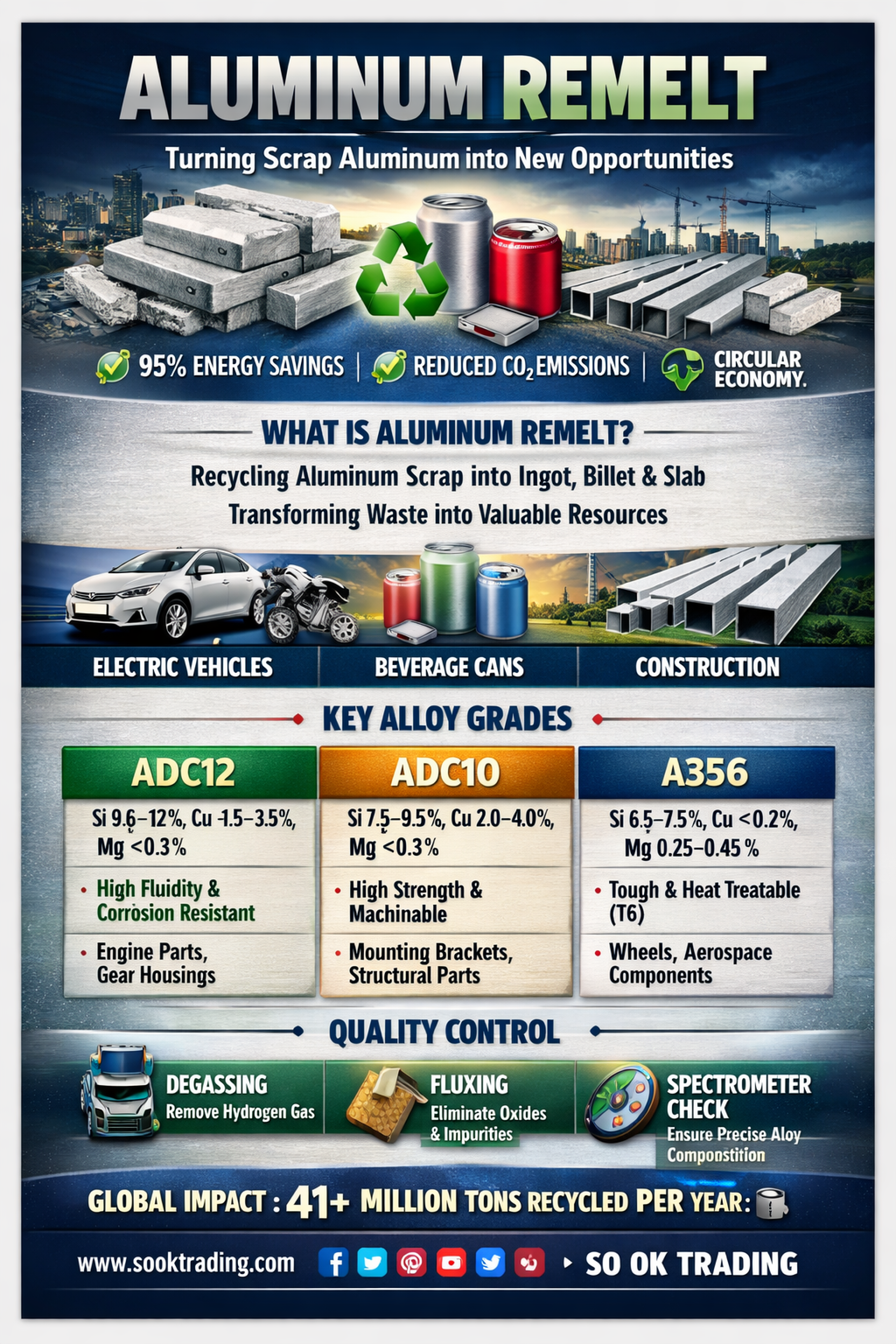
♻️ What is Aluminum Remelt? Aluminum Remelt is the process of taking aluminum scrap from production or end‑of‑life products, re‑melting it, improving its properties, and casting it into ingots, billets, or slabs to be reused by industries. The highlight: it saves up to 95% of energy compared to primary aluminum production, while reducing carbon emissions — directly supporting Circular Economy and Net Zero goals.

 
Main Industrial Applications
Automotive: ADC12 and ADC10 grades are used for high‑pressure die casting of engine covers, gear housings, and structural components. These alloys can be recycled repeatedly, and demand will rise further with the growth of EVs, which rely heavily on aluminum for body frames, wheels, and battery housings.
Packaging: Slabs are rolled into beverage cans, which can be recycled endlessly.
Construction: Billets are extruded into lightweight yet durable building structures — recycled aluminum can be used infinitely in this sector.
 
⚙️ Alloy Specifications
ADC12 (JIS Standard)

Composition: Si 9.6–12.0%, Cu 1.5–3.5%, Mg <0.3%
Properties: Excellent fluidity, corrosion resistance, high mechanical strength
Applications: Engine covers, gear housings, electrical and electronic casings
Highlight: The most versatile and widely used die‑casting grade
ADC10 (JIS Standard)

Composition: Si 7.5–9.5%, Cu 2.0–4.0%, Mg <0.3%
Properties: Higher strength and tensile resistance than ADC12, but slightly less fluidity and corrosion resistance
Applications: Engine mounts, high‑stress components, parts requiring additional machining
Highlight: Ideal for applications needing strength and impact resistance
A356 (ASTM/AA Standard)

Composition: Si 6.5–7.5%, Cu <0.2%, Mg 0.25–0.45%
Properties: High toughness and impact resistance, can be heat‑treated (T6) for enhanced strength
Applications: Alloy wheels, suspension components, aircraft parts, hydraulic pumps
Highlight: Perfect for safety‑critical structural components
 
Quality Enhancement Techniques
Degassing: Removes hydrogen gas to prevent porosity
Fluxing: Eliminates oil residues and oxide films
Spectrometer Check: Ensures precise Si, Cu, Mg ratios to meet alloy standards
 
Global and Thai Market
Global: Over 41 million tons/year of recycled aluminum are used, projected to reach 51 million tons by 2031
Thailand: Annual demand of 3.5–4 million tons, with a market value of USD 8.23 billion. Automotive and packaging lead the way, with aluminum can recycling rates as high as 78%, among the highest in ASEAN.
 
Demand Drivers
CBAM Policies (EU & US): Mandating low‑carbon aluminum in exports
EV Boom: Lightweight yet strong aluminum structures are increasingly essential
 
Conclusion
Aluminum Remelt is not just recycling — it is the creation of new value from scrap metal. It delivers both environmental and economic advantages, giving industries a competitive edge in sustainability and global market access.

SO OK TRADING — Your Business Partner FAST | SHARP | RELIABLE www.sooktrading.com Facebook: SO OK TRADING

Related Content
Aluminum Recycling the Circle and How it work
Aluminium is the most abundant metal in the earth’s crust. Approximately 75% of aluminium ever produced is still in use today as it can be recycled endlessly without compromising any of its unique properties or quality. Aluminium’s lifecycle provides significant benefits through recycling, saving 95% of the energy it would take to make new aluminium metal. More information on recycling may be found here. Recycling aluminium has five steps: Step 1: Collecting Scrap There are two categories of aluminium scrap: New Scrap New Scrap is surplus material that arises during the manufacture and fabrication of aluminium products, up to the point where they are sold to the final consumer. For example, off cuts of aluminium sheet or extrusions are considered new scrap. Sometimes, this new scrap can be safely recycled by aluminium smelters as its composition is known. Old Scrap Old Scrap is material that has been used by the consumer and subsequently discarded. For example, used beverage cans, window frames, electrical cabling and car cylinder heads are all considered old scrap. Aluminium smelters are unable to safely accept this old scrap as its composition is usually unknown and it can be contaminated. Scrap aluminium is also collected from the community – from households, scrap merchants, local and regional authorities, etc. Step 2: Sorting Scrap The scrap is then sorted – grouping all coated (painted or lacquered) aluminium together, and grouping all uncoated aluminium together. Paper, plastic and other non-aluminium recycling needs to be removed. Step 3: Crushing The sorted aluminium is then crushed into bales – by compacting the aluminium scrap, it reduces freight, storage and handling costs Step 4: Remelting Uncoated scrap is loaded directly into a large furnace called a remelter, where it is heated at high temperatures and turned into molten form. If the scrap aluminium is coated, it is processed through a gas fired rotary furnace to remove any coating and then transferred to the remelter. Step 5: Casting The molten aluminium is cast at a temperature of just over 700°C to form ingots
13 Nov 2025
“Global Gold Market – May 2026: Short-Term Pause Before the Next Big Bull Wave” SO OK TRADING : 5 May 2026
“Global Gold Market – May 2026: Short-Term Consolidation Before the Next Big Bull Wave” After reaching record highs in Q1, the global gold market has entered a phase of short-term consolidation, pressured by a stronger U.S. dollar and the Federal Reserve’s high interest rate stance. Yet, the medium- to long-term fundamentals remain robust. Continuous net buying by central banks worldwide and ongoing geopolitical uncertainties make 2026 truly a strategic golden year.
5 May 2026
“2026 Global &amp; Thai Economy Outlook: AI, Clean Energy, and the Rise of Strategic Commodities” Article by SO OK TRADING
2026 is shaping up to be a pivotal year for both the global and Thai economies. The world is being driven by Artificial Intelligence (AI) and Clean Energy, alongside the rise of strategic commodities such as gold, silver, copper, and aluminum. While global growth continues, risks from trade wars and geopolitical tensions remain strong headwinds. Thailand, meanwhile, is still in a transition phase, where attracting more Foreign Direct Investment (FDI) and boosting Research & Development (R&D) are critical to avoid falling behind. In this article, SO OK TRADING explores the 2026 outlook for the global and Thai economies, highlighting new opportunities across rising industries — from digital technology and integrated healthcare to clean energy and niche lifestyle markets that are expanding rapidly. 2026 marks a pivotal transition for the global and Thai economies. Driven by Artificial Intelligence (AI) and Clean Energy, the world is witnessing the rise of strategic commodities — gold, silver, copper, and aluminum. While global growth continues, Thailand remains in transition, seeking FDI and stronger R&D to capture opportunities in medical hub, green manufacturing, and lifestyle markets.
17 Feb 2026
This website uses cookies for best user experience, to find out more you can go to our Privacy Policy and Cookies Policy
Powered By MakeWebEasy Logo MakeWebEasy