Share

“Aluminum Sow vs. Remelt Block: A New Strategy in Recycled Aluminum Transforming Global Industry Toward Circular Economy and a Net Zero Future” SO OK TRADING – 18 May 2026
Last updated: 18 May 2026
99 Views

 Aluminum Sow vs. Remelt Block: Recycling Giants Transforming Global Industry Toward the Net Zero Era SO OK TRADING – 18 May 2026

 
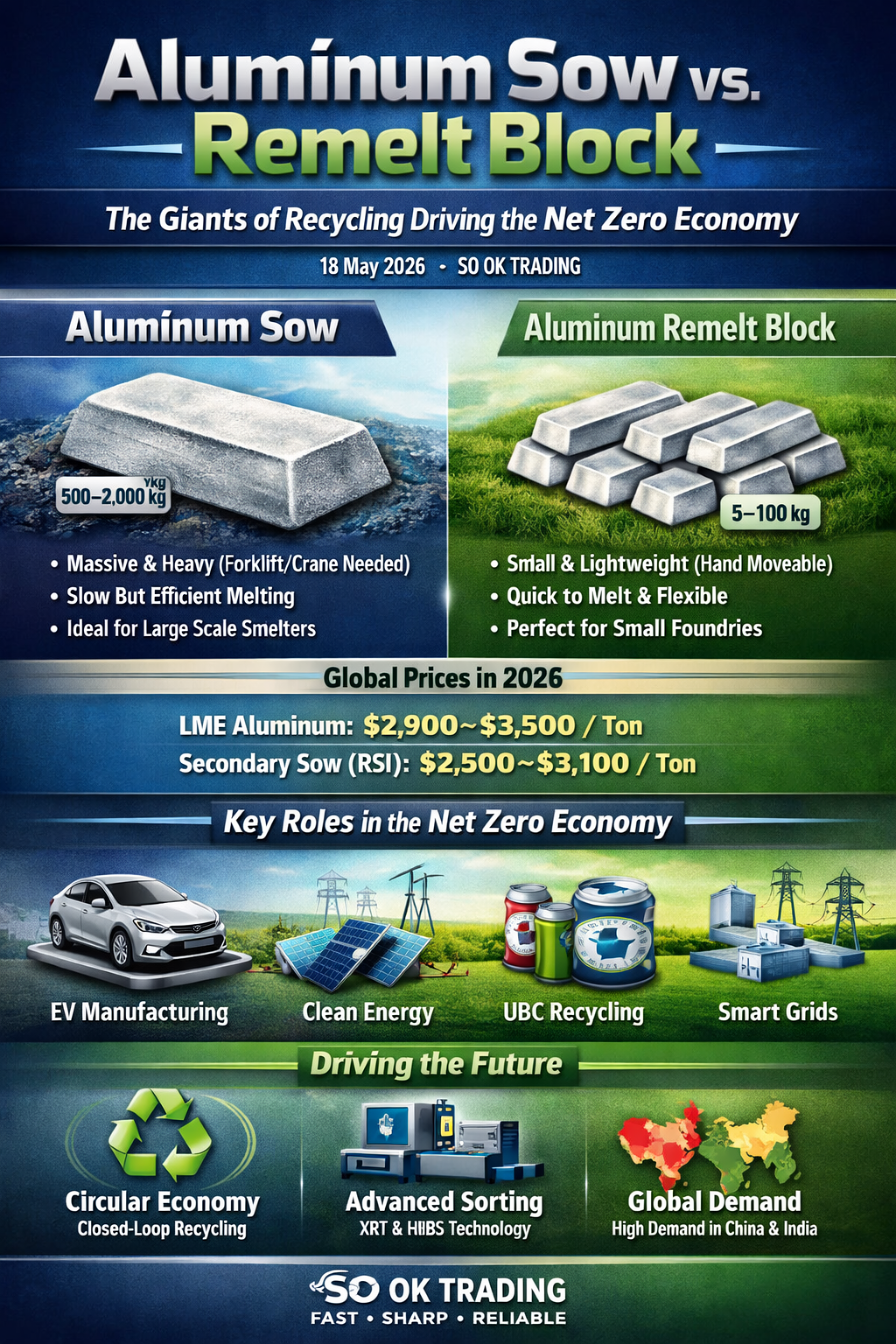
✨ What is Aluminum Sow? Aluminum Sow, or Sow Ingot, is a massive aluminum block weighing between 500–2,000 kilograms. It is produced as a fundamental raw material for industries worldwide, used in electric vehicle components, clean energy cables, and recycled packaging. Its key features are its large size, squat shape, and the ability to be manufactured from both primary aluminum (from ore) and secondary aluminum (from scrap).

 
⚖️ Aluminum Sow vs. Aluminum Remelt Block

Although both are made for “remelting,” their differences lie in size, shape, and usage.

Aluminum Sow: A giant ingot weighing hundreds to thousands of kilograms, requiring heavy machinery such as forklifts or cranes for movement. It is suited for large industrial furnaces (Reverb Furnaces). Melting takes longer and requires strict moisture control to prevent steam explosions. Its strength lies in low unit cost and suitability for bulk transport.
Aluminum Remelt Block/Ingot: Smaller in size, weighing 5–100 kilograms. Easily moved by workers or conveyors, quick to melt due to larger surface area, and highly flexible. Ideal for small to medium foundries, allowing batch feeding into furnaces for precise temperature and alloy adjustments.
In short: Sow is the “giant” for large-scale industries, while Remelt Block is the “compact partner” for general foundries needing flexibility.

 
Global Market Prices (2026)

LME Aluminum: 2,900–3,500 USD/ton
Secondary Sow (RSI): 2,500–3,100 USD/ton Recycled Sow is usually 10–20% cheaper than primary aluminum, but with high-quality scrap, its price can approach LME levels.
 
Role in the Circular Economy Aluminum Sow is becoming a cornerstone of the Circular Economy, reducing energy use by up to 95% compared to primary production, while also helping industries avoid Europe’s carbon border tax (CBAM). Key applications include:

Electric Vehicles (EVs): Casting vehicle structures and battery housings
Clean Energy: Manufacturing cables for smart grids and solar farms
Packaging: Recycling UBC cans into foil and new cans
 
Thailand’s Position Although Thailand does not produce primary aluminum, it is the hub of recycling and mid-to-downstream processing in ASEAN. Domestic secondary smelters purchase scrap aluminum such as UBC cans and old auto parts, remelting them into Sow or Remelt Blocks for export to China, Japan, and India. The EEC (Chonburi–Rayong) region, in particular, is seeing soaring demand for Sow driven by the EV and clean energy boom.

 
Future Outlook

Closed-loop Recycling: Advancing Circular Economy / Green Environment
Advanced Sorting Technologies (XRT, LIBS): Enhancing purity levels
Global Competition: Especially China and India, with massive demand for recycled Sow
 
✨ Conclusion Aluminum Sow is not just a giant ingot — it is a bridge to a green future through the Circular Economy. Remelt Block, as its flexible partner, supports general foundries. Together, they are vital gears driving the world toward a stable Net Zero future.

 
SO OK TRADING: Your trusted business partner FAST • SHARP • RELIABLE Visit us: www.sooktrading.com Contact: sooktrading@outlook.com Facebook: SO OK TRADING

Related Content
Battery to Bullion: Thailand’s Circular Power Play: Lead the Future: Car Batteries & Circular Economy: From Cars to Commodities: The Rise of Lead Recycling
“Car Batteries: From Energy to Business Opportunity” In an era where the world is transitioning to clean energy, car batteries are no longer just about starting engines. They represent the starting point of a circular economy that transforms waste into pure lead, creating golden opportunities for Thai entrepreneurs in 2026–2027. ♻️ Battery Recycling = Lead Bullion Production = Driving a Sustainable Metal Industry
17 Feb 2026
เกร็ดความรู้ การใช้งาน ALUMINUM INGOT (อลูมิเนียม INGOT) P1020 A7
Aluminum Ingot P1020 , A7 อลูมิเนียมเป็นหนึ่งในรูปแบบทั่วไปของโลหะผสมอลูมิเนียมที่ใช้ในอุตสาหกรรมสมัยใหม่ การผสมผสานคุณสมบัติที่เป็นเอกลักษณ์ของอลูมิเนียมทำให้เป็นวัสดุที่มีคุณค่าสำหรับการใช้งานที่หลากหลาย รวมถึงการก่อสร้าง การบินและอวกาศ การขนส่ง และสินค้าอุปโภคบริโภค ในบทความนี้ เราจะพิจารณากระบวนการผลิตแท่งอลูมิเนียมอย่างละเอียดมากยิ่งขึ้น กระบวนการผลิตแท่งอลูมิเนียมเริ่มต้นด้วยการสกัดแร่บอกไซต์ แร่นี้จะถูกบดเป็นผงละเอียดก่อนแล้วจึงผสมกับโซเดียมไฮดรอกไซด์ในกระบวนการที่เรียกว่ากระบวนการไบเออร์ สารละลายที่ได้จะถูกบำบัดด้วยความร้อนและความดันเพื่อสร้างอะลูมิเนียมไฮดรอกไซด์ ซึ่งจะถูกทำให้แห้งเพื่อผลิตผงอะลูมินาจากนั้นนำผงอลูมินามาผสมกับไครโอไลต์ ซึ่งเป็นแร่ธาตุหายากที่ทำหน้าที่เป็นฟลักซ์ ส่วนผสมจะถูกวางในเซลล์อิเล็กโทรไลต์ขนาดใหญ่ที่เต็มไปด้วยเกลือหลอมเหลว และกระแสไฟฟ้าจะถูกส่งผ่านเซลล์ กระบวนการนี้เรียกว่ากระบวนการ Hall-Héroult ทำให้อะลูมิเนียมออกไซด์แยกตัวออกจากออกซิเจน เหลือแต่อโลหะอะลูมิเนียมบริสุทธิ์ จากนั้นโลหะอลูมิเนียมจะถูกเทลงในแม่พิมพ์เพื่อสร้างรูปทรงลิ่ม แม่พิมพ์มักทำจากเหล็กหรือกราไฟต์และมีหลายขนาดและรูปร่าง แท่งอโลหะจะถูกทำให้เย็นและแข็งตัว จากนั้นนำออกจากแม่พิมพ์และตัดตามความยาว (Aluminum Slab) ก่อนที่แท่งอโลหะจะสามารถนำมาใช้ในอุตสาหกรรมได้ จะต้องผ่านกระบวนการต่อไป โดยทั่วไปแล้วจะละลายและหล่อเป็นรูปแบบเฉพาะสำหรับการใช้งานเฉพาะ ซึ่งอาจเกี่ยวข้องกับการผสมอลูมิเนียมกับอโลหะอื่นเพื่อให้ได้คุณสมบัติเฉพาะ เช่น ความแข็งแรง ความทนทานต่อการกัดกร่อน หรือการทนความร้อน แท่งอะลูมิเนียมมีขนาดตั้งแต่ไม่กี่ปอนด์ไปจนถึงหลายตัน ขึ้นอยู่กับการใช้งาน โดยปกติแล้วจะจัดส่งในปริมาณมากไปยังผู้ผลิต ซึ่งจะนำไปแปรรูปเป็นผลิตภัณฑ์ที่หลากหลายต่อไป (Aluminum Ingot, Aluminum Billet, Aluminum Slab) ETC. โดยสรุปแล้ว การผลิตแท่งอะลูมิเนียมเป็นกระบวนการที่ซับซ้อนซึ่งเกี่ยวข้องกับการเปลี่ยนแปลงทางเคมีและกายภาพหลายขั้นตอน จำเป็นต้องมีความเข้าใจอย่างลึกซึ้งเกี่ยวกับวัสดุศาสตร์และหลักการทางวิศวกรรม เช่นเดียวกับแรงงานที่มีทักษะในการใช้งานอุปกรณ์ที่ซับซ้อนที่ใช้ในกระบวนการ แท่งอลูมิเนียมมีบทบาทสำคัญในอุตสาหกรรมสมัยใหม่ และความสามารถรอบด้านและความน่าเชื่อถือทำให้เป็นวัสดุที่ขาดไม่ได้สำหรับการใช้งานที่หลากหลาย ตั้งแต่เครื่องครัว ไปจนถึง เครื่องบิน และ ชิ้นส่วนในยานอวกาศ
28 Nov 2025
Copper Usage and Trend of it use and price
Copper's excellent electrical/thermal conductivity, corrosion resistance, and antimicrobial properties make it vital for electrical wiring, plumbing (pipes, fittings), and electronics; it's also crucial in construction (roofing, gutters), transportation (EVs, radiators), machinery (motors, pumps), and has uses in medicine (hospital surfaces), art, and agriculture (fungicides). Its role is growing with the energy transition (solar, wind, EV infrastructure). Key Applications by Industry Electrical & Electronics: Wires, cables, circuit boards, motors, transformers, switches, connectors (essential for data centers, AI, EVs). Construction: Plumbing (pipes), roofing, gutters, downspouts, architectural details, door handles (due to antimicrobial nature). Transportation: Vehicle wiring, motors, radiators, braking systems, marine hardware (anti-fouling). Industrial Machinery: Heat exchangers, pumps, valves, bearings, industrial piping. Medical: Hospital surfaces, doorknobs, equipment (reduces bacteria). Consumer Goods: Cookware, jewelry, musical instruments, tools, decorative items. Agriculture: Copper sulfate used as fungicide and algaecide. Why Copper is Used High Conductivity: Best for transferring electricity and heat efficiently. Corrosion Resistance: Resists weathering and soil corrosion, ideal for water/plumbing. Malleability & Ductility: Easy to shape and draw into wires. Antimicrobial: Kills microbes, reducing infection spread. Durability & Recyclability: Long-lasting and highly sustainable
21 Dec 2025
This website uses cookies for best user experience, to find out more you can go to our Privacy Policy and Cookies Policy
Powered By MakeWebEasy Logo MakeWebEasy