Share

“Recycling 5.0: The New Business Game — How AI and the Circular Economy Transform Waste into the Strategic Capital of the Future” SO OK TRADING|May 16, 2026

Last updated: 16 May 2026
835 Views

Recycling – From “Waste” to “Strategic Capital” In today’s world racing toward Net Zero and the Circular Economy, recycling is no longer just about protecting the environment. It has become a new global business mandate that every industry must adapt to — both to reduce carbon footprints and to secure future resource stability.

 
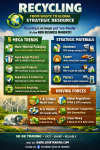
♻️ 5 Recycling Trends Transforming Global Business

Mono-Material Packaging: Single-material packaging simplifies sorting and produces higher-quality recycled plastics.
Food-Grade Plastics: rPET and rHDPE are now widely used in food and beverage packaging after regulatory approval.
Upcycled Premium Products: PET bottles become sportswear; glass and metal waste turn into luxury furniture.
Regulation & Carbon Tax: Mandatory recycled content ratios and carbon footprint accounting reshape supply chains.
Advanced Recycling: Chemical recycling restores complex plastics into pure raw materials, enabling endless reuse.
 
⚡ Metal Recycling: From Scrap Yard to Strategic Industry

Aluminum: The green metal of EVs, saving 95% energy when recycled, enhanced by AI sorting for high purity.
Copper: The heart of clean energy; urban mining from e-waste supplies strategic copper, cutting emissions by 85%.
Lead: Over 90% recycled in closed-loop systems, powering UPS batteries for data centers and solar storage.
Plastics: Global supply chains now mandate recycled content, with chemical recycling delivering virgin-like quality.
 
Driving Forces of the Recycling Economy

Market value soaring to $1.6 trillion.
Global regulations like PPWR and EPR enforce producer responsibility.
AI & robotics achieve 95% precision in waste sorting.
Blockchain transparency prevents greenwashing.
Urban mining supplies critical resources for EVs and data centers.
 
Global Landscape: Opportunities & Contradictions

Worldwide recycling rates average only 19%, despite growth.
Europe leads with strict regulations and rates above 50%.
Asia-Pacific holds 41% of the market, with China and South Korea leading EV battery recycling.
North America invests heavily in polymer centers and advanced technologies.
 
For Business Recycling is the New S-Curve, blending innovation, regulation, and sustainability.

Early adopters gain cost advantages and market access.
Late movers risk carbon taxes and exclusion from supply chains.
Conclusion: Recycling is not just “waste reused” — it is strategic capital that will define the future of global business and trade in the coming decade.

 
SO OK TRADING Your Business Partner FAST • SHARP • RELIABLE www.sooktrading.com Facebook: SO OK TRADING

Related Content
Global Plastic Crisis 2026: Rising Costs as War and Naphtha Shake the Industry
Global Plastic Crisis 2026: How War and Naphtha Shook the Industry Article by SO OK TRADING | April 5, 2026 Plastic — once considered a basic raw material of everyday life — has now become a “scarce commodity” shaking the world in April 2026. The ongoing Middle East conflict and the global naphtha shortage have delivered a heavy blow to the petrochemical industry, driving plastic prices sharply upward and impacting every sector, from food packaging to automotive components. This article explores: The roots of the crisis — from the Hormuz Strait blockade to factory shutdowns in the Middle East The impact on prices and costs — with plastic prices soaring over 37% in just one month The situation in Thailand and worldwide — as industries face severe shortages Adaptation strategies — with governments and businesses racing to implement solutions This is not just about “rising costs” — it is about “shortages” that are reshaping global industry in unprecedented ways. SO OK TRADING Your Trusted Business Partner FAST • SHARP • RELIABLE
5 Apr 2026
“Energy Pulse 2026: Naphtha Recovery – Positive Signals from the Global Energy Crisis Toward a New Market Balance” Article by SO OK TRADING | May 18, 2026
Naphtha Crisis 2026 – Latest Situation Update Positive Outlook | SO OK TRADING Since the outbreak of the Middle East conflict in late February, the global energy market has been shaken dramatically. Crude oil prices surged past $150 per barrel, driving Asian naphtha prices to nearly double. By mid‑May, prices corrected to $897 per ton, though still 62.54% higher than last year. Even as prices begin to ease, supply chain “lag effects” remain — shipping delays of 15–20 days and congested ports due to competition for raw material shipments from the Middle East continue to pressure industries across Asia. In Thailand, SCGC declared force majeure and temporarily shut down the Rayong Olefins plant, while PTTGC and SCGC are studying the establishment of a joint venture to enhance flexibility and reduce long‑term costs. In Japan, leading snack brand Calbee announced a packaging strategy shift, reducing color printing on 14 products to black‑and‑white to cope with ink and resin shortages — reflecting the rising trend of “minimalist design” during the crisis. At the same time, recovery signals are emerging: Naphtha prices dropped from the peak of $1,020 → $897 per ton Spreads rebounded: Ethylene–Naphtha +250–280 / Propylene–Naphtha +310–330 Plastic prices remain high but show signs of stabilization If the Middle East situation does not flare up again, this crisis is expected to ease by late June – early July 2026. SO OK TRADING FAST • SHARP • RELIABLE Your Trusted Business Partner
18 May 2026
This website uses cookies for best user experience, to find out more you can go to our Privacy Policy and Cookies Policy
Powered By MakeWebEasy Logo MakeWebEasy