Share

“Oil Shock 2026: Energy Crossroads on the Global Stage — From War to Diplomacy, Volatile Prices Every Business Must Watch” : SO OK TRADING : 6 MAY 2026
Last updated: 6 May 2026
119 Views

“Global Oil 2026: From War to Diplomacy on the World Stage — Volatile Prices Every Business Must Watch” : SO OK TRADING : 6 MAY 2026

 
Market Overview
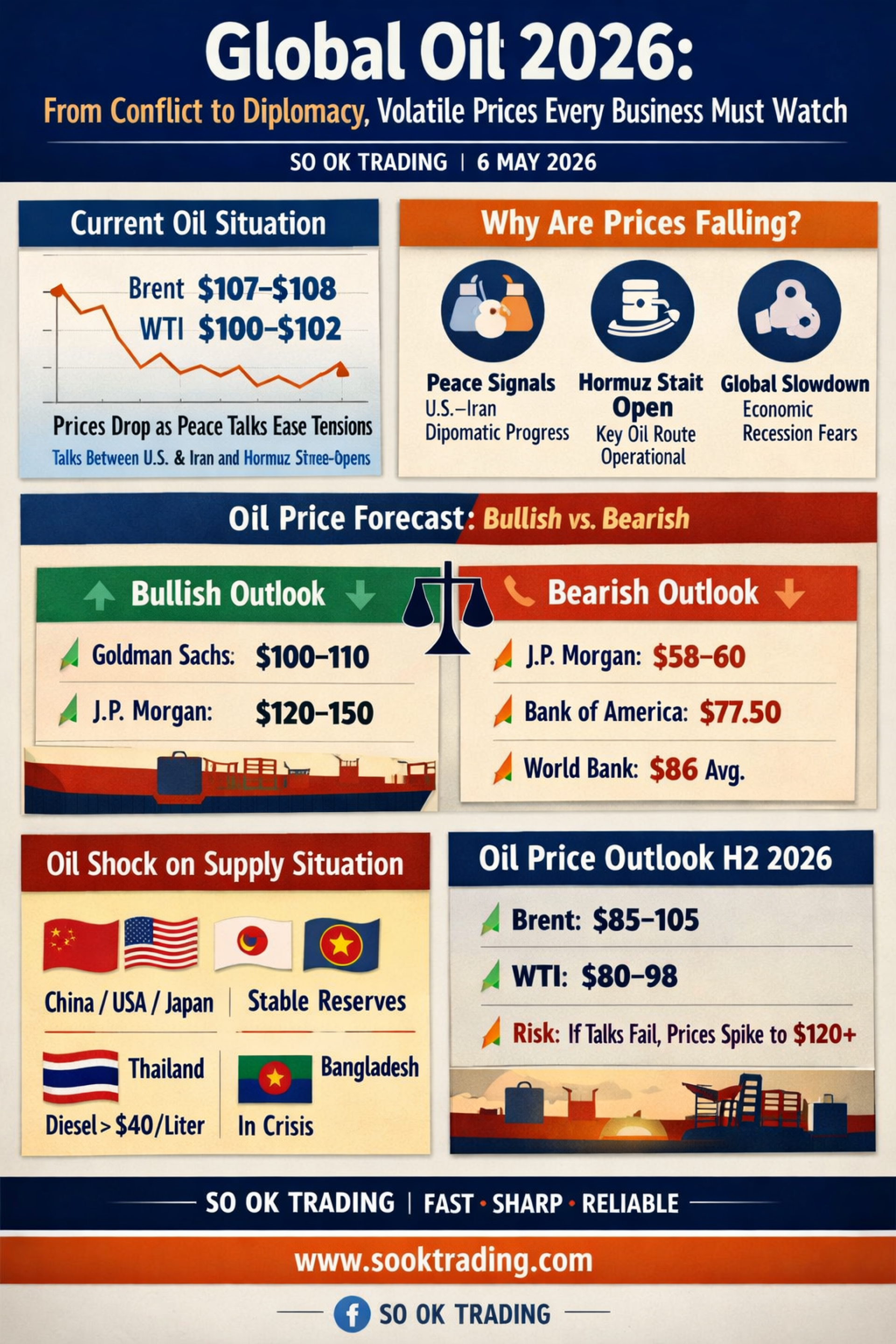
On May 6, 2026, global crude oil prices continued to decline for the second consecutive day after a sharp surge earlier this month. Brent fell to $107–108 per barrel, while WTI dropped to $100–102 per barrel. This adjustment came as supply concerns eased following peace signals between the U.S. and Iran, and the reopening of the Strait of Hormuz, a critical global oil transport route.

 
Factors Behind the Price Drop
Peace Signals from the U.S.: Donald Trump sent positive signals for negotiations and ordered a partial halt to military operations.
Transport Route Reopened: The Strait of Hormuz, previously disrupted, is expected to resume full operations.
Global Economic Slowdown: Recession fears have reduced oil demand.
 
⚖️ Financial Institutions’ Outlook
Bullish (Higher Prices):

Goldman Sachs expects Brent could rebound to $100–110 if conflicts intensify.
J.P. Morgan warns prices could surge to $120–150 if the Strait of Hormuz remains blocked.
Bearish (Lower Prices):

J.P. Morgan projects Brent may average only $58–60 throughout the year.
Bank of America estimates $77.50, with higher prices in the first half and gradual decline later.
World Bank forecasts an annual average of $86.
 
Regional Impacts (OIL SHOCK on Supply Situation)
China, U.S., Japan: Well-prepared with massive reserves and domestic production.
Thailand: Diesel prices remain above 40 THB/liter, requiring government subsidies through the Oil Fund.
Bangladesh: Facing severe crisis, universities ordered to close to reduce energy consumption.
ASEAN: Singapore and Vietnam struggle with inflationary pressure and limited reserves.
 
Price Outlook for H2 2026
Brent: $85–105
WTI: $80–98
If peace talks fail, prices could spike immediately to $120.
If peace progresses, prices may drop below $90.
 
Strategic Insights for Businesses
The global oil market is in a state of “crisis within crisis” with extreme volatility. Energy and transport-related businesses should:

Lock in costs in advance to mitigate risks.
Explore alternative energy sources such as LNG or renewables.
 
SO OK TRADING: Your Trusted Business Partner SO OK TRADING: FAST • SHARP • RELIABLE


Related Content
“RDF/SRF: From Waste to Clean Energy — The Path to Net Zero, Circular Economy, and Business Value Creation” Article by SO OK TRADING : March 22, 2026
Waste is no longer a burden — it is clean energy that creates value! In an era where the world is transitioning to renewable energy and a low-carbon economy, waste-derived fuels (RDF/SRF) are becoming the “golden key” that simultaneously addresses waste management, reduces CO₂ emissions, and generates sustainable electricity.
22 Mar 2026
Aluminum For Packaging How it used and it application
Aluminum is ideal for beverages due to its light weight, strength for carbonation, and excellent barrier properties (blocking light/air) to keep drinks fresh, plus it's infinitely recyclable, requiring much less energy to recycle than to produce new, making it highly sustainable for packaging sodas, beers, juices, and more. Its high recycling rate and ability to form a perfect, airtight seal make it a superior choice for preserving flavor, extending shelf life, and reducing environmental impact. Key Benefits of Aluminum for Beverages: Preserves Freshness: Blocks 100% of light and oxygen, preventing contamination and spoilage, protecting flavor. Sustainable & Recyclable: Infinitely recyclable in a true closed-loop system, using 95% less energy to recycle than to make new aluminum, with high recycled content. Lightweight & Efficient: Easier and cheaper to transport, store, and display, reducing carbon footprints. Durable & Strong: Withstands the pressure of carbonated drinks and resists breakage during transport, unlike glass. Versatile: Used for soda, beer, hard seltzers, energy drinks, juices, and more. Cooling: Has a natural cooling effect, keeping drinks cool with minimal energy. How it Works: Manufacturing: Bauxite ore is refined into pure aluminum, then rolled into thin sheets, stamped into discs, and drawn into the can shape. Lining: An epoxy lacquer or polymer lining is sprayed inside to prevent the aluminum from corroding and imparting a metallic taste. Sealing: A double-seam process creates an airtight, hygienic seal for the lid, locking in freshness. Recycling: Cans can be melted and reformed into new cans in as little as 60 days, making aluminum a circular packaging material.
20 Dec 2025
This website uses cookies for best user experience, to find out more you can go to our Privacy Policy and Cookies Policy
Powered By MakeWebEasy Logo MakeWebEasy