Share

“Renewable Revolution – Transforming Global Energy with Biomass and Solar Power: The Green Choice the World Embraces”
Last updated: 17 Apr 2026
1568 Views

Alternative Energy – Biofuels: The Game-Changer Set to Replace Fossil Fuels and Coal
The world is accelerating into an era of clean energy that is cheaper and growing faster than ever before. This transition is not just about technology—it is about laying a new foundation for global economic development and energy security.

 
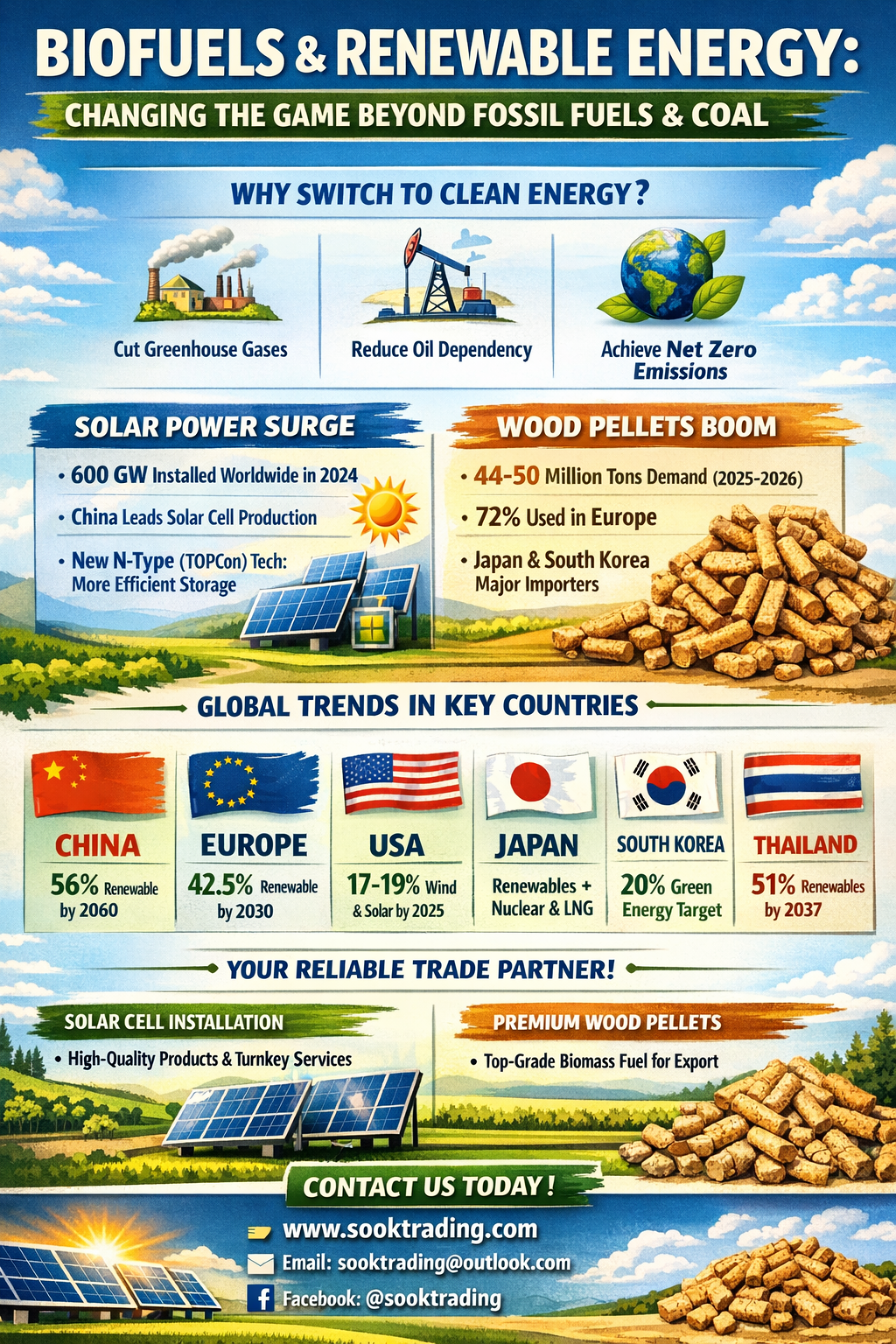
Types of Alternative Energy
Renewable Energy: Solar, wind, hydro, biomass, geothermal
Non-renewable Alternatives: Natural gas, coal, nuclear → Coal may not meet the ZERO EMISSION target
 
Why Alternative Energy Matters
Reduce greenhouse gas emissions → Slow down global warming
Reduce dependence on crude oil → Strengthen energy security
Align with Net Zero Emissions goals
 
Solar Cells: The Rising Star of Solar Power
In 2024, nearly 600 GW of new installations worldwide
China leads both in technology and production of solar cells used globally
New N-type (TOPCon) technology is replacing older models → Next-generation batteries store more energy, and solar panels capture sunlight more efficiently
 
Wood Pellets: Biomass on the Rise
Global demand (2025–2026): 44–50 million tons per year
Europe consumes the most (72% of global demand)
Japan and South Korea import massive volumes to replace coal → Mainly for power plants
Vietnam has risen to become the world’s second-largest exporter
Average price early 2026: $204–221 per ton (approx. 3,100–4,950 THB/ton in Thailand)
 
Alternative Energy Trends in Key Countries
China: Installed over 360 GW of new renewable energy in one year, accounting for 56% of total electricity capacity. Targeting carbon neutrality by 2060.
European Union (EU): Nearly 50% of electricity from renewables. Aiming for 42.5% by 2030 under the REPowerEU plan.
United States: Wind and solar expected to generate 17–19% of electricity in 2025. Growth continues but faces policy and land-use constraints.
Japan: Expanding renewables alongside nuclear and LNG to ensure energy stability.
South Korea: Targeting 20% renewable energy share, cooperating with Japan to secure clean energy.
Thailand: Under PDP 2024, aiming for 51% renewable energy share by 2037. Focus on solar, wind, and biomass, with Direct PPA projects to attract foreign investors.
ASEAN: Targeting 23% of primary energy from renewables by 2025. While short of target, renewables are expected to surpass fossil fuels by 2030.
 
Market Overview
Wood Pellets: Tight market, strong demand
Solar Cells: Competition driven by new technology
The world is entering an era of clean, affordable, and fast-growing energy. Every nation is accelerating its transition to achieve Net Zero.

 
Our Services
If you are interested in installing solar cells at your home or factory, we provide high-quality products with full-service support—from licensing to installation.

If you require or wish to import high-quality wood pellets from Thailand, we also supply premium products ready for export.

Email: sooktrading@outlook.com Website: www.sooktrading.com

 
SO OK TRADING
Your Trusted Business Partner

FAST • SHARP • RELIABLE

Facebook: SOOKTRADING

Related Content
Coconut Shell Charcoal Growing Demand from China and Japan BY SOOK TRADING
Uses of Coconut Shell Charcoal — Based on the Chinese and Japanese Markets Chinese Market According to market data, China is one of the largest importers of coconut shell charcoal. In 2025, import volumes increased significantly, and the average import price rose by more than 75% compared to the previous year. Demand has grown not only from Thailand but also from other major exporters such as Indonesia and Malaysia. Coconut shell charcoal is in very high demand in China, mainly for: - Clean energy industries - Production of Activated Carbon - Water treatment and air purification Japanese Market In Japan, coconut shell charcoal is widely used in both households and industries. It is especially popular in Japanese-style grilling restaurants (Yakiniku, Yakitori, BBQ), which require smokeless charcoal with consistent high heat. Japan also applies coconut shell charcoal in environmental sectors, including: - Biochar production → Contributing to carbon sequestration and reduction of greenhouse gas emissions - Activated Carbon production → Used in water treatment, air purification, and chemical industries Japan places strong emphasis on clean energy and carbon reduction, which drives high demand for high-quality imports from Thailand and Southeast Asia. Contact Information If you are interested in sourcing coconut shell charcoal from Thailand, please contact SOOK TRADING. We supply high-quality export-grade products for both the Chinese and Japanese markets.
8 Jan 2026
“Africa: The Future Resource Treasure — Africa Rising & Copperbelt Awakening, The Turning Point of Global Industry and the New Supply Shift in Mineral Markets”   SO OK TRADING | 5 July 2026
Africa: The Future Resource Treasure LME • NON‑FERROUS • RARE EARTH • PRECIOUS METAL SO OK TRADING | 5 July 2026 Africa — a continent rich in mineral resources and industrial metals, now standing at the center of global demand in the era of clean energy and advanced technology. From copper in the Copperbelt (DRC–Zambia), with the world’s highest ore grades, to cobalt, lithium, and rare earths powering EV batteries and next‑generation energy systems, Africa is becoming the world’s supply frontier. “The Kamoa‑Kakula mine in Congo produced 388,838 tonnes of copper in 2025 — a new high‑quality deposit under global spotlight.” The race among global powers is intensifying — China, the United States, Europe, the Middle East, Russia, and Japan are all investing heavily to secure strategic mineral supply chains across Africa. Yet despite its vast resources, Africa faces critical logistics bottlenecks: copper cathode exports delayed at borders for days, truck shortages, and high security risks. New infrastructure projects — railways and ports in Tanzania, Mozambique, and South Africa — are now being accelerated to unlock smoother trade routes.
5 Jul 2026
“Global Raw Material Crisis: Hormuz Eases, Energy Landscape Transforms — Oil Plunges, Naphtha Softens, Fertilizer Remains Costly”
Global Raw Material Crisis: From Middle East Conflict to the Recovery of Energy and Industrial Markets SO OK TRADING | April 18, 2026 After the tension in the Strait of Hormuz that sent oil and raw material prices soaring, the world is now witnessing clear signs of easing and recovery. Crude oil prices have dropped sharply, naphtha is gradually stabilizing though still costly, and chemical fertilizers remain expensive. Yet the overall direction is a tangible return to balance. ⛽ Oil: Prices fell immediately after Iran reopened the Strait of Hormuz ⚗️ Naphtha: Supply is returning, but full recovery will take time
18 Apr 2026
This website uses cookies for best user experience, to find out more you can go to our Privacy Policy and Cookies Policy
Powered By MakeWebEasy Logo MakeWebEasy