Share

The war is not over The Middle East is ablaze The global economy hangs by a thread — The world awaits the outcome of the second round of talks in Islamabad, coming soon Article by SO OK TRADING 15 April 2026
Last updated: 15 Apr 2026
895 Views

 Middle East Situation Summary: War — USA, Israel, Iran, and the Strait of Hormuz April 15, 2026 BY SO OK TRADING

 
“Fragile Ceasefire • Global Economy on a Tightrope” This article offers a clear, engaging overview of the latest Middle East situation, combining readability with essential insights, along with likely scenarios and global impacts now under close watch.

 
Current Situation
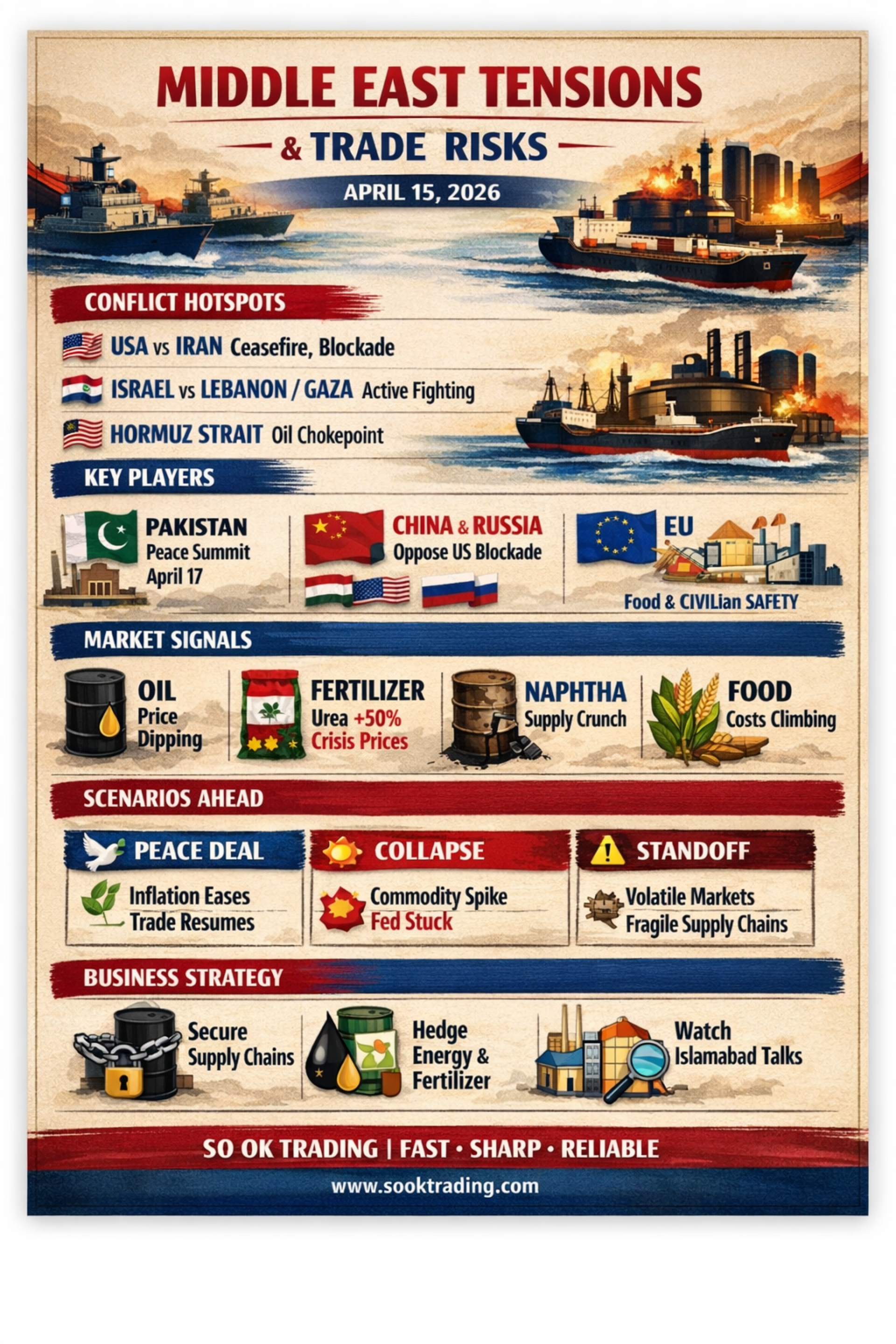
USA–Iran: In a “temporary ceasefire” following the blockade of the Strait of Hormuz and military strikes
Trump declares victory: Emphasizes that the U.S. is “close to ending the war,” though forces remain deployed
Lebanon–Gaza: Fighting continues, keeping the region volatile
New negotiation stage: Pakistan to host the second round of peace talks in two days
 
Roles of Major Powers and Mediators
Pakistan: Key intermediary, organizing ceasefire talks in Islamabad to secure trade routes
China: Proposed a five-point peace plan, pressing the U.S. to lift the blockade
Russia: Fully backs Iran, exercising veto power in the UNSC
EU: Alarmed by soaring energy and food prices, urging civilian protection
 
Global Market Overview (April 14, 2026)
Crude Oil: Brent $103–107, WTI below $96 → Slight decline on ceasefire news
Urea Fertilizer: Surged to $700–719 per ton → Severe crisis as the Middle East supplies over 40% globally
Naphtha: Japan prices spiked to $756 per ton → Extreme supply tightness, requiring imports from the Americas
Agricultural Commodities: Wheat $5.85–6.09, Corn $4.42, Soybeans $11.64 → Costs rising in line with energy and fertilizer
 
Probable Outcomes — Islamabad Round 2 Talks (Expected April 17, 2026)
Successful Negotiation (~50%)

Shipping routes reopen → Oil and fertilizer prices fall
Global inflation eases quickly → Stock markets rebound strongly
U.S. image strengthened as the power broker
Failed Negotiation (~40%)

Energy and fertilizer prices hit new highs
Inflation in the U.S. and globally surges → Fed unable to cut rates
Risk of full-scale war returns
Prolonged but Non-Permanent Ceasefire (~10%)

Global markets highly volatile → Investors cautious
Region remains fragile, ready to flare up anytime
 
Business and Market Impacts
Energy, Raw Materials, Logistics: Costs remain high → Route planning and insurance (WAR CHARGE) essential
Agriculture & Food: Prices still at risk of rising → Businesses should lock in costs early
Investment: Stock markets may rally if talks succeed, but risks remain high if they fail
 
The world now hangs on the outcome of talks in Pakistan.

If successful → Global economy recovers rapidly
If failed → Inflation and full-scale war return, potentially worse than before
 
SO OK TRADING: Your Business Partner

SO OK TRADING: FAST • SHARP • RELIABLE

VISIT US AT: WWW.SOOKTRADING.COM FACEBOOK: SOOKTRADING

Related Content
Steel Industry Outlook 2026: Gradual Recovery with Rising Price Potential BY SOOK TRADING
Steel Industry Outlook 2026: Gradual Recovery with Rising Price Potential The year 2026 marks a turning point for the global steel industry. After hitting its lowest point in 2025, the market is entering a “new equilibrium,” with demand gradually recovering and prices showing signs of stable upward movement. Global steel demand is forecast to grow 1.3%, reaching 1,773 million tons. India will be the main driver, with growth of 9% fueled by infrastructure investments in roads, railways, and energy. The United States and Europe are also expected to recover steadily, supported by interest rate cuts, clean energy projects, and the automotive sector—1.8% growth in the US and 3.2% in the EU. China, while still facing a slowdown in real estate, will see demand decline ease to -1%, supported by infrastructure projects and steel exports. Meanwhile, Southeast Asia and the Middle East are expected to contribute to diversified demand growth through infrastructure and energy investments. On the pricing side, steel bars (Rebar) are expected to average 16,000–17,000 THB/ton (450–530 USD/MT). Iron ore costs are projected at 83–95 USD/ton, with new supply from Guinea and Australia helping to stabilize input costs. Although trade barriers in the US and EU may keep domestic prices above global levels, the market is moving toward a more stable balance. In Thailand, steel demand is expected to grow modestly, driven by construction and automotive industries, with a base of 16.2 million tons in 2025. However, cheap Chinese steel could account for up to 50% of the market, putting pressure on local producers. Thai businesses must adapt by developing value-added specialty products, enhancing quality standards, and targeting premium and niche export markets such as ASEAN, the Middle East, and Africa. SO OK Trading: Partnering Thai Steel with Global Markets SO OK Trading supports Thai steel producers with comprehensive solutions: - Market Connectivity: Linking Thai producers with buyers in China and East Asia through an extensive partner network and integrated rail–sea–road logistics. - Market Analysis & Pricing Strategy: Providing insights into steel and iron ore price trends, with index-linked pricing recommendations to reduce volatility. - Stable Contracts & Compliance: Assisting in contract structuring, export documentation, standards, and certifications to ensure reliable trade. - Customer Development: Delivering tailored technical and commercial proposals to meet the needs of Chinese buyers seeking specialty steel. SO OK Trading is more than an exporter—it is a trusted business partner, helping Thai steel enterprises compete with stability and sustainability in the global steel market.
15 Jan 2026
This website uses cookies for best user experience, to find out more you can go to our Privacy Policy and Cookies Policy
Powered By MakeWebEasy Logo MakeWebEasy