Share

“Double Crisis: Oil, Fertilizer, Plastics and the Future of the Global Economy — Strait of Hormuz, When the World’s Lifeline Trembles as Islamabad Peace Talks Collapse”
Last updated: 13 Apr 2026
117 Views

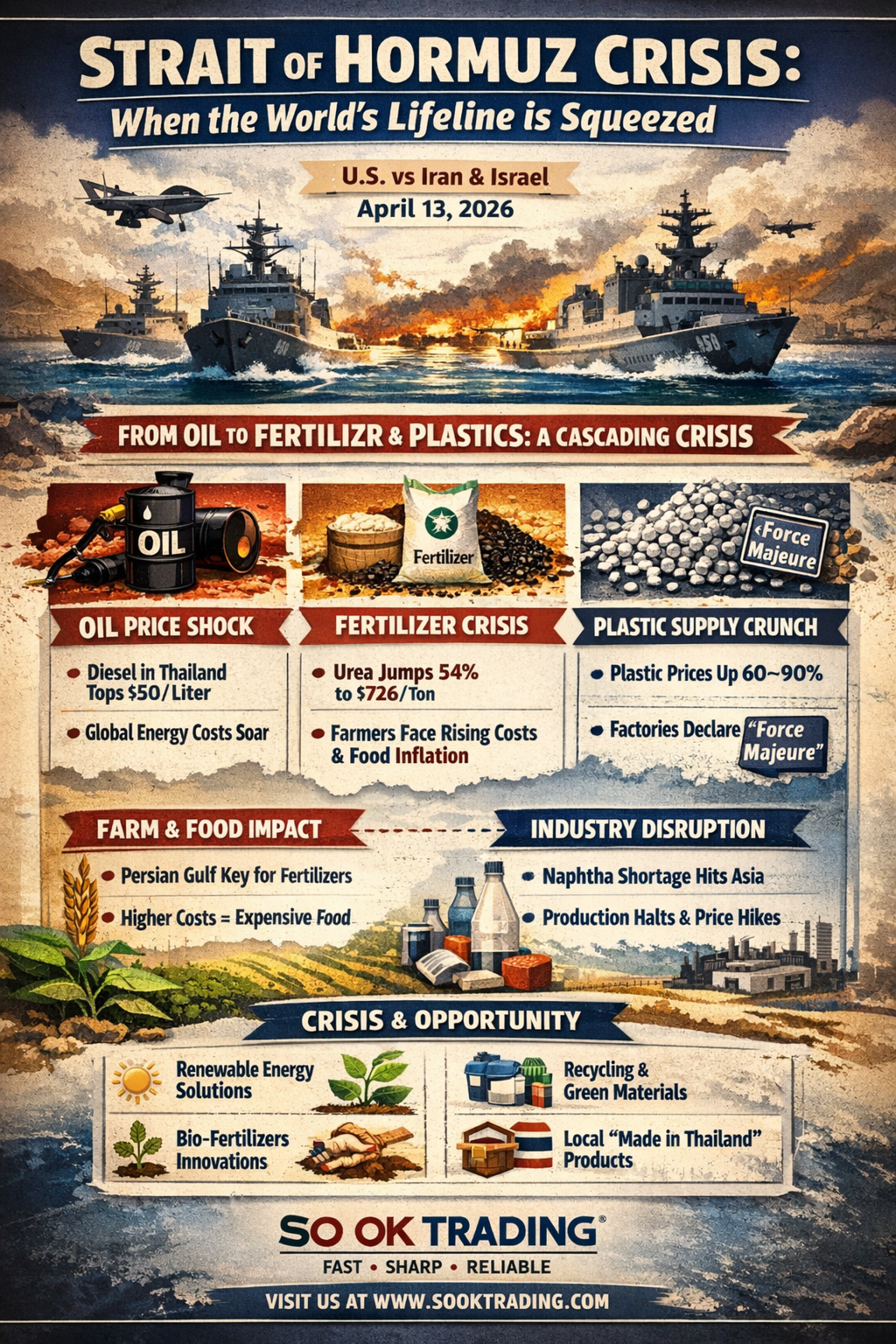
April 13, 2026: Strait of Hormuz — When the World’s Lifeline is Squeezed
The conflict between the United States, Israel, and Iran remains unresolved, and the peace talks in Islamabad have collapsed.

 
Latest Developments (April 13, 2026)
U.S. Full Naval Blockade: CENTCOM deploys warships and drones to control all vessels entering or leaving Iran.
Iran’s Strong Warning: IRGC declares that any intruding warship will be attacked immediately.
800+ Oil Tankers Stranded: Global trade grinds to a halt.
Brent Crude Surges: Prices jump to $100–$120 per barrel in a single day.
Underwater Mines Detected: Heightened risk of direct military confrontation.
The Strait of Hormuz is not just an oil passage — it is the “artery of global industry.” When squeezed, the entire world trembles.

 
Ripple Effects Across the Globe
⛽ Oil Shock
Diesel prices in Thailand are expected to surpass 50 THB/L.
Electricity costs rise as imported energy becomes more expensive.
Fertilizer Crisis
Urea prices surge 54% to $726/ton.
Thailand imports nearly all of its fertilizer → farmers face soaring costs, reduced yields, and food inflation.
Naphtha Crisis
Naphtha is the key feedstock for plastics.
PE/PP prices in Thailand spike 60–90% within two weeks.
Multiple factories across Asia declare Force Majeure due to raw material shortages.
 
Impact on Thailand
Diesel prices near 50 THB/L.
Electricity bills rise.
Farmers struggle with fertilizer costs, industries face raw material shortages, and consumers bear higher living expenses.
 
Marketing Perspective: Crisis as Opportunity
Energy Sector: Investment in renewables such as solar and biomass.
Agriculture: Bio-fertilizers and sustainable farming practices gain traction.
Plastics Industry: Recycling and alternative materials become new selling points.
Consumer Market: Rising costs create space for “Made in Thailand” products using local resources.
 
✨ Conclusion
The Strait of Hormuz crisis is not just about “expensive oil” — it is the disruption of global supply chains, from energy to fertilizer to plastics. Every business must adapt quickly, and within every challenge lies an opportunity for those ready to innovate.

 
SO OK TRADING Your trusted business partner in every global challenge FAST • SHARP • RELIABLE VISIT US AT WWW.SOOKTRADING.COM

Related Content
Experience the King of Fruits – Premium Thai Durian from SO OK TRADING Sweet and creamy flavor, guaranteed ripeness, direct from farm to your hands worldwide.
Experience the luxury of the “King of Fruits” that captivates the global market! SO OK TRADING proudly presents Premium Thai Durian – sweet and creamy flavor, silky smooth texture, guaranteed ripeness, delivered fresh from the farm to your hands within 48 hours.
23 Jan 2026
ถ่านกะลามะพร้าวคืออะไร ทำไมทางจีนนำเข้าเยอะ ใช้เยอะ By SO OK TRADING
Coconut charcoal is a sustainable, eco-friendly fuel made from carbonized coconut shells, prized for grilling, shisha, and water filtration due to its high heat, long burn time, low ash, and minimal smoke compared to wood charcoal. It's produced by heating shells in an oxygen-deprived environment (pyrolysis) and is compressed into briquettes or used as activated carbon, offering benefits like using agricultural waste and aiding detoxification. Production Source: Discarded coconut shells, a byproduct of the coconut industry. Process (Pyrolysis): Shells are heated to high temperatures (300-500°C) in a limited-oxygen kiln, turning them into charcoal. Forms: Can be crushed and formed into briquettes (cubes/discs) or processed further into activated carbon. Key Benefits & Uses Sustainability: Uses waste, prevents deforestation, renewable. Performance: Burns hotter, longer, cleaner, with less smoke and ash. Versatile Uses: Cooking: BBQ, shisha/hookah. Filtration: Water purification, air deodorization (activated carbon). Health/Beauty: Detoxification (activated charcoal). Agriculture: Ash can be used as fertilizer. Advantages Over Wood Charcoal Longer Burn: A smaller amount goes further. Higher Heat: More efficient for grilling. Eco-Friendly: Doesn't harm trees. Clean Burning: Less smoke and odor.
23 Dec 2025
The Future of Biofuels and Biomass Energy — Pathways to Replace Coal (Article by SO OK TRADING)
BIOFUELS & BIOMASS: CLEAN ENERGY FOR CARBON CREDIT & CBM By SO OK TRADING As the world accelerates toward Net Zero, biofuels and biomass are no longer just alternatives — they’re becoming the new standard. From SAF in East Asia to RDF in ASEAN, clean energy is reshaping global trade, carbon strategies, and industrial fuel choices. This infographic breaks down: ✅ Global market growth (USD 257.61B by 2034) ✅ Regional trends across USA, EU, and Asia ✅ East Asia’s SAF & marine fuel revolution ✅ Biomass fuel comparison: Wood Pellets, Chips, RDF ✅ Market prices & business opportunities for producers Whether you're exporting premium pellets, supplying local chips, or scaling RDF for heavy industry — the future is green, and the momentum is real.
28 Feb 2026
This website uses cookies for best user experience, to find out more you can go to our Privacy Policy and Cookies Policy
Powered By MakeWebEasy Logo MakeWebEasy