Share

“Lead Bullion: Powering Batteries, Forging the Green Energy Future — An Article by SO OK TRADING, April 7, 2026”
Last updated: 7 Apr 2026
67 Views

Lead Bullion & Battery Market: The Metal Power Driving the New Energy World
 
What is Lead Bullion?
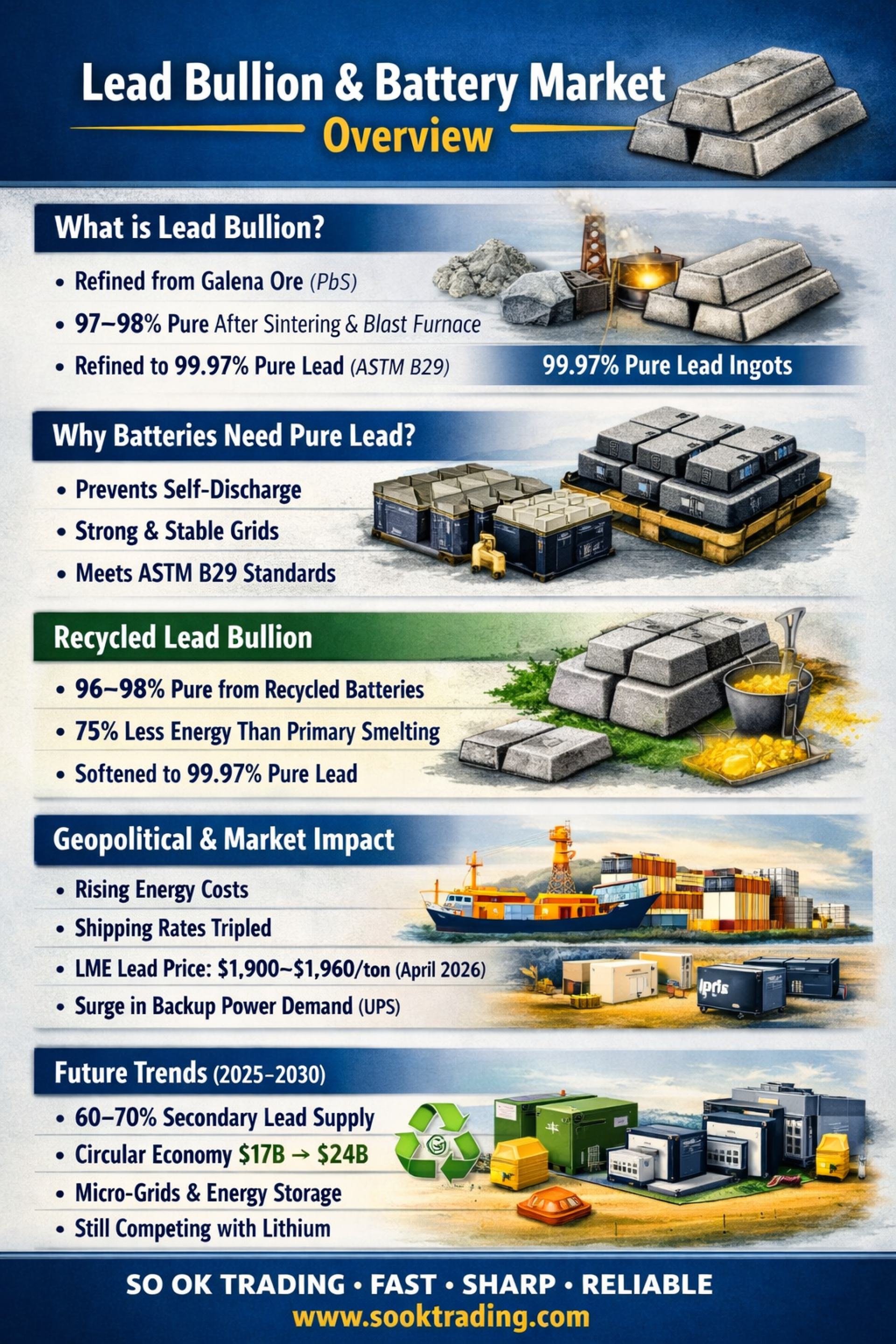
Lead Bullion (crude lead) is produced from Galena ore (PbS) through sintering and blast furnace smelting, with purity around 97–98%. However, it still contains impurities such as silver, copper, antimony, tin, and arsenic. Therefore, it must undergo refining to reach 99.97% pure lead under ASTM B29 standards, before being used in the battery industry.

“Lead Bullion is often cast into large ingots (Ingots or Pigs) for easy transport to refineries.”
 
⚡ Why Do Batteries Require Pure Lead?
Impurities accelerate degradation: Copper or iron cause rapid self-discharge.
Grid strength: Refined lead is often alloyed with antimony or calcium to ensure strong and stable battery grids.
Strict standards: ASTM B29 strictly limits impurities such as antimony, arsenic, and nickel.
 
♻️ Lead Bullion from Battery Recycling
Purity 96–98%, but with high antimony content (1.5–4%).
Softening process: Removes antimony, arsenic, and tin to achieve 99.97% soft lead.
Advantages: Uses 75% less energy compared to primary smelting.
Caution: Poor separation may leave high levels of bismuth, which is difficult to remove and affects battery quality.
 
Geopolitical Factors & Middle East Conflict Impact
Energy prices surge: Refining costs rise immediately.
Freight rates soar: Shipping costs increased 2–3 times after the Strait of Hormuz crisis.
Global market (April 2026): LME lead price at USD 1,900–1,950/ton, with inventories up to 281,000 tons.
Impact on Thailand: Lead prices fell, but electricity and shipping costs rose by 47%.
Opportunity in crisis: UPS battery demand surged in hospitals, data centers, and communication systems.
 
Future Outlook (2025–2030)
Secondary lead dominates: Expected to account for 60–70% of global demand.
Circular economy growth: Lead-acid battery recycling market projected to grow from USD 17B to USD 24B.
Competition with lithium: EVs rely on lithium, but starter batteries and UPS remain lead-based.
Micro-Grid & ESS: Developing countries favor lead batteries for affordability and easy maintenance.
ESG & clean technology: Smelters must adopt emission-reduction technologies, such as hydrogen instead of coke.
 
Lead Bullion Summary
Lead prices down, but energy and shipping costs up → Thai manufacturers must manage costs carefully.
Golden opportunity in UPS market → Geopolitical instability drives demand for lead-acid batteries.
Future is recycling → Closed-loop systems will be the key strategy for sustainable battery production.
Recycled Lead = 75% Cost Savings + ESG Compliance + Circular Economy Solutions

 
SO OK TRADING — FAST • SHARP • RELIABLE We are your trusted business partner, delivering high-quality Lead Bullion and Lead Ingots that meet international standards, supporting the battery industry and renewable energy sectors.

Visit us at: www.sooktrading.com Contact us directly: sooktrading@outlook.com


Related Content
“Thai Natural Rubber: The Soft Power Driving the World – A Strategic Commodity of the New Century in the EV and BCG Era. Thai Rubber: The Essential Resource Demanded by Global Industries” Article by SO OK TRADING | March 26, 2026
“Thai Natural Rubber: From Plantations to Global Strategic Commodity” Published: March 28, 2026 Thailand is not just a rubber producer—it is the world’s leading exporter, holding over 30% of global natural rubber exports. Thai rubber has become the backbone of industries worldwide, from automotive and medical to construction. This article explores Thailand’s strengths and the future direction of the rubber industry in the EV era and the Bio-Circular-Green (BCG) economy.
28 Mar 2026
เกร็ดความรู้ การใช้งาน ALUMINUM INGOT (อลูมิเนียม INGOT) P1020 A7
Aluminum Ingot P1020 , A7 อลูมิเนียมเป็นหนึ่งในรูปแบบทั่วไปของโลหะผสมอลูมิเนียมที่ใช้ในอุตสาหกรรมสมัยใหม่ การผสมผสานคุณสมบัติที่เป็นเอกลักษณ์ของอลูมิเนียมทำให้เป็นวัสดุที่มีคุณค่าสำหรับการใช้งานที่หลากหลาย รวมถึงการก่อสร้าง การบินและอวกาศ การขนส่ง และสินค้าอุปโภคบริโภค ในบทความนี้ เราจะพิจารณากระบวนการผลิตแท่งอลูมิเนียมอย่างละเอียดมากยิ่งขึ้น กระบวนการผลิตแท่งอลูมิเนียมเริ่มต้นด้วยการสกัดแร่บอกไซต์ แร่นี้จะถูกบดเป็นผงละเอียดก่อนแล้วจึงผสมกับโซเดียมไฮดรอกไซด์ในกระบวนการที่เรียกว่ากระบวนการไบเออร์ สารละลายที่ได้จะถูกบำบัดด้วยความร้อนและความดันเพื่อสร้างอะลูมิเนียมไฮดรอกไซด์ ซึ่งจะถูกทำให้แห้งเพื่อผลิตผงอะลูมินาจากนั้นนำผงอลูมินามาผสมกับไครโอไลต์ ซึ่งเป็นแร่ธาตุหายากที่ทำหน้าที่เป็นฟลักซ์ ส่วนผสมจะถูกวางในเซลล์อิเล็กโทรไลต์ขนาดใหญ่ที่เต็มไปด้วยเกลือหลอมเหลว และกระแสไฟฟ้าจะถูกส่งผ่านเซลล์ กระบวนการนี้เรียกว่ากระบวนการ Hall-Héroult ทำให้อะลูมิเนียมออกไซด์แยกตัวออกจากออกซิเจน เหลือแต่อโลหะอะลูมิเนียมบริสุทธิ์ จากนั้นโลหะอลูมิเนียมจะถูกเทลงในแม่พิมพ์เพื่อสร้างรูปทรงลิ่ม แม่พิมพ์มักทำจากเหล็กหรือกราไฟต์และมีหลายขนาดและรูปร่าง แท่งอโลหะจะถูกทำให้เย็นและแข็งตัว จากนั้นนำออกจากแม่พิมพ์และตัดตามความยาว (Aluminum Slab) ก่อนที่แท่งอโลหะจะสามารถนำมาใช้ในอุตสาหกรรมได้ จะต้องผ่านกระบวนการต่อไป โดยทั่วไปแล้วจะละลายและหล่อเป็นรูปแบบเฉพาะสำหรับการใช้งานเฉพาะ ซึ่งอาจเกี่ยวข้องกับการผสมอลูมิเนียมกับอโลหะอื่นเพื่อให้ได้คุณสมบัติเฉพาะ เช่น ความแข็งแรง ความทนทานต่อการกัดกร่อน หรือการทนความร้อน แท่งอะลูมิเนียมมีขนาดตั้งแต่ไม่กี่ปอนด์ไปจนถึงหลายตัน ขึ้นอยู่กับการใช้งาน โดยปกติแล้วจะจัดส่งในปริมาณมากไปยังผู้ผลิต ซึ่งจะนำไปแปรรูปเป็นผลิตภัณฑ์ที่หลากหลายต่อไป (Aluminum Ingot, Aluminum Billet, Aluminum Slab) ETC. โดยสรุปแล้ว การผลิตแท่งอะลูมิเนียมเป็นกระบวนการที่ซับซ้อนซึ่งเกี่ยวข้องกับการเปลี่ยนแปลงทางเคมีและกายภาพหลายขั้นตอน จำเป็นต้องมีความเข้าใจอย่างลึกซึ้งเกี่ยวกับวัสดุศาสตร์และหลักการทางวิศวกรรม เช่นเดียวกับแรงงานที่มีทักษะในการใช้งานอุปกรณ์ที่ซับซ้อนที่ใช้ในกระบวนการ แท่งอลูมิเนียมมีบทบาทสำคัญในอุตสาหกรรมสมัยใหม่ และความสามารถรอบด้านและความน่าเชื่อถือทำให้เป็นวัสดุที่ขาดไม่ได้สำหรับการใช้งานที่หลากหลาย ตั้งแต่เครื่องครัว ไปจนถึง เครื่องบิน และ ชิ้นส่วนในยานอวกาศ
28 Nov 2025
This website uses cookies for best user experience, to find out more you can go to our Privacy Policy and Cookies Policy
Powered By MakeWebEasy Logo MakeWebEasy