Share

“Thai Baht Volatility – Late May 2026: Stronger Dollar, Falling Gold, and Global Focus on the Fed. Importers urged to hedge risks quickly, while exporters eye selling USD near 33 Baht.”
Last updated: 19 May 2026
1067 Views

Thai Baht Volatility – Late May 2026: Exchange Rates, A Business Reality
Article by SO OK TRADING | 19 MAY 2026

 
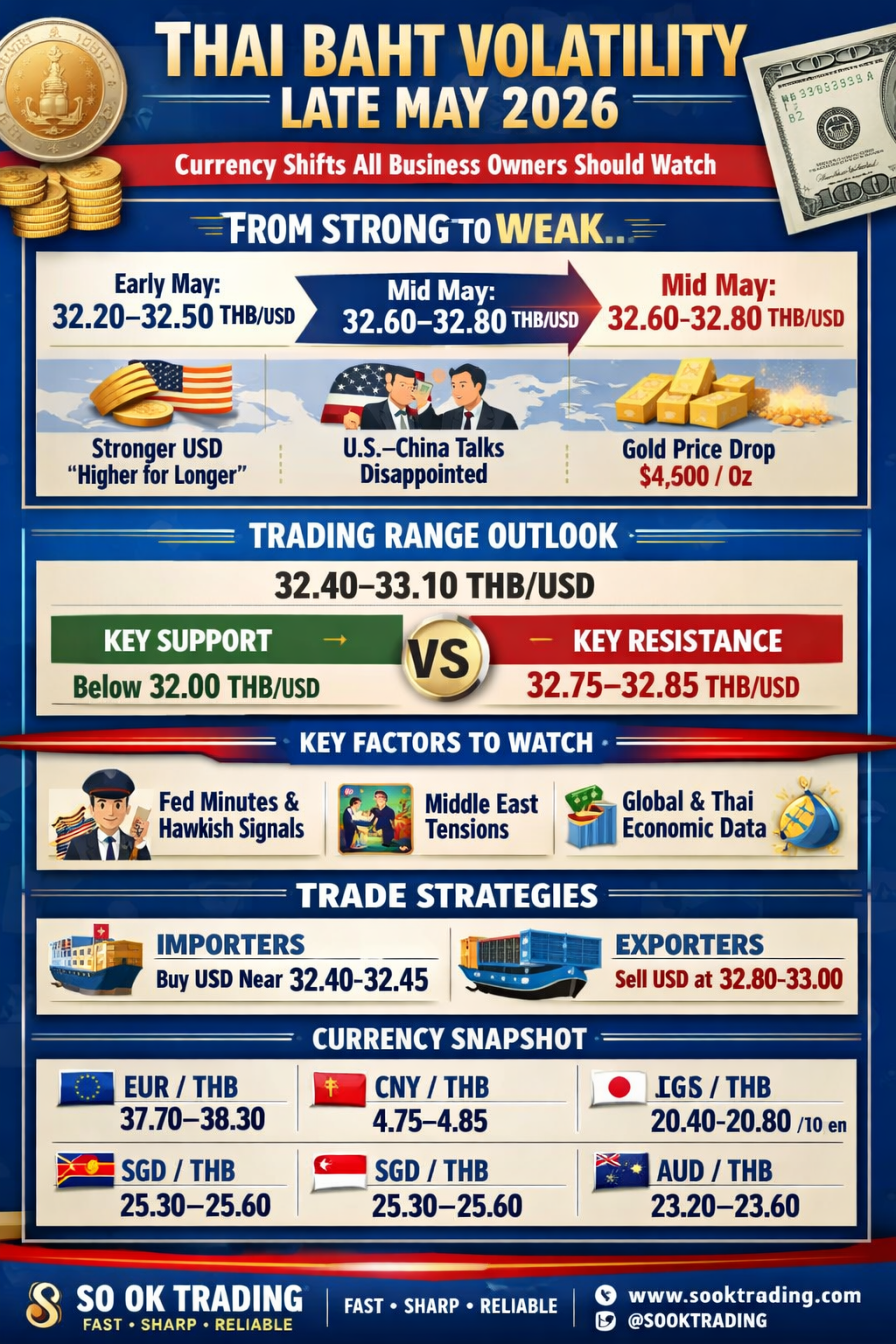
From Strength to Pressure and Weakness At the beginning of May, the Thai Baht held firm around 32.20–32.50 THB/USD, as markets expected the Fed to cut interest rates. However, by mid-month, the Baht weakened to 32.60–32.80 THB/USD, pressured by three key factors:

Stronger US Dollar – Markets reduced expectations of Fed rate cuts this year (“Higher for longer”).
US–China Talks Disappointed – The Yuan weakened, dragging the Baht down in tandem.
Gold Price Drop – Gold fell to 4,500 USD/oz, increasing demand for USD in Thailand to settle gold transactions.
 
Trading Range & Technical Outlook (Mid–Late May)

Trading Range: 32.40 – 33.10 THB/USD
Key Support: Below 32.00 THB/USD → trend may shift back to appreciation
Key Resistance: 32.75 – 32.85 THB/USD → zone of slowed depreciation
 
Key Drivers for Late May (Baht & US Dollar)

Fed Minutes & Officials’ Signals: Hawkish tone would strengthen USD and pressure the Baht further.
Middle East Negotiations: Positive developments could reduce safe-haven demand for USD, slowing Baht depreciation.
Thai Economy & Global PMI Data: Clear signs of Thai recovery may attract fund flows into long-term bonds, supporting the Baht.
 
Advice for Importers & Exporters

Importers: Buy USD when Baht strengthens near 32.40–32.45 to hedge risks.
Exporters: Sell USD in the resistance zone 32.80–33.00 for favorable exchange rates.
 
Regional Currency Overview (Late May 2026)

EUR/THB: Stable, 37.70–38.30
CNY/THB: Narrow range, 4.75–4.85
JPY/THB: Yen weakens sharply, Baht stronger → 20.40–20.80 per 100 Yen
SGD/THB: Slight appreciation, 25.30–25.60
AUD/THB: Sideways, 23.20–23.60
 
Summary The Thai Baht in May 2026 reflects a global picture of stronger USD, weaker gold, and geopolitical uncertainty. Importers and exporters must adopt smart hedging strategies to navigate persistent two-way risks throughout the month.

 
⚡ SO OK TRADING FAST • SHARP • RELIABLE www.sooktrading.com Facebook: SO OK TRADING

Related Content
“Global Metals 2026: Antimony Surges, Tin Heats Up, Zinc Recovers, Silicon Steadies, Lead Holds Firm — Five Metals Reshaping the Future of Industry. Are You Ready?”
Global Metals 2026: The Supply Game Reshaping Industry’s Future ZINC ANTIMONY SILICON TIN LEAD The essential metals driving batteries, galvanized steel, die casting, tin coating, and clean energy industries.
31 Mar 2026
“Global Energy Crisis 2026: Strait of Hormuz at Boiling Point – The Supply Shock the World Is Watching” Scenario Analysis By SO OK TRADING
“Global Energy Crisis: When the Strait of Hormuz Is Blocked” In March 2026, Iran announced the closure of the Strait of Hormuz, a strategic passage that carries more than 30% of the world’s crude oil. The move sent oil prices soaring, accelerated inflation, and shook the global economy.
7 Mar 2026
Steel Industry Outlook 2026: Gradual Recovery with Rising Price Potential BY SOOK TRADING
Steel Industry Outlook 2026: Gradual Recovery with Rising Price Potential The year 2026 marks a turning point for the global steel industry. After hitting its lowest point in 2025, the market is entering a “new equilibrium,” with demand gradually recovering and prices showing signs of stable upward movement. Global steel demand is forecast to grow 1.3%, reaching 1,773 million tons. India will be the main driver, with growth of 9% fueled by infrastructure investments in roads, railways, and energy. The United States and Europe are also expected to recover steadily, supported by interest rate cuts, clean energy projects, and the automotive sector—1.8% growth in the US and 3.2% in the EU. China, while still facing a slowdown in real estate, will see demand decline ease to -1%, supported by infrastructure projects and steel exports. Meanwhile, Southeast Asia and the Middle East are expected to contribute to diversified demand growth through infrastructure and energy investments. On the pricing side, steel bars (Rebar) are expected to average 16,000–17,000 THB/ton (450–530 USD/MT). Iron ore costs are projected at 83–95 USD/ton, with new supply from Guinea and Australia helping to stabilize input costs. Although trade barriers in the US and EU may keep domestic prices above global levels, the market is moving toward a more stable balance. In Thailand, steel demand is expected to grow modestly, driven by construction and automotive industries, with a base of 16.2 million tons in 2025. However, cheap Chinese steel could account for up to 50% of the market, putting pressure on local producers. Thai businesses must adapt by developing value-added specialty products, enhancing quality standards, and targeting premium and niche export markets such as ASEAN, the Middle East, and Africa. SO OK Trading: Partnering Thai Steel with Global Markets SO OK Trading supports Thai steel producers with comprehensive solutions: - Market Connectivity: Linking Thai producers with buyers in China and East Asia through an extensive partner network and integrated rail–sea–road logistics. - Market Analysis & Pricing Strategy: Providing insights into steel and iron ore price trends, with index-linked pricing recommendations to reduce volatility. - Stable Contracts & Compliance: Assisting in contract structuring, export documentation, standards, and certifications to ensure reliable trade. - Customer Development: Delivering tailored technical and commercial proposals to meet the needs of Chinese buyers seeking specialty steel. SO OK Trading is more than an exporter—it is a trusted business partner, helping Thai steel enterprises compete with stability and sustainability in the global steel market.
15 Jan 2026
This website uses cookies for best user experience, to find out more you can go to our Privacy Policy and Cookies Policy
Powered By MakeWebEasy Logo MakeWebEasy