Share

“Global Sugar Industry 2024/25: From Sweetness to ‘Oil on Land’ — Transforming into Aviation Fuel and Bio-Economy in the Net Zero Era”
Last updated: 24 Mar 2026
158 Views

 Global Sugar Industry 2024/25: From Sweetness to Future Energy

Article by SO OK TRADING March 24, 2026

The sugar industry is undergoing a major transformation. Once seen merely as a flavoring ingredient for food and beverages, sugar is now evolving into a biofuel and a green raw material directly tied to the world’s Net Zero ambitions.


Global Sugar Market Overview

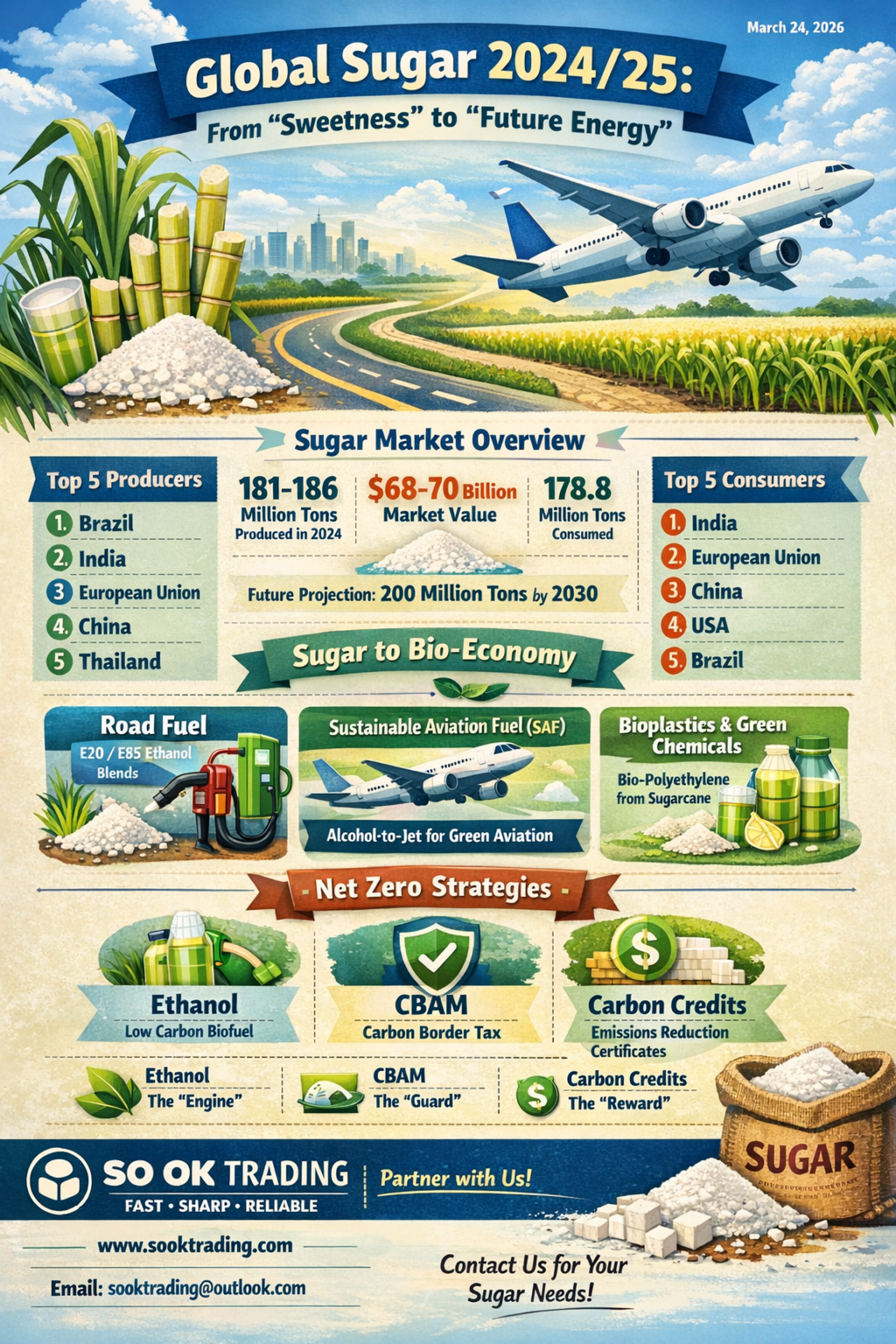
Production (2024): 181–186 million tons
Market Value: USD 68–70 billion
Consumption: 178.8 million tons (driven by food, beverage, and bakery industries)
Average Prices: Raw sugar USD 448.6/ton; White sugar USD 577.8/ton
Projection: Output expected to reach 200 million tons by 2030
 

Top 5 Sugar Producers (as of end-2025)

Brazil — 44–47 million tons annually; world’s largest exporter with flexibility to switch between sugar and ethanol.
India — 33–35 million tons; second-largest producer, with exports restricted to stabilize domestic prices.
European Union (EU) — 16 million tons; beet-based production facing environmental regulation challenges.
China — 11 million tons; insufficient for domestic demand, heavily reliant on imports from Brazil and Thailand.
Thailand — 10–14 million tons; fifth-largest producer but second–third largest exporter globally, especially in raw sugar.
 

Top 5 Sugar Consumers (as of end-2025)

India — 28–32 million tons; largest consumer due to population size and sweet-based culture.
European Union (EU) — 16–17 million tons; strong demand in food and bakery industries, though health trends are reducing sugar intake.
China — 15–16 million tons; major net importer as consumption outpaces production.
United States — 11–12 million tons; highest per capita consumption, with import quotas in place.
Brazil — 9–10 million tons; large domestic demand driven by population and food industry.
 

From Sugar to Ethanol: The Bio-Economy Transition

Sugarcane is no longer just about sweetness — it is becoming a biorefinery powerhouse:

Road Fuel: Thailand and India promote ethanol-blended fuels (E20/E85). India targets E20 by 2025, diverting 5–6 million tons of sugar from global markets.
Aviation Fuel (SAF): Brazil and India are pioneering Alcohol-to-Jet technologies. SAF commands premium prices and is emerging as the “star” of clean energy.
Bioplastics & Green Chemicals: Ethanol is a feedstock for bio-polyethylene. Global brands like Coca-Cola and LEGO are adopting plant-based packaging.
 

Ethanol, CBAM, and Carbon Credits: Three Tools for Net Zero

Though distinct, these mechanisms complement each other toward the same goal:

Ethanol: Low-carbon biofuel replacing fossil fuels.
CBAM (Carbon Border Adjustment Mechanism): EU’s carbon tariff penalizing high-emission products.
Carbon Credits: Certificates for verified emission reductions, tradable for revenue.
In simple terms:

Ethanol = The Engine
CBAM = The Guard
Carbon Credits = The Reward
 

Strategic Outlook

Rising oil prices → More ethanol production, sugar shortages, and price spikes.
Stricter climate policies → Sugarcane ethanol becomes a premium product for aviation and green chemicals.
Thailand → Positioned to become ASEAN’s Bio-Hub, leveraging its sugarcane production and export strength.
✨ The sugar industry is shifting from a volatile commodity to a high-value Bio-Economy, linked to clean energy, bioplastics, and Net Zero policies.


SO OK TRADING: Your Business Partner

SO OK TRADING — FAST • SHARP • RELIABLE

Visit us: www.sooktrading.com
Inquiries: sooktrading@outlook.com

We provide high-quality sugar for industrial and commercial use, with competitive pricing and export-ready services.


Related Content
Thai Agricultural & Processed Products “The Food Innovation Era – Starting in Thailand, Reaching the World: From Orchards to Global Supermarkets, Fresh, Delicious, and Safe with Thai Standards, Exporting Future Food Innovation” Article by SO OK TRADIN
hailand as the “Food Innovation Hub” From raw materials to added value! Thai processed fruits, innovative rice products, health foods, and alternative proteins are reaching global markets, backed by standards and quality trusted worldwide.
24 Mar 2026
“Thai Canned Food & Smart Packaging: A New Global Kitchen Exporting Taste, Health, and Sustainability”
“Thai Canned Food & Smart Packaging: The Global Kitchen Leading with Taste and Innovation” When the freshness of Thai canned food moves forward together with smart packaging that delivers sustainability, safety, and convenience, Thailand continues to win the hearts of consumers worldwide. Thailand is a global leader in canned tuna, tropical fruits, and premium pet food, supported by packaging innovations such as Easy-Open lids, BPA-Free coatings, and 100% recyclable aluminum cans. Key Export Markets: USA • Middle East • Japan • Europe Opportunities: Health trends, organic food, and AI in supply chain management Challenges: Volatile metal costs and low-cost competitors Read the full article by SO OK TRADING www.sooktrading.com Contact us: sooktrading@outlook.com SO OK TRADING — FAST • SHARP • RELIABLE Your trusted partner in Thai canned food business
16 Mar 2026
Thai Sugar Trend and Movement 2026-2027
The Thai sugar trend shows a recovery after drought impacts, with increased production and exports expected for 2024/2025 due to better rainfall, boosting overall value despite potentially lower prices. Key trends include a shift towards higher-value white sugar exports, focus on sustainability (ESG), new product development (low-calorie sugar), and technological innovation in utilizing byproducts like filter cake for energy or materials, all while adapting to health trends and global market shifts. Production & Supply: Drought Recovery: Severe droughts in previous years reduced production, but improved rainfall (especially La Niña conditions) is expected to significantly increase sugarcane volume and sugar output for 2024/2025. Increased Exports: Higher production means larger export volumes, particularly for white sugar, benefiting from strong regional demand and ASEAN trade benefits. Market Dynamics: Price Volatility: While global sugar prices have been volatile, Thailand benefits from its central Asian location and relatively low production costs. Domestic Consumption: The domestic market is also growing, supported by Thailand's economic recovery. Industry Focus & Innovation: Sustainability (ESG): Companies are prioritizing sustainable practices, reducing emissions, and ethical sourcing, including avoiding fire-affected cane. Health Trends: Development of low-calorie sugar and other health-conscious products is a key area for differentiation. Circular Economy: Focus on turning byproducts (like filter cake) into valuable resources for biogas, construction materials, or high-value products. Technological Advancement: Improving efficiency in processing and exploring new uses for sugarcane byproducts are growing trends. Challenges: Climate Change: Ongoing climate volatility remains a significant risk. Global Slowdown: Potential for slower global economic growth impacting export demand. In essence, Thailand's sugar industry is rebounding from climate setbacks, leveraging increased supply for exports while strategically focusing on sustainability, innovation, and higher-value products to navigate evolving consumer and market demands.
29 Dec 2025
This website uses cookies for best user experience, to find out more you can go to our Privacy Policy and Cookies Policy
Compare product
0/4
Remove all
Compare
Powered By MakeWebEasy Logo MakeWebEasy