“Aluminum: The Industrial Metal of the EV and Clean Energy Era — From Door Frames to Car Batteries, Unlocking Thailand’s Green Aluminum Opportunities in a Low-Carbon Economy” Article by SO OK TRADING · March 19, 2026
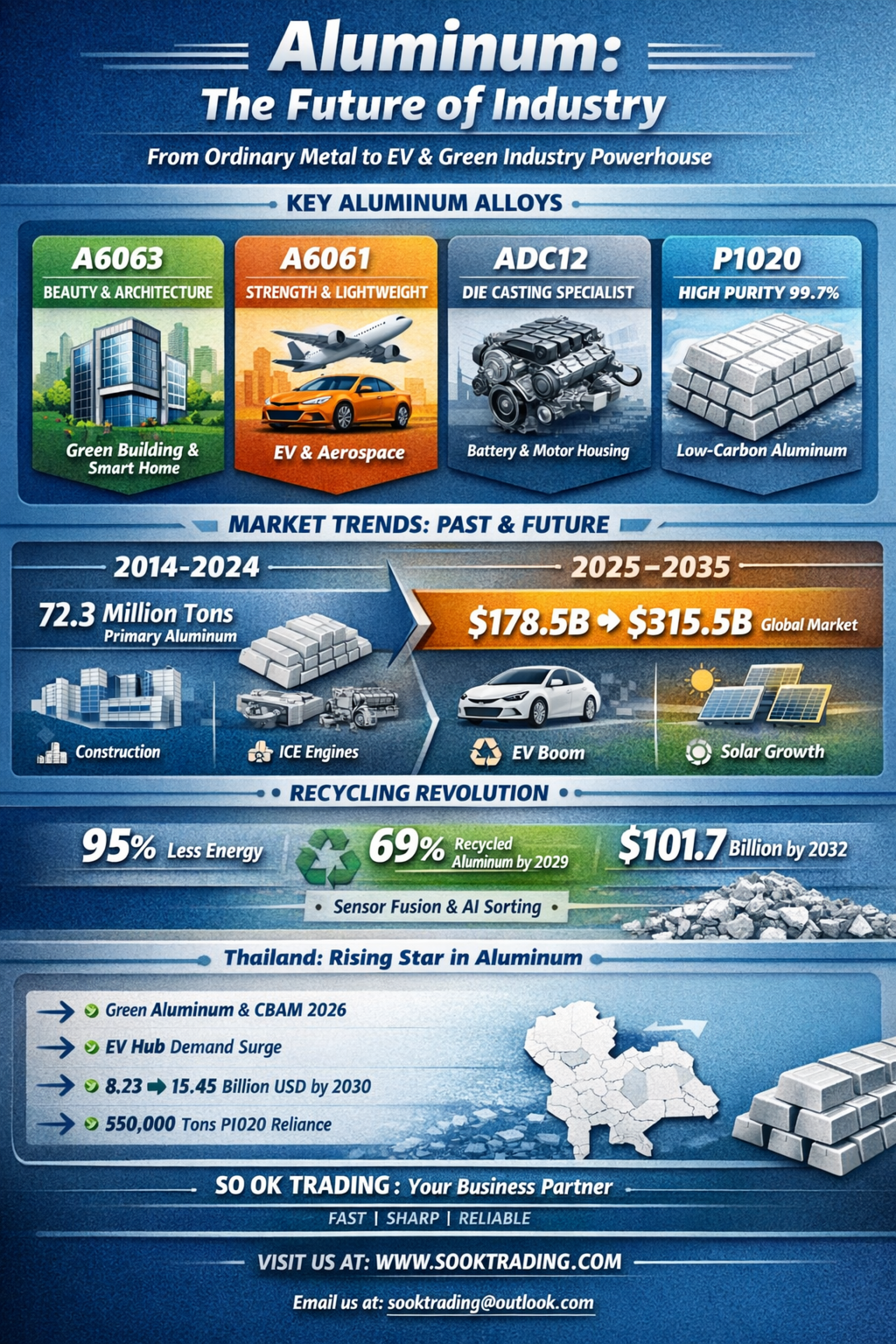
“Aluminum: The Industrial Metal of the Future”
From Ordinary Material to the Heart of EVs and the Green Industry
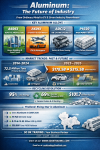
Aluminum is no longer just a common industrial metal — it is becoming the lifeblood of the modern global economy, both in Thailand and worldwide. Four key grades are driving this transformation: A6063, A6061, ADC12, and P1020.
Discover the 4 Key Aluminum Grades
A6063 – Smooth & Elegant
A star in architecture, used for door and window frames and façades.
Global trends are pushing toward Green Buildings and Smart Homes.
A6061 – Strong, Light & Durable
Widely used in Thailand for EV structures and machinery.
Internationally popular in Aerospace and Solar Cell applications.
ADC12 – Complex Die Casting
Transitioning from ICE engine parts to EV battery housings and motor housings.
The new trend: Gigacasting — casting large auto parts in a single piece.
P1020 – 99.7% Pure Ingot
Imported into Thailand for specialized alloy production.
Globally shifting toward Low-Carbon Aluminum produced with clean energy.
Market Outlook: Past 10 Years & Next 10 Years
2014–2024:
A6063 dominated construction.
ADC12 grew with internal combustion engines.
P1020 remained stable as a raw material.
Global primary aluminum production reached 72.3 million tons.
2025–2035:
Global aluminum market projected to grow from $178.5B → $315.5B (CAGR ~5.9%).
Demand for A6061 & ADC12 surges from EVs and Aerospace.
A6063 expands into Green Building and Solar Infrastructure.
P1020 shifts focus from “quantity” to “origin” — Low-Carbon Aluminum becomes the standard.
♻️ Recycling: From Option to Obligation
Recycling uses 95% less energy than primary production.
By 2029, recycled aluminum will account for 69% of global use.
Recycling market expected to reach $101.7B by 2032.
Thailand invests in Sensor Fusion + AI to sort high-quality aluminum scrap.
Thailand: From General Producer → High-Value Base
Green Aluminum & Net Zero: CBAM fully enforced in 2026 — exporters must report carbon emissions.
EV Hub: Demand for A6061 and ADC12 rising sharply.
Thai Market Growth: From $8.23B → $15.45B by 2030 (CAGR ~10.46%).
Challenges: Chinese dumping and reliance on importing over 550,000 tons/year of P1020.
Thailand’s Aluminum Industry Entering a New Golden Era
The measure is no longer “volume” but sustainability and environmental value.
Major opportunities: EVs, Solar Cells, Smart Electronics
New technologies: Closed-loop Recycling, Gigacasting
New regulations: ESG and Carbon Tax
Aluminum is the industrial metal of the future — shaping the global economy, with Thailand playing a vital role on the world stage.
SO OK TRADING: Your Trusted Business Partner
FAST | SHARP | RELIABLE
Visit us at: www.sooktrading.com
Email: sooktrading@outlook.com
This English version is ready for LinkedIn, Facebook, WeChat, or website publication.
Would you like me to also refine a short headline-style version (8–10 words) in English for social media feeds, so it grabs attention instantly?