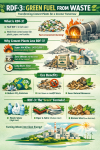
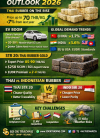
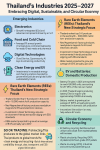
“RDF-3: Transforming Cement Plants Towards Clean Energy — The Net Zero Survival Strategy Article by SO OK TRADING (March 15, 2026)”
RDF: The Waste Fuel Transforming Cement Plants into “Eco-Friendly” Leaders
Imagine cement plants that once relied heavily on costly coal and emitted massive amounts of carbon. Today, they are turning to RDF (Refuse Derived Fuel)—fuel made from waste—to cut costs and confidently move toward Net Zero.
Types of RDF and What Cement Plants Prefer
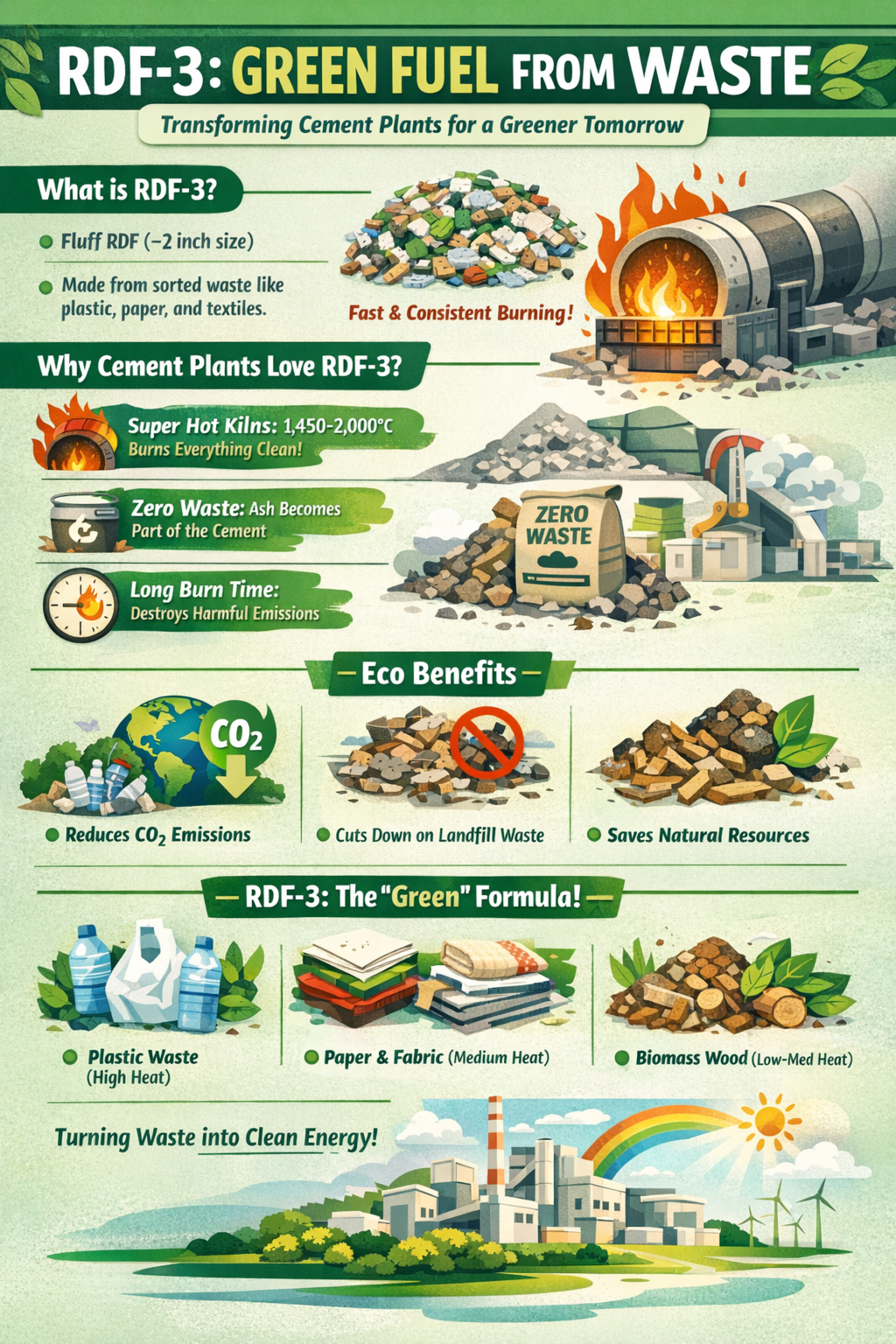
RDF-3 (Fluff RDF): finely shredded (~2 inches), metals and glass removed, burns fast and consistently → Top choice for cement plants
RDF-5 (Densified RDF): compressed into pellets or briquettes → easy to transport and store
SRF (Solid Recovered Fuel): premium version with strict calorific and moisture control → keeps kiln temperature stable
Key Properties Cement Plants Require
Calorific Value: 2,500–4,500 kcal/kg → sufficient to replace coal
Moisture: ≤15–20% → excess moisture makes kilns “cold” and energy-hungry
Size: 30–50 mm → ideal for feeding systems
Impurities: low chlorine (<1%), no heavy metals or glass
Why Cement Plants Are the “Perfect Arena” for RDF
Extreme Heat: kilns reach 1,450–2,000°C → completely destroy harmful substances
Zero Residual Ash: ash becomes part of the clinker
Long Residence Time: hot gases stay long enough to eliminate dioxins
Preferred Raw Materials
Plastic packaging (excluding PVC)
Paper and cardboard
Used tires (TDF), industrial rubber, shoe soles
Textile and fabric waste
Wood chips and dried sludge
⚠️ RDF-3 Supply Considerations
Chlorine (PVC): corrosive, clogs systems
Blending Formula:
Plastics (High Heat) → boost calorific value
Paper/Fabric (Medium Heat) → add volume for steady burn
Biomass/Wood (Low–Medium Heat) → reduce cost, add renewable energy
→ Common blend: ~3,500 kcal/kg, moisture <15%
Quality Testing
Heating Value: Bomb Calorimeter (HHV/LHV)
Proximate Analysis: moisture, volatile matter, ash, fixed carbon
Ultimate Analysis: chlorine, sulfur, heavy metals
Sample Prep: ground <1 mm for representative testing
RDF Trends in East Asia
South Korea: Standards & Enforcement Leader
RDF use in industry grew 26% (2022–2023)
Cement plants replace up to 36% coal and 30% limestone with waste
Strict RDF standards ensure consistent calorific value and environmental safety
China: Fastest-Growing Market
Produced over 3 million tons of RDF in 2023
Major players like Hongshi Cement and Huaxin Cement use high-quality RDF (<50 mm)
Goal: co-processing to replace 22.4% fossil fuels by 2060
Japan: High-Quality SRF & Advanced Tech
Moving from RDF to premium SRF for cleaner, stable energy
Over 1,500 waste incineration plants producing fuel for industry
Smart sensors improve RDF purity by 15%
Market Outlook (2024–2034): East Asia RDF market projected at USD 537 million by 2034
China: 40.19%
Japan: 15.04%
South Korea: 10.09%
RDF Trends in Thailand and Worldwide
Thailand
Major cement plants target 50–100% RDF usage
“Community Waste to Cement” models like Saraburi Sandbox
Draft national standard TIS RDF (TIS 2900) → clear pricing benchmark
Global
Europe: shifting to premium SRF, nearly 100% coal replacement
CBAM: pushing cement plants worldwide to cut carbon footprints
Technology: AI + NIR sensors for real-time RDF quality monitoring
Conclusion: RDF-3 as the Green Fuel of the Future
RDF-3 is not just an “alternative fuel” — it is the fuel of the future, transforming cement plants from major carbon emitters into clean energy players. It reduces costs, protects the environment, and strengthens energy security in Thailand, East Asia, and across the globe. Cement plants adopting RDF today are positioning themselves as global leaders in both economics and sustainability.
SO OK TRADING: Your Trusted Business Partner
FAST · SHARP · RELIABLE
Visit: WWW.SOOKTRADING.COM
Email: SOOKTRADING@OUTLOOK.COM
We supply high-quality RDF-3 in Thailand. Contact us today — thank you!