“Recycled Aluminum: From Scrap to Global Standard – Circular Economy Reshaping Industry with Aluminum Remelt – Remelt Revolution: Transforming the Metal Industry for Net Zero”
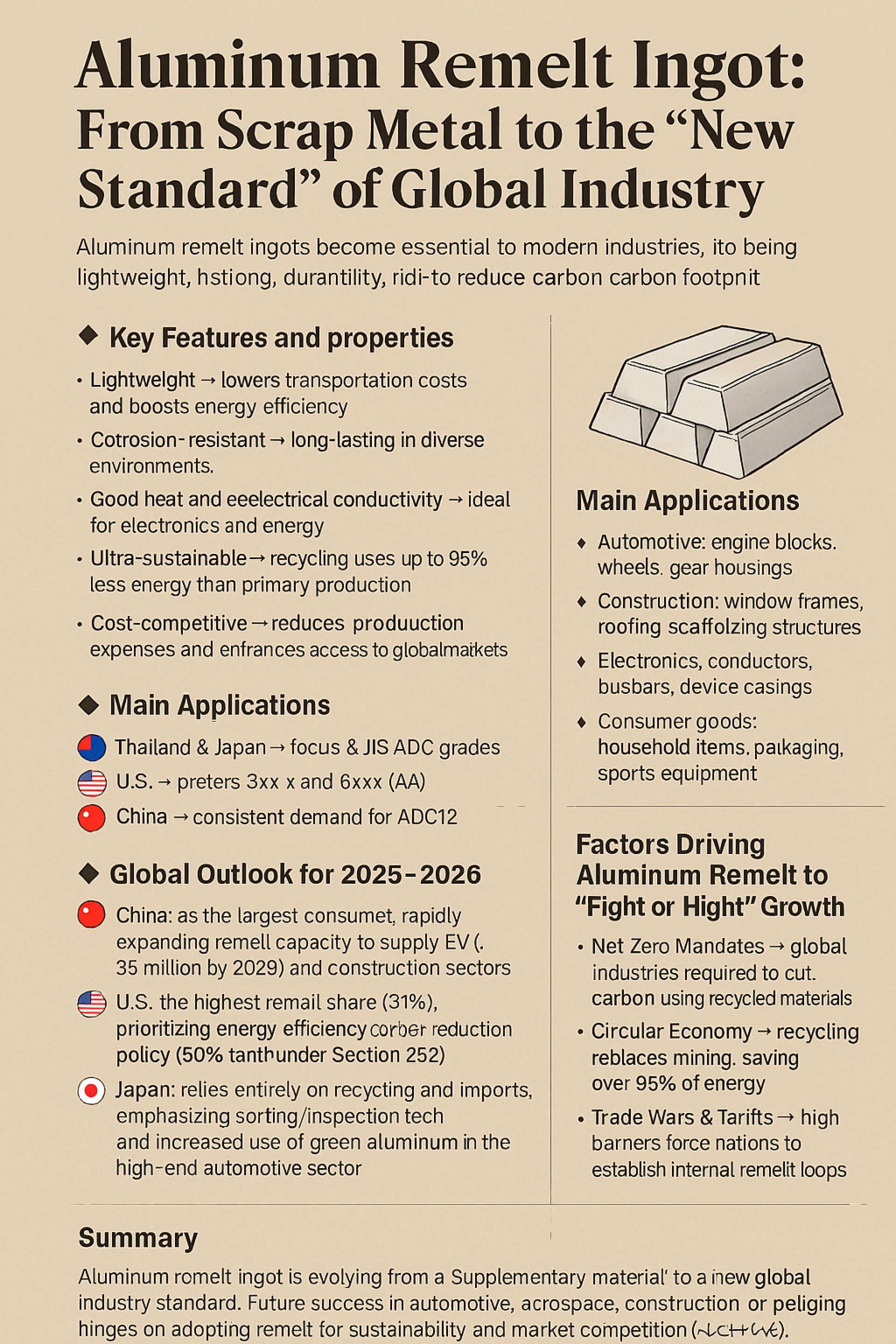
Aluminum Remelt Ingot: From Scrap to the “New Standard” of Global Industry
Aluminum Remelt Ingots are becoming the cornerstone of modern industry. Not only are they lightweight, strong, and durable, but they also directly address the global demand for sustainability and carbon footprint reduction.
✦ Key Features and Properties
Lightweight → reduces transportation costs and boosts energy efficiency
Corrosion-resistant → ensures long service life in diverse environments
Excellent thermal & electrical conductivity → ideal for electronics and energy sectors
Highly sustainable → recycling consumes up to 95% less energy than primary production
Cost-competitive → lowers production expenses and improves access to global markets
✦ Most Popular Grades
ADC12 / A383 → versatile grades for engine components and appliances
A356 → premium grade for alloy wheels and high-strength structures
AC4B → suitable for cylinder heads and high-pressure parts
Global Market Insights:
Thailand & Japan → focus on ADC (JIS standard)
USA → prefers 3xx.x and 6xxx (AA standard)
China → consistently high demand for ADC12
✦ Main Applications
Automotive: engine blocks, wheels, gear housings
Construction: window frames, roofing, scaffolding structures
Electronics: conductors, busbars, device casings
Consumer Goods: household items, packaging, sports equipment
✦ Global Outlook 2025–2026
China: the largest consumer, rapidly expanding remelt capacity to support EV production (targeting 35 million units in 2025) and construction, with stricter import standards for scrap aluminum.
United States: highest remelt usage worldwide (81%), driven by energy efficiency and carbon reduction. Section 232 tariffs raised to 50% to encourage domestic scrap use.
Japan: fully dependent on imports and recycling, leveraging advanced sorting and inspection technologies, and mandating greater use of green aluminum in high-end automotive manufacturing.
Thailand: emerging as ASEAN’s scrap hub, exporting heavily to China and the U.S., with an aluminum can recycling rate of 86% and circular economy initiatives such as the Aluminium Loop.
✦ Factors Driving “Fight-or-Flight” Growth
Net Zero Demand → industries worldwide required to adopt recycled materials
Circular Economy → recycling replaces mining, saving over 95% of energy
Trade Wars & Tariffs → high barriers push nations to build internal remelt loops
Investment in New Technologies → precise sorting and inspection deliver near-primary quality
EV & Packaging Demand → electric mobility and sustainable packaging are major growth drivers
✦ Conclusion
Aluminum Remelt Ingots are evolving from a “supplementary material” into the new global standard. Whether in automotive, aerospace, construction, or packaging, adopting remelt is now essential for sustainability and competitiveness.
From Scrap → To the Hero of Tomorrow
For those in the metals and manufacturing industries, now is the time to adapt and seize opportunities in the global market.
SOOK TRADING – Your Business Partner
If you require ADC12 or Aluminum Remelt Ingots, please contact us via our website www.sooktrading.com → Give Inquiry, or email us directly at sooktrading@outlook.com.