Global Gold Market Building a New Base — Opportunity or Risk: Article by SO OK TRADING
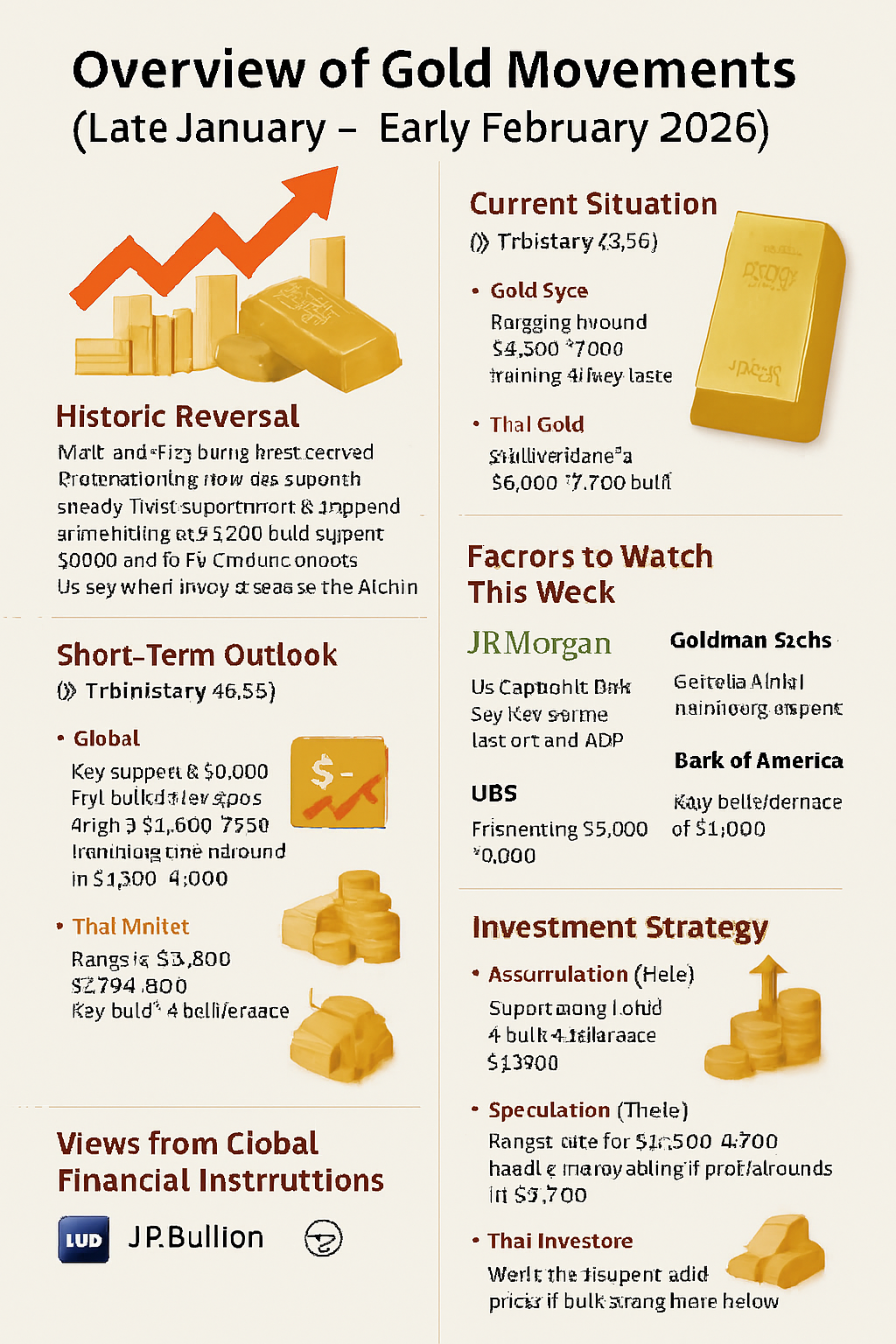
Overview of Gold Movements (Late January – Early February 2026)
The global gold market has just experienced what can be called a Historic Reversal, the largest in decades. At the end of January, gold prices surged past $5,500 per ounce for the first time in history, while Thai gold prices soared above 80,000 Baht, also a record high.
Yet only a few days later, heavy profit-taking by institutional investors and large funds triggered a sharp correction. Global gold prices fell by $800–900 within less than a week, while Thai gold dropped by more than 10,000 Baht. However, the Thai baht weakened to 31.60–32.00 per USD, cushioning domestic gold prices from falling as steeply as the global market.
Current Situation (February 3, 2026)
Global Gold Spot: $4,664–4,700 per ounce
Thai Gold (96.5% bar): 70,000–71,000 Baht
Short-Term Outlook (February 3–10, 2026)
Global Market:
Prices are in a “consolidation phase” after the correction. Key support lies at $4,600; if broken, prices may test $4,400–4,550. On a rebound, the first target is $4,900–5,000.
Thai Market:
Expected to move within 69,500–72,500 Baht. If the baht strengthens below 31.50/USD, domestic gold prices could fall further.
Key Factors to Watch This Week
U.S. economic data, especially Non-Farm Payrolls and ADP employment reports
Continued profit-taking after record highs
Federal Reserve’s stance on interest rates and inflation
Geopolitical tensions, particularly in the Middle East
Global Financial Institutions’ Views
J.P. Morgan: End-year target at $6,300, viewing the correction as a purge of speculative excess.
Goldman Sachs: Target $4,900–5,400, supported by central banks’ ongoing gold purchases.
UBS: Forecast $5,400–6,200, citing supply constraints and geopolitical risks.
Bank of America: Average price forecast around $5,000 for the year.
Thai Analysts’ Views
YLG Bullion: Sees potential for further gains, with a target of $4,900, but warns of volatility in February.
SO OK TRADING: Expects February prices around $5,000/oz, moving within $4,500–5,250. Thai gold likely in the 70,000–76,000 Baht range, averaging 73,500 Baht, though highly volatile and dependent on the baht.
Investment Strategies (SO OK TRADING Summary)
Long-term holders: If gold holds above $4,600, it’s a good entry point for accumulation.
Short-term traders: Operate within $4,600–4,900, but beware of heavy selling if prices retest $5,000.
Thai investors: Watch the baht; if it strengthens below 31.50/USD, it’s a chance to buy cheaper gold domestically.
Summary
The gold market is undergoing a sharp correction after January’s surge. Short-term volatility remains high, but medium- to long-term outlooks are still bullish according to major institutions. Long-term investors may see this as an opportunity to accumulate, while short-term traders must remain cautious of strong selling pressure.