Thai Mangosteen: The Queen of Tropical Fruits Loved Worldwide by SO OK TRADING
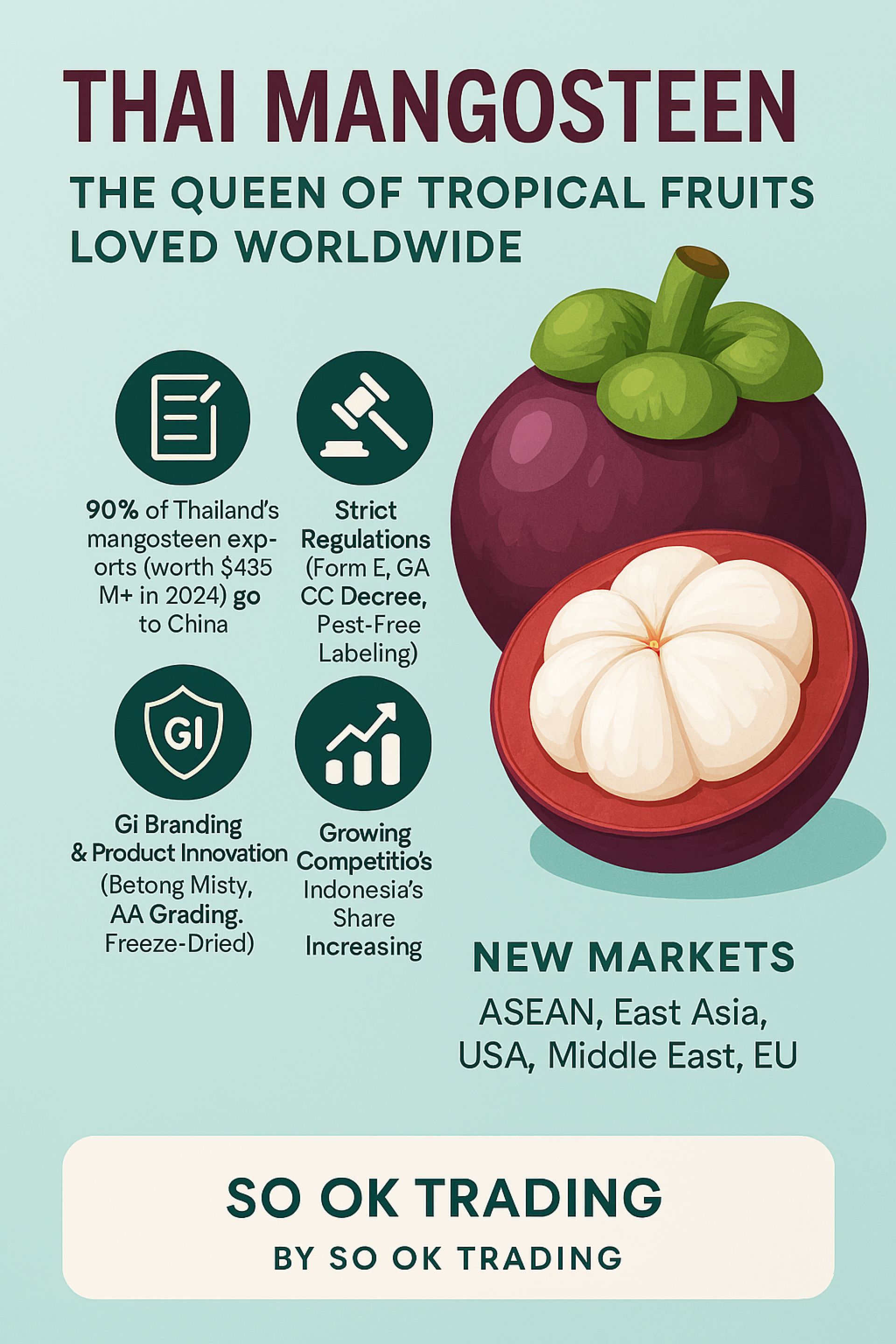
Thai Mangosteen: The Queen of Tropical Fruits Conquering the Global Market ✨
China remains the primary customer, but competition is intensifying.
Market Overview
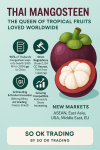
Thailand continues to hold the position as the world’s No.1 exporter of fresh mangosteens, with China accounting for more than 90% of total exports. Thai mangosteens are recognized as premium fruits — sweet in flavor, pure white flesh, and thin skin — perfectly matching Chinese consumers’ preferences for quality and appearance.
However, market share is facing pressure from new competitors such as Indonesia, which is aggressively entering the market. Thailand must adapt strategies quickly to maintain its “world champion” status.
Regulations and Standards for Entering China
Exporting mangosteens to China is not simple. Exporters must comply with strict requirements:
Form E → Tariff exemption when presented to Chinese customs
Orchard & Packing House Registration → Certification required by GACC
GACC Decree 248 & 249 → Fresh food producers must register and comply with import food safety measures
Phytosanitary Measures → Fruits must be pest-free
Labeling → Packaging must meet Chinese labeling standards
Though demanding, these measures serve as the “gateway” for Thai mangosteens to confidently enter and compete in China’s premium market.
Challenges and Opportunities
Competition from Indonesia → Thailand’s share slightly declined, while Indonesia’s imports grew significantly
Value Addition through GI → Betong Misty Mangosteen, Ranong Mangosteen, Khiri Wong Mangosteen
Product Innovation → Freeze-dried mangosteen, sugar-free mangosteen paste, concentrated juice, peel extract for cosmetics
Diversified Distribution Channels → Both offline retail and online platforms to reach wider consumers
Statistics and Current Situation
2024: Exports to China valued at over 15 billion THB
2023: Export volume to China reached 223,300 tons, a 20.8% growth from the previous year
January 2026: China remains the top market with a 93.73% share, retail prices reaching up to 70 THB/kg in certain periods
September 2025: Thailand and China agreed to add 5 new import checkpoints, reducing costs and speeding up distribution
Products Favored by Chinese Consumers
Premium Fresh Mangosteen → Smooth clean skin, pure white flesh, sweet taste, large fruit with thin skin
GI Mangosteen → Betong Misty Mangosteen, Tap Phang Nga Mangosteen
New Grading Standards (AA, A) → Targeting premium markets in major cities like Beijing, Shanghai, Guangzhou
Processed Products → Freeze-dried mangosteen, mangosteen sticks, concentrated juice, peel extract
Opportunities to Expand New Markets
To reduce reliance on China, Thailand can expand to:
ASEAN → Vietnam, Cambodia
East Asia → Japan, South Korea, Taiwan
Emerging Markets → USA, Middle East, EU
Processed Products → Frozen mangosteen, extracts, cosmetics, dietary supplements
✨ Conclusion
Thai mangosteen remains the “Queen of Tropical Fruits” loved by Chinese consumers. But to maintain its global champion status, Thailand must differentiate through premium quality, GI branding, product innovation, and market expansion.
The combination of freshness + innovative processed products will be the key to elevating Thai mangosteen into a true global fruit brand — not only dominating China but also expanding into premium markets worldwide.