Share

Thai Rubber: Premium Quality, Exported Worldwide – SO OK TRADING Insights into Thai Rubber for the Global Market
Last updated: 17 Jan 2026
1746 Views

Thai Rubber: A Strategic Economic Crop for the Global Market

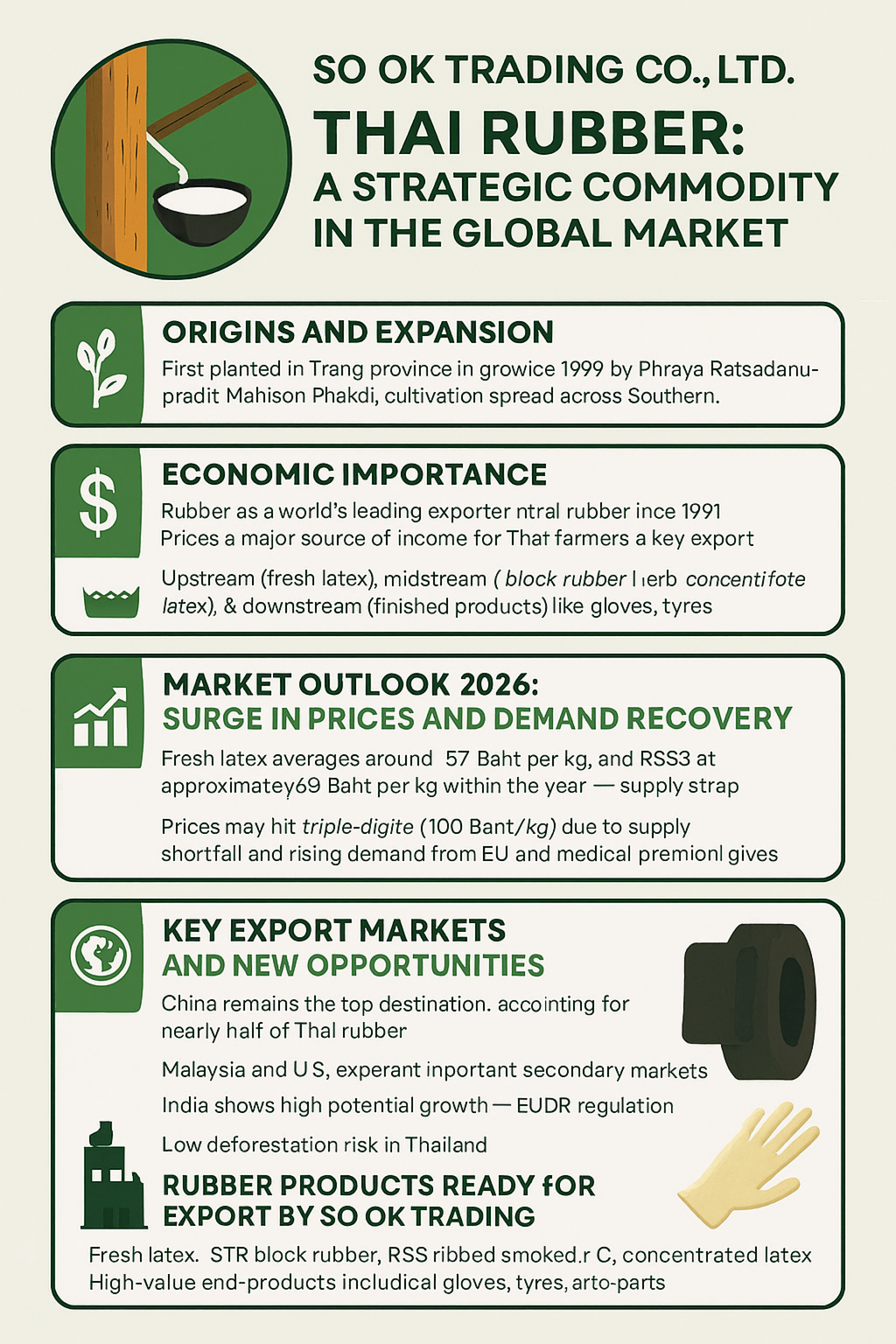
SO OK TRADING CO., LTD. is positioned as a premium trading partner for Thai natural rubber. With a nationwide sourcing network and comprehensive export services, we deliver solutions that meet the evolving demands of the global market.


Origins and Growth of the Thai Rubber Industry

Rubber cultivation in Thailand began in 1899 when Phraya Ratsadanupradit Mahison Phakdi introduced rubber trees in Trang province.
From the south, plantations expanded to the east and northeast, now covering more than 19 million rai nationwide.
Key production areas include Songkhla, Nakhon Si Thammarat, Chanthaburi, Buriram, and Sisaket.


Economic Importance and Export Leadership

Thailand has been the world’s leading exporter of natural rubber since 1991.
Rubber is a vital source of income for Thai farmers and a major contributor to foreign exchange earnings.
The industry is fully integrated, spanning upstream (fresh latex), midstream (STR block rubber, RSS ribbed smoked sheets, concentrated latex), and downstream (finished products such as medical gloves, tires, and automotive components).


Market Outlook 2026: Rising Prices and Demand Recovery

At the beginning of 2026, fresh latex prices averaged around 57 Baht/kg, while RSS3 traded at approximately 60 Baht/kg.
The Rubber Authority of Thailand forecasts that prices may reach triple digits (100 Baht/kg) within the year, driven by supply shortages from leaf fall disease in Indonesia and Malaysia, alongside rising demand from the electric vehicle (EV) industry and medical glove manufacturing.


EUDR Regulation: A New Opportunity

The European Union’s new EUDR regulation on deforestation-free products will take effect at the end of 2026.
Thailand, classified as a low-risk country, enjoys a competitive advantage. Rubber products with full traceability may gain a premium of 2–5 Baht/kg, enhancing credibility and market value in Europe.


Export Markets and Emerging Opportunities

China remains Thailand’s largest export destination, accounting for nearly half of total shipments, primarily for tire production and rubber processing.
Malaysia and the United States are important secondary markets, with Malaysia focusing on concentrated latex for glove manufacturing.
India is a fast-growing market, driven by demand in automotive and manufacturing sectors.
Meanwhile, the EU presents new opportunities for sustainable Thai rubber under EUDR compliance.


Rubber Products Ready for Export by SO OK TRADING

SO OK TRADING offers a wide range of rubber products to meet global demand, including:

Fresh latex for medical glove production
STR block rubber meeting international standards
RSS ribbed smoked sheets with high flexibility
Concentrated latex for industrial applications
High-value downstream products such as medical gloves, tires, and automotive components
 

Strengths of SO OK TRADING

Nationwide sourcing network
End-to-end logistics and export handling
Compliance with EUDR and traceability systems
Expert team across metals, agriculture, and pharmaceuticals
Tailored quotations and consulting for Europe, China, and India markets
 

Contact SO OK TRADING Today

sooktrading@outlook.com
+66 955564255
www.sooktrading.com

SO OK TRADING – Your Premium Thai Rubber Partner
Export with confidence, backed by quality, standards, and global reliability.


Would you like me to also prepare a shorter executive summary version in English? That would be ideal for a one-page brochure or LinkedIn post.


Related Content
HNY 2026 with a First Analysis on Thai Baht Value
he Thai baht in Q1 2026 is expected to strengthen against the US dollar, driven primarily by a weaker dollar globally, a seasonal tourism boost, and expectations of US Federal Reserve rate cuts. This strength is occurring despite a weak domestic economic outlook and the Bank of Thailand's (BoT) likely continued easing of its policy rate. Exchange Rate Drivers and Forecast External Factors: The primary driver for the strengthening baht is external, mainly the broad weakness of the US dollar as global markets price in expected Fed rate cuts. The baht is also correlated with global gold prices, which have been climbing. Tourism High Season: The period extending into Q1 2026 is the high season for tourism, which typically brings in foreign currency and supports the baht's value. Policy Divergence: The BoT is expected to continue its easing cycle, potentially cutting the policy rate further to 1.00% by Q1 2026 to stimulate the sluggish domestic economy. This divergence from a potentially less aggressive US Fed in Q1 could support the baht in the short term, though some analysts warn the currency could weaken later in 2026. Forecasts: Projections for 2026 generally place the baht in a range of 30.80–33.00 per US dollar. Some models estimate it could trade around 31.06 by the end of Q1. A persistently strong baht below 31 per US$ is seen as a significant risk to the Thai export and tourism sectors. Key Economic Context Weak Growth: Thailand's economy is expected to slow down to a 5-year low growth rate of around 1.6-1.8% in 2026, pressured by US tariffs, global trade tensions, and high household debt. The central bank chief expects an improvement in Q1 2026 after a weak second half of 2025. Political Uncertainty: A general election expected in February 2026 could also introduce volatility, though some historical trends suggest the baht may strengthen following the formation of a new government. Low Inflation: Headline inflation is projected to remain subdued or even negative, providing the central bank with justification for further rate cuts to stimulate demand. In summary, Q1 2026 is characterized by a strong and volatile baht driven by external factors, contrasting sharply with a weak domestic economy and accommodative monetary policy.
1 Jan 2026
“Lead Bullion: Powering Batteries, Forging the Green Energy Future — An Article by SO OK TRADING, April 7, 2026”
Lead Bullion & Battery Market: The Metal Power Driving the New Energy World In an era of rapid change in energy and technology, lead remains at the heart of the global battery industry. Especially Lead Bullion (crude lead), refined from Galena ore (PbS) through sintering and blast furnace smelting, then purified to 99.97% pure lead under ASTM B29 standards. This refined lead is essential for producing lead-acid batteries widely used in automobiles, backup power systems (UPS), and energy infrastructure. With global energy prices and shipping costs surging, the Lead Bullion market has regained attention. Particularly in battery production and recycling, recycled lead can reduce energy consumption by up to 75% compared to primary smelting, aligning with the principles of the Circular Economy and ESG standards valued worldwide. Between 2025–2030, the world is entering the era of Secondary Lead — high-quality, environmentally friendly recycled lead expected to account for 60–70% of global demand. This opens new opportunities for Thai manufacturers to build Closed-loop Systems, ensuring long-term sustainability and resilience.
7 Apr 2026
This website uses cookies for best user experience, to find out more you can go to our Privacy Policy and Cookies Policy
Powered By MakeWebEasy Logo MakeWebEasy