SO OK TRADING'S MARKET INSIGHT | A Turning Point in the Global Aluminium Cycle: Historic Backwardation, Near-Term Supply Tightness, and the Challenge of New Capacity in 2027 | 29 NOV 2026
SO OK TRADING'S MARKET INSIGHT
When LME Aluminium Records Its Most Severe Backwardation in Nearly 40 Years While MJP Premiums Enter a Downtrend: A Critical Signal for Procurement Professionals and Investors
29 NOV 2026
The global aluminium market is currently presenting two remarkably different realities between the financial market and the physical market.
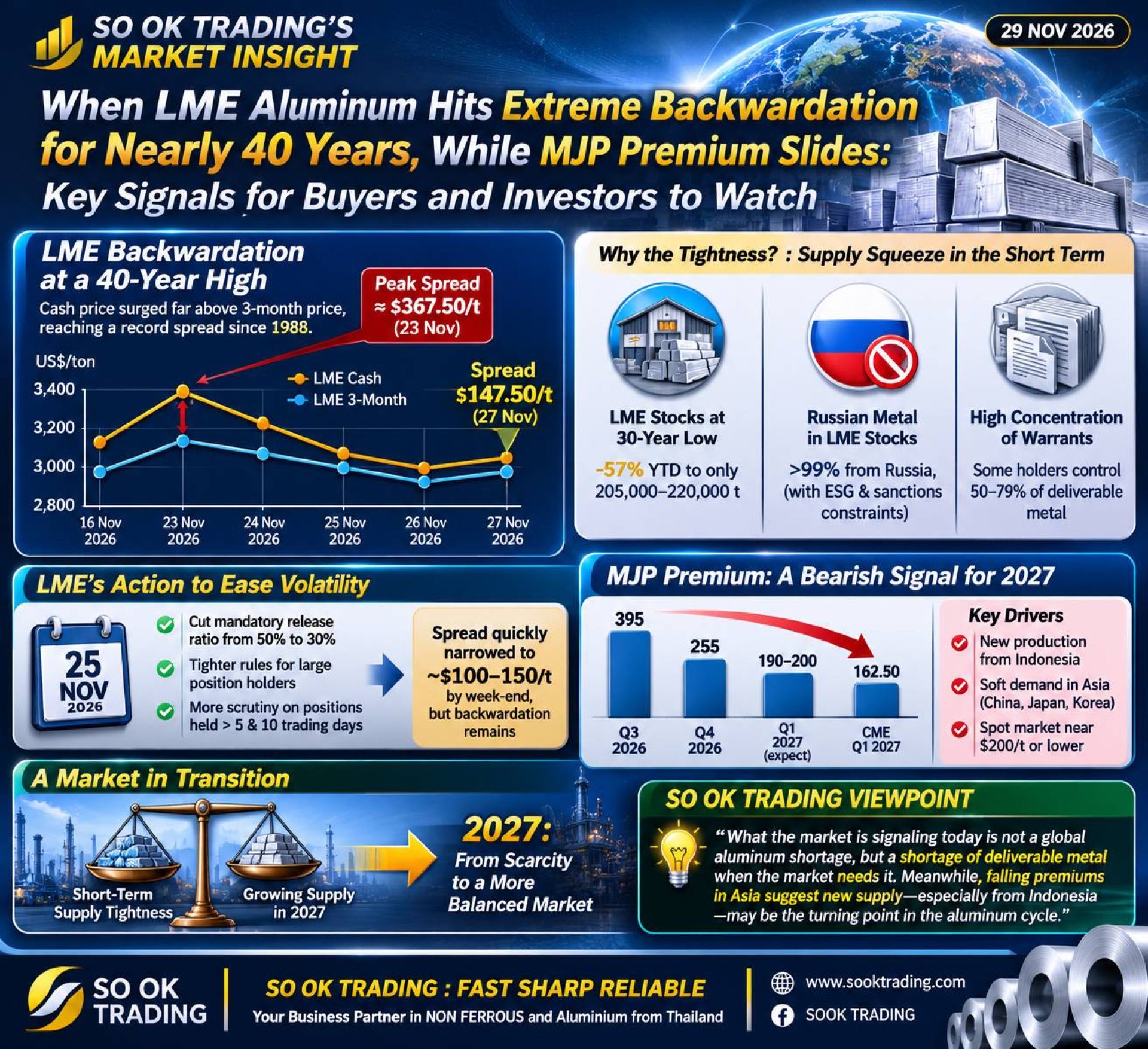
On one hand, the London Metal Exchange (LME) is experiencing its most severe aluminium backwardation since 1988. Cash prices have risen significantly above 3-Month futures prices, reaching levels not seen in nearly four decades. This development reflects an acute shortage of immediately deliverable metal and highlights the tightness of short-term physical supply.
On the other hand, the Main Japanese Ports (MJP) Aluminium Premium, one of Asia's most important benchmarks for imported aluminium costs, has continued to decline, signaling that market participants are increasingly anticipating a significant increase in aluminium supply during 2027.
Taken together, these contrasting signals suggest that the global aluminium market is entering a critical transition period between short-term supply scarcity and expectations of future oversupply.
The Most Severe Backwardation in Nearly Four Decades
Under normal market conditions, 3-Month futures prices typically trade above Cash prices because they incorporate financing costs, warehousing expenses, and inventory carrying costs.
However, during November 2026, the aluminium market experienced an extraordinary reversal of this relationship.
On 23 November 2026, the spread between LME Cash and LME 3-Month aluminium briefly surged to approximately USD 405 per metric ton, marking its highest level since 1988.
While the spread has moderated following intervention by the LME, it remains historically elevated compared with long-term market norms.
Key Market Developments
16 November 2026
LME Cash: USD 3,332.00/MT
LME 3-Month: USD 3,020.00/MT
Cash Premium to 3-Month: +USD 312.00/MT
23 November 2026
LME Cash: USD 3,201.50/MT
LME 3-Month: USD 2,834.00/MT
Spread: +USD 367.50/MT
Intraday peak exceeded approximately USD 405.00/MT
24 November 2026
LME Cash: USD 3,120.50/MT
LME 3-Month: USD 2,789.00/MT
Spread: +USD 331.50/MT
25 November 2026
LME Cash: USD 2,849.00/MT
LME 3-Month: USD 2,760.00/MT
Spread: +USD 89.00/MT
26 November 2026
LME Cash: USD 2,980.00/MT
LME 3-Month: USD 2,820.50/MT
Spread: +USD 159.50/MT
27 November 2026
LME Cash: USD 2,983.00/MT
LME 3-Month: USD 2,835.50/MT
Spread: +USD 147.50/MT
Although the spread has narrowed from its peak, current levels continue to indicate substantial pressure in the prompt physical market.
Key Drivers Behind the Historic Supply Squeeze
1. LME Aluminium Inventories Have Fallen to Multi-Decade Lows
The primary driver behind the backwardation is the rapid depletion of aluminium inventories within the LME warehouse system.
Since the beginning of 2026, aluminium stocks have declined by more than 57%, falling to approximately 205,000-220,000 metric tons, their lowest level in more than three decades.
With limited metal available for immediate delivery, buyers have been willing to pay increasingly higher prices for prompt material, pushing Cash prices significantly above forward prices.
2. Constraints Associated with Russian-Origin Aluminium
While headline inventory figures continue to show available stocks, more than 99% of the remaining LME inventory is reported to be of Russian origin.
Amid sanctions-related concerns, geopolitical uncertainty, and ESG policies adopted by many multinational corporations, a significant portion of buyers in Europe and parts of Asia have chosen to avoid Russian-origin metal.
As a result, the volume of aluminium that is commercially acceptable and actively sought by the market is considerably smaller than headline inventory figures suggest.
3. Concentration of Warehouse Warrant Holdings
Another contributing factor has been the concentration of warehouse warrant ownership among a small number of market participants.
Market data indicate that certain holders control between 50% and 79% of available warrants and nearby positions.
This concentration has intensified pressure on the prompt market and contributed to the exceptional widening of short-term spreads.
LME Intervention to Reduce Market Distortions
To prevent excessive market squeezes and restore orderly trading conditions, the London Metal Exchange introduced temporary measures effective 25 November 2026.
Key elements of the intervention included:
Reducing the threshold for mandatory lending obligations from 50% to 30%
Tightening requirements for large position holders
Implementing stricter controls for positions maintained over 5 and 10 consecutive business days
Following the announcement, the Cash-to-3-Month spread contracted from more than USD 300-400/MT to approximately USD 100-150/MT by the end of the week.
Nevertheless, the market remains in backwardation, indicating that the underlying supply constraints have not yet been fully resolved.
MJP Premiums Are Signaling a Different Future
While LME Cash prices reflect immediate physical tightness, MJP Premiums are increasingly reflecting market expectations regarding future supply conditions.
Recent MJP Premium Developments
Q3 2026
USD 395/MT
Highest level recorded during 2026
Q4 2026
USD 255/MT
Down USD 140/MT, or 35.4%, from the previous quarter
December 2026 CME Futures
Approximately USD 225/MT
Expected Negotiation Range for Q1 2027
USD 190-200/MT
Q1 2027 CME Futures
Approximately USD 162.50/MT
These figures suggest that market participants increasingly expect additional aluminium supply to enter Asia during 2027.
Why Are MJP Premiums Falling?
New Capacity Expansion in Indonesia
Indonesia is rapidly emerging as one of the world's fastest-growing primary aluminium production hubs.
Several smelter expansion projects are progressing toward commercial operation, and the country's aluminium production capacity is expected to increase substantially during 2027.
As a result, the market anticipates significantly greater metal availability across Asia in the coming years.
Asian Demand Remains Relatively Soft
Despite improving global economic conditions, manufacturing sectors in China, Japan, and South Korea continue to face demand challenges.
Many downstream consumers remain cautious in their inventory management strategies, limiting demand for physical premiums.
Spot Markets Have Shifted Toward a Buyer's Market
Across major Asian locations, including South Korea, Malaysia, and Taiwan, spot premiums have declined toward USD 200/MT or even below that level.
This has strengthened buyers' negotiating leverage for upcoming annual and quarterly contracts.
The Indirect Impact of LME Backwardation
When Cash prices trade substantially above forward prices, inventory holders are incentivized to release material into the market rather than store it.
This dynamic increases the availability of physical metal in regional markets and places additional downward pressure on premiums.
Outlook for 2027
In the short term, the market is likely to remain exposed to backwardation risk and continued tightness in prompt supply.
Consequently, both Spot and Cash prices may remain highly volatile.
Over the medium to long term, however, 3-Month aluminium prices in the range of USD 2,800-2,850/MT suggest that the market is increasingly pricing in future supply growth, particularly from Southeast Asia.
For aluminium consumers and procurement teams, current market conditions may provide opportunities to evaluate hedging strategies and secure forward supply before a new supply cycle emerges.
Conclusion
The most severe aluminium backwardation seen on the LME in nearly 40 years is a clear indication of short-term shortages in immediately deliverable metal.
However, the persistent decline in MJP Premiums tells a different story.
Market participants are increasingly convinced that new supply, particularly from Indonesia and other emerging Asian production centers, will enter the market during 2027 and gradually alleviate the supply tightness witnessed throughout 2026.
As a result, 2027 may become a pivotal year for the global aluminium industry, marking a transition from an era of supply scarcity toward a new market equilibrium.
SO OK TRADING VIEWPOINT
"What today's market is signaling is not a global shortage of aluminium, but rather a shortage of metal available when the market needs it most. At the same time, futures prices and Asian premiums are increasingly reflecting expectations that a new wave of supply in 2027 could mark the beginning of a major shift in the global aluminium cycle."
SO OK TRADING | Your Business Partner
FAST • SHARP • RELIABLE
WWW.SOOKTRADING.COM
FACEBOOK: SO OK TRADING
Thailand's Trusted Specialist in Non-Ferrous Metals and Aluminium Solutions
A Leading Partner for Global Aluminium and Non-Ferrous Metal Trade