SO OK TRADING'S INSIGHT | The Copper Age: When Copper Becomes the Infrastructure of the New Global Economy | 27 NOV 2026
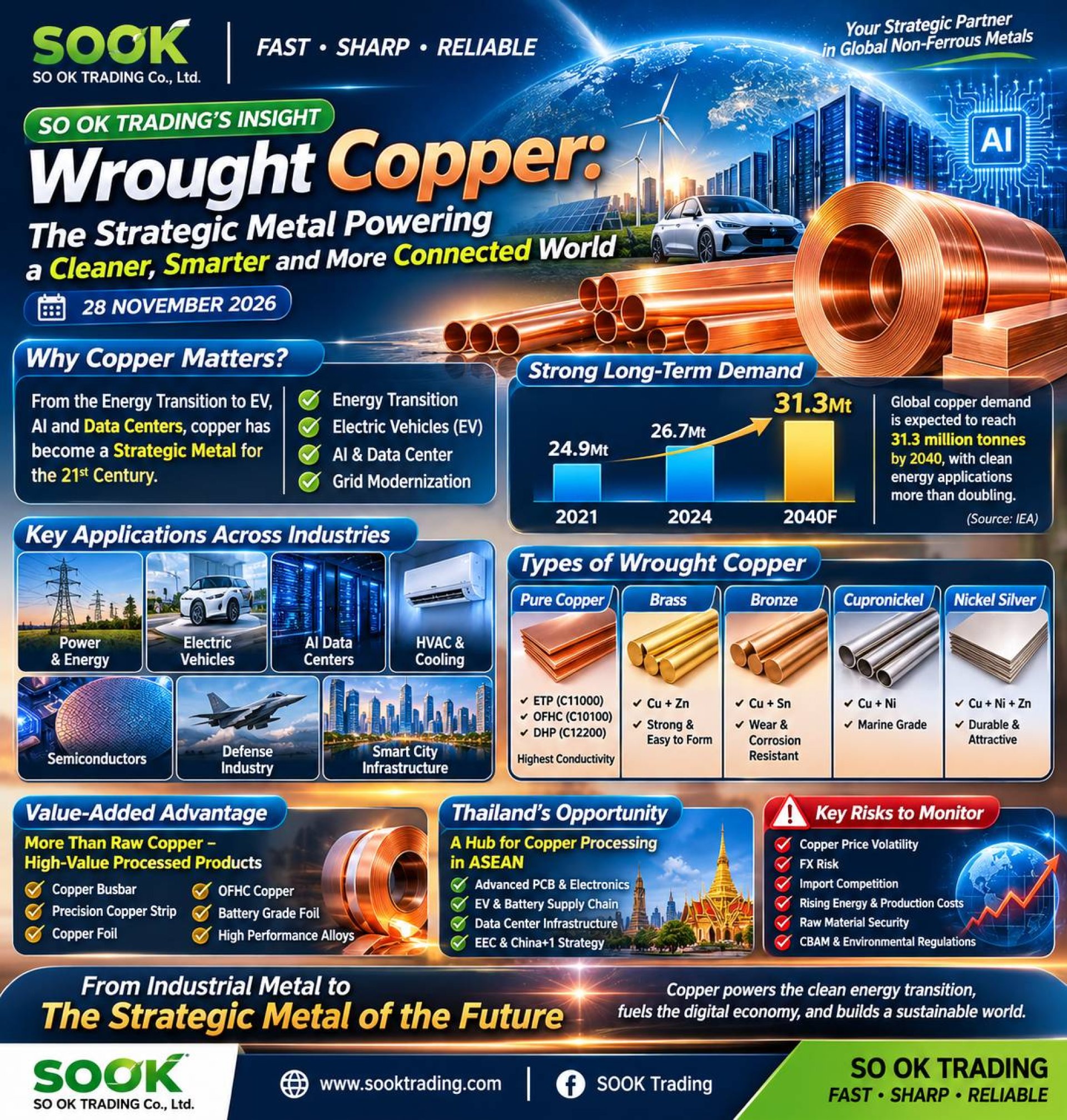
SO OK TRADING'S INSIGHT | Wrought Copper: The Foundational Material Powering the Era of Clean Energy, AI, and Modern Industry | 28 NOV 2026
When Copper Becomes the Strategic Metal of the 21st Century
Between 2025 and 2035, the global economy is undergoing a profound transformation driven by the rapid growth of clean energy, electric vehicles (EVs), artificial intelligence (AI), and large-scale data centers. All of these emerging industries rely on robust electrical infrastructure and efficient energy systems.
Amid this transition, copper is evolving from a traditional industrial raw material into a strategic metal, playing a critical role in economic security, technological advancement, and energy resilience worldwide.
Four major megatrends are driving long-term copper demand:
Energy Transition
Electric Vehicles (EVs)
AI Infrastructure & Data Centers
Grid Modernization
At the same time, the supply of new copper mines remains constrained, making copper one of the most closely watched resources in the global industrial economy.
The Role of Copper in Modern Industry and the New Economy
1. Copper Remains One of the Most Difficult Materials to Replace
Although alternative materials such as aluminum exist, copper remains the preferred choice in applications requiring superior conductivity, reliability, and long service life.
Key industries that depend heavily on copper include:
Electrical and power systems
AI Data Centers
Semiconductors
Electric Vehicles (EVs)
HVAC and refrigeration systems
Defense industries
Smart City infrastructure
2. The Highest Value Lies in Processing, Not Raw Materials
Copper Cathode is merely the upstream raw material. The real value creation occurs through advanced processing and engineering applications such as:
Copper Busbars
Precision Copper Strips
Copper Foils
OFHC Copper
Electronic Connector Materials
Battery-Grade Copper Foils
High-Performance Copper Alloys
Companies capable of producing specialized copper products can achieve significantly higher margins and stronger competitive advantages than those focused solely on raw material trading.
3. AI and Data Centers Are Emerging as New Demand Drivers
Historically, copper demand was driven by the construction and automotive sectors.
Today, Data Centers, Cloud Computing, and AI Infrastructure are becoming major consumers of copper due to their extensive requirements for:
Power distribution systems
Busbars
Transformers
Cooling systems
UPS and Energy Storage Systems
This new wave of demand is expanding alongside the growth of EVs and renewable energy worldwide.
4. Thailand Has the Potential to Become ASEAN's Copper Processing Hub
Although Thailand does not possess large-scale copper mines, it has established itself as a strong manufacturing base for downstream industries.
Growth sectors include:
Advanced PCB Manufacturing
Electronic Components
Air Conditioning and Refrigeration
Electric Vehicles
Battery Supply Chains
Data Center Infrastructure
The continued development of the Eastern Economic Corridor (EEC) and the China+1 manufacturing strategy are creating new long-term opportunities for Thailand's copper processing industry.
5. Key Risks That Business Leaders Should Monitor
Despite the strong growth outlook, several critical risks remain:
✅ Global Copper Price Volatility
✅ Foreign Exchange Risk
✅ Competition from Low-Cost Imports
✅ Rising Energy and Manufacturing Costs
✅ Supply Security of Copper Cathodes and Copper Scrap
✅ Environmental Regulations and Carbon Border Adjustment Mechanism (CBAM)
From Industrial Metal to Strategic Metal of the Future
Behind every power grid, electric vehicle, air-conditioning system, electronic circuit board, and AI data center lies copper.
Its exceptional electrical conductivity, thermal efficiency, and workability have made copper one of the most important materials underpinning modern industrial development.
As the world becomes increasingly electrified and digitized, copper's strategic importance is expected to grow even further.
What Is Wrought Copper?
Wrought Copper refers to copper or copper alloys that have been mechanically processed through methods such as:
Rolling
Drawing
Extrusion
Forming
These manufacturing processes allow copper to be shaped and engineered to meet specific industrial requirements.
The key advantage of wrought copper lies in its ability to optimize conductivity, strength, corrosion resistance, and formability for a wide range of applications.
Major Categories of Wrought Copper
1. Pure Copper
Containing more than 99.3-99.9% copper, this category offers the highest electrical and thermal conductivity among commercial metals.
Key Grades
ETP Copper (C11000)
Standard electrical-grade copper
Conductivity up to 100% IACS
OFHC / OFC Copper (C10100, C10200)
Oxygen-free copper
High-end audio systems
High-frequency electronics
Vacuum equipment
Semiconductor applications
DHP Copper (C12200)
Phosphorus-deoxidized copper
Air-conditioning tubing
Refrigeration systems
Heat exchangers
2. Brass
An alloy of copper and zinc.
Common Applications
Faucets
Valves
Pipe fittings
Bolts and screws
Musical instruments
Architectural decoration
3. Bronze
An alloy of copper and tin, or other alloying elements.
Common Applications
Gears
Bushings
Bearings
Springs
Marine propellers
Industrial pumps
4. Cupronickel
An alloy of copper and nickel known for its superior resistance to seawater corrosion.
Common Applications
Marine piping systems
Coastal power plants
Heat exchangers
Offshore platforms
Coinage
5. Nickel Silver
An alloy of copper, nickel, and zinc.
Common Applications
Jewelry
Musical instruments
Guitar frets
Keys
Electrical contacts
Why Copper Is the Metal of the Future
Copper stands at the center of four transformational megatrends: clean energy, EVs, artificial intelligence, data centers, and smart electrical grids.
As the global economy accelerates toward electrification and digitalization, the importance of copper will continue to rise.
If the 20th century was powered by oil, the 21st century may well be defined by The Copper Age.
"If oil was the strategic resource of the 20th century, copper may become the most important strategic metal of the 21st century. From clean energy and electric vehicles to AI and data centers, every major growth engine of the global economy begins with electricity, and electricity continues to rely on copper as its essential backbone."
SO OK TRADING: Your Trusted Business Partner
FAST • SHARP • RELIABLE
Website: www.sooktrading.com
Facebook: SO OK TRADING
SO OK TRADING
Thailand's Trusted Specialist in Non-Ferrous Metals