SO OK TRADING'S MARKET INSIGHT | Global Financial Turning Point 2027: The Fed's Rate Game and the New Direction of the Thai Baht and Gold
SO OK TRADING'S MARKET INSIGHT
What Signals Are the Thai Baht and Gold Sending? As the Fed Returns to the Center of Global Markets
26 November 2026
As 2026 enters its final stretch, global financial markets are approaching a critical inflection point in both the economic and monetary policy cycle. Recent U.S. economic data have continued to outperform expectations, while inflationary pressures remain persistent enough that the Federal Reserve (Fed) cannot yet declare victory over inflation.
Against this backdrop, investors are reassessing the interest rate outlook for 2027, reviving the "Higher for Longer" narrative and increasing expectations that policy rates may remain elevated for longer than previously anticipated.
The implications extend far beyond the U.S. dollar and Treasury yields. They are increasingly shaping the outlook for the Thai baht, gold prices, and global capital flows, making Fed policy one of the most influential drivers of market sentiment worldwide.
The Thai Baht Remains Resilient, But Downside Risks Persist
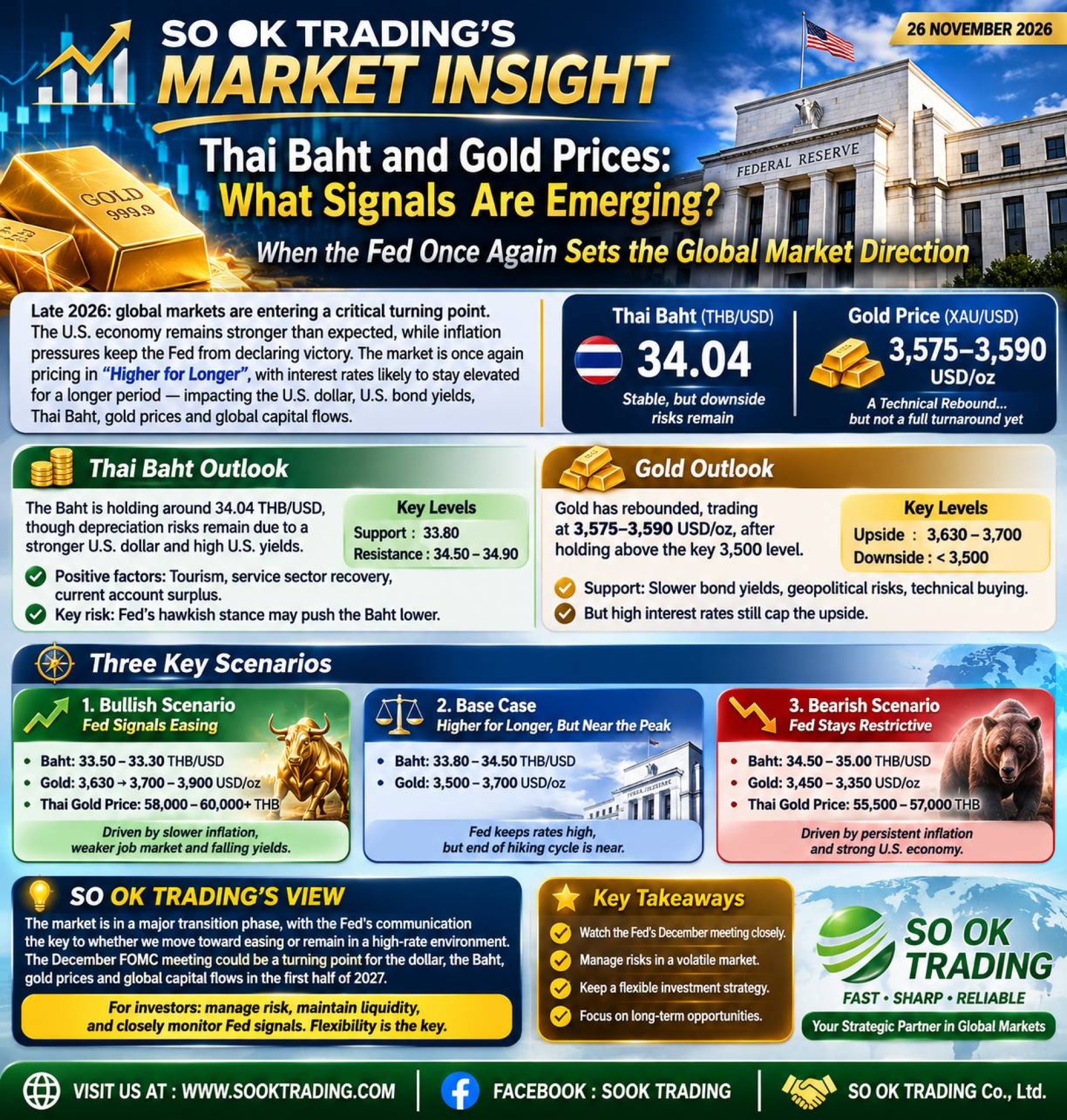
The Thai baht is currently trading around 34.04 per U.S. dollar, maintaining relative stability despite continued pressure from a stronger dollar and a prolonged high-interest-rate environment in the United States.
From a structural perspective, the resilience of the U.S. economy continues to attract capital flows into dollar-denominated assets. At the same time, elevated U.S. Treasury yields remain highly attractive to institutional investors, placing persistent pressure on emerging market currencies, including the Thai baht.
However, domestic fundamentals have started to provide meaningful support. Rising tourism revenues during Thailand's high season, an improving services sector, and a gradual recovery in the current account balance have helped offset some of the external headwinds.
From a strategic standpoint, the 33.80 level remains an important dividing line between consolidation and a renewed appreciation trend for the baht. On the upside, the 34.50-34.90 range could come back into focus if the Fed adopts a more hawkish tone than markets currently expect at the December FOMC meeting.
Gold Is Recovering, But Still Needs to Prove Itself
In the precious metals market, gold (XAU/USD) has rebounded toward the $3,575-$3,590 per ounce range, supported by its ability to hold above the key psychological support level of $3,500.
The recent recovery has been driven by several factors, including a temporary moderation in Treasury yields, ongoing geopolitical uncertainties in the Middle East, and technical buying following a sharp correction in previous months.
Nevertheless, the broader fundamental backdrop remains challenging.
Higher interest rates continue to increase the opportunity cost of holding gold, a non-yielding asset. As long as real yields remain elevated, gold's upside potential is likely to remain constrained.
As a result, the current rally appears more consistent with a technical rebound than the beginning of a new structural bull market. Future price action will largely depend on how investors interpret the Fed's policy outlook for 2027.
If gold can establish a sustainable foothold above $3,600 per ounce, the market could advance toward the $3,630-$3,700 range.
Conversely, a move back below $3,500 could trigger renewed selling pressure and increase the likelihood of a retest of previous lows.
Investment Scenarios Investors Should Prepare For
Looking ahead to late 2026 and the first quarter of 2027, three primary scenarios appear most relevant.
Bullish Scenario: The Fed Begins Signaling a Policy Pivot
If U.S. inflation slows faster than expected, labor market conditions gradually cool, and Treasury yields continue to decline, investors may begin pricing in future rate cuts during 2027.
Under this scenario, the Thai baht could appreciate toward 33.50-33.30 per dollar, while gold could break above $3,630 and potentially advance toward the $3,700-$3,900 range.
For Thai investors, domestic gold prices could move back toward THB 58,000-60,000, or even higher should safe-haven demand strengthen further.
Bearish Scenario: The Fed Remains Hawkish for Longer
Alternatively, if inflation remains stubbornly high and the U.S. economy continues to display resilience, the Federal Reserve may have little incentive to change its policy stance anytime soon.
In this environment, the U.S. dollar could remain firm, pushing the Thai baht toward the 34.50-35.00 range.
Gold would likely face additional headwinds, with downside risks extending toward $3,450-$3,350 per ounce.
Although a weaker baht could help cushion some of the impact on domestic gold prices, Thai gold could still retreat into the THB 55,500-57,000 range.
Base Case Scenario: Higher for Longer, But Near the Peak
At present, markets appear to assign the highest probability to neither an aggressively bullish nor bearish outcome.
Instead, the prevailing view is that the Federal Reserve will keep rates elevated for some time, while the current tightening cycle is approaching its final phase.
Under this base-case scenario, the Thai baht is likely to trade within the 33.80-34.50 range, while gold fluctuates between $3,500 and $3,700 per ounce as investors await clearer policy signals.
Market reactions will continue to be driven by incoming U.S. economic data and Fed communication, but a decisive trend in either direction may remain elusive in the near term.
SO OK TRADING'S VIEW
The market is no longer focused solely on where interest rates are today. The real question is how the Fed will communicate its future policy path.
What investors are increasingly trying to assess is when the Federal Reserve will begin shifting its priorities from fighting inflation toward supporting economic growth.
In our view, global markets are currently navigating one of the most important transition phases since the beginning of the current monetary tightening cycle. The upcoming December FOMC meeting could become a pivotal event, influencing the direction of the U.S. dollar, the Thai baht, gold prices, and global capital flows throughout the first half of 2027.
For investors, effective risk management, liquidity preservation, and close monitoring of Fed signals remain far more important than attempting to predict short-term price fluctuations.
In an environment where market conviction remains limited and uncertainty persists, maintaining portfolio flexibility may prove to be the most valuable investment strategy of all.
SO OK TRADING: Your Trusted Business Partner
SO OK TRADING: FAST • SHARP • RELIABLE
VISIT US AT: www.sooktrading.com
FACEBOOK: SOOK TRADING