SO OK TRADING'S INSIGHT | New 18% U.S. Tariffs: Thai Exporters and the World Face a Challenge Greater Than Trade War | 26 NOV 2026
SO OK TRADING'S INSIGHT
From Tariff Barriers to Supply Chain Barriers: As the U.S. Rewrites the Rules of Global Trade, Thailand Must Adapt Fast
26 NOV 2026
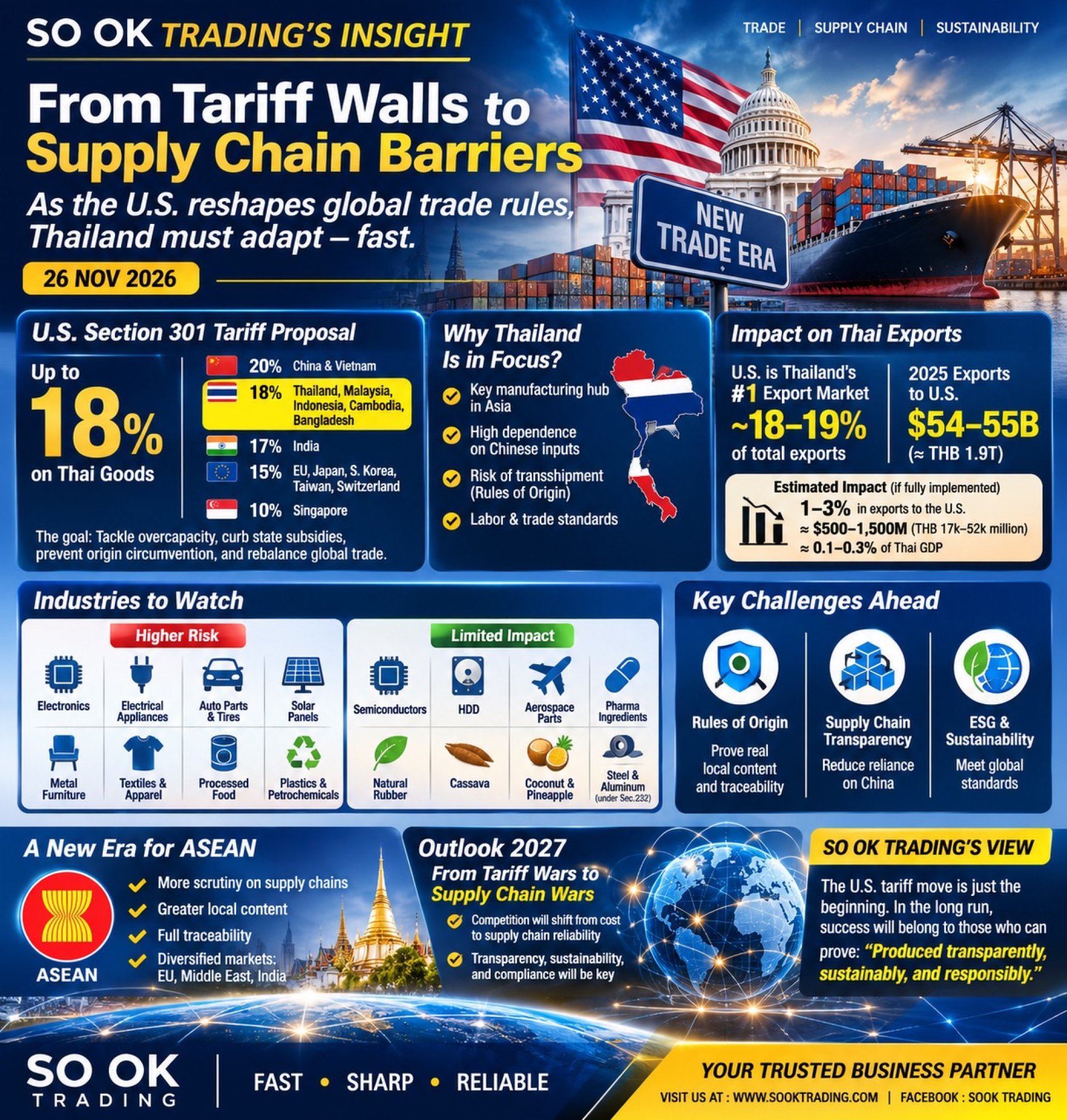
The proposed Section 301 tariffs of up to 18% on Thai exports are more than just a trade measure. They signal a major transformation in the global trading system.
The United States is increasingly using tariffs as a strategic tool to reorganize supply chains, reduce dependence on China, and tighten scrutiny of product origins.
For Thailand, future competitiveness will no longer be measured solely by production costs. It will depend on the transparency, sustainability, and credibility of its entire supply chain.
Global trade is approaching another major turning point.
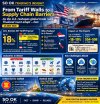
The U.S. Trade Representative (USTR) has proposed a new round of import tariffs under Section 301 targeting 14 economies worldwide. Thailand has been placed among the countries that could face tariffs of up to 18%, a rate comparable to several ASEAN economies and among the highest in the region, behind only China and Vietnam.
Although the proposal is still under public consultation and has not yet taken effect, it sends a clear signal that the United States is shifting its trade strategy from using tariffs as a broad trade weapon toward reshaping global supply chains and reducing reliance on China.
Where Does Thailand Stand in the New U.S. Tariff Framework?
The proposed maximum tariff rates are as follows:
20%: China and Vietnam
18%: Thailand, Malaysia, Indonesia, Cambodia, and Bangladesh
17%: India
15%: European Union, Japan, South Korea, Taiwan, and Switzerland
10%: Singapore
The primary objectives of these measures are to address:
Global overcapacity
Market distortions caused by state subsidies
Unfair trade practices
The use of third countries as alternative export routes to bypass U.S. tariffs on Chinese goods
Why Is Thailand Under the Spotlight?
From Washington's perspective, Thailand is a key manufacturing hub in Asia with deep ties to regional supply chains, particularly those linked to China.
The main concerns cited by U.S. policymakers include:
Thailand's export-driven economic model
Growing investment and imports from China
Risks associated with Rules of Origin circumvention
Labor standards and market access concerns
These issues suggest that future U.S. trade policies will focus not only on where a product is exported from, but also on where its components, capital, and value creation originate.
How Vulnerable Are Thai Exports?
The United States remains Thailand's largest export market, accounting for approximately 18-19% of total exports.
In 2025, Thailand's exports to the United States exceeded US$54-55 billion, equivalent to around THB 1.9 trillion.
While the proposed tariff rate is as high as 18%, more than 50% of Thai exports to the U.S. are expected to remain exempt or face only limited impact, which may soften the short-term economic effects.
However, if the measures are implemented in full, some economists estimate that:
Thai exports to the U.S. could decline by 1-3%
Equivalent to US$500 million to US$1.5 billion
Or approximately THB 17-52 billion annually
Potentially reducing Thailand's GDP by 0.1-0.3%
Although the macroeconomic impact may remain manageable, export-oriented industries with heavy exposure to the U.S. market are likely to face growing pressure.
Industries That Deserve Close Attention
The sectors most likely to experience heightened scrutiny include:
Electronics and ICT products
Electrical appliances
Automotive parts and tires
Solar panels
Metal furniture
Textiles and apparel
Processed food products
Plastics and petrochemicals
The electronics sector is particularly vulnerable, as it represents one of Thailand's largest export categories to the United States and remains deeply integrated with Chinese supply chains.
Industries Likely to Face Limited Impact
Several sectors may remain relatively insulated from the new measures, including:
Semiconductors and integrated circuits
Hard Disk Drives (HDDs)
Aerospace components
Pharmaceutical raw materials
Natural rubber
Cassava products
Coconut and pineapple products
Products already covered under Section 232 measures, such as steel and aluminum
Nevertheless, the most critical factor will not be the product category itself, but rather the level of Local Content and the ability to verify a product's origin transparently.
The Real Turning Point: Rules of Origin
For businesses, the most important issue is not the tariff rate itself, but the tightening enforcement of Rules of Origin.
The United States is expected to scrutinize more closely:
How much value is genuinely created in Thailand
The proportion of Chinese components and materials used
Whether supply chains can be traced and verified
Products viewed as simply carrying out final assembly in Thailand while relying heavily on Chinese inputs may lose preferential treatment and potentially face tariff treatment similar to Chinese exports.
ASEAN Is Entering the Era of Supply Chain Competition
The latest proposal also suggests that the traditional "China Plus One" strategy is entering a new phase.
In the past, companies relocated production from China to Southeast Asia primarily to reduce trade war risks. Going forward, however, the United States is likely to focus less on where factories are located and more on how transparent and resilient their supply chains are.
Potential outcomes include:
Slower new investment flows into ASEAN in the short term
Greater emphasis on Local Content
Stronger supply chain traceability requirements
Accelerated diversification into markets such as Europe, the Middle East, India, and emerging economies
Outlook 2027: From Trade War to Supply Chain War
Beyond 2027, global trade competition is shifting from a focus on cost efficiency to a focus on supply chain credibility.
The key questions will no longer be:
"Where was this product manufactured?"
Instead, markets and regulators will increasingly ask:
Where do the raw materials come from?
Who owns and finances the investment?
Can the supply chain be traced and audited?
Does the product comply with ESG and Trade Compliance standards?
For Thailand, the challenge is not simply an 18% tariff. It is about upgrading industries, increasing domestic value creation, and building transparent supply chains that meet the standards of a rapidly evolving global trade environment.
SO OK TRADING'S VIEW
The latest U.S. tariff proposal may be just the beginning of a broader transformation in global trade.
In the years ahead, Supply Chain Management, Local Content, ESG, and Trade Compliance will become just as important as production costs and labor competitiveness.
For Thai businesses, this is not merely a tariff risk. It is a wake-up call.
The winners in the next era of global trade will not necessarily be those with the lowest costs, but those that can prove their supply chains are:
✅ Transparent
✅ Traceable
✅ Sustainable
✅ Trusted
Final Thought
After 2027, the winners may not be the countries that produce at the lowest cost, but those that can demonstrate that their supply chains are transparent, sustainable, and trusted by global markets.
SO OK TRADING | Your Trusted Business Partner
FAST • SHARP • RELIABLE
Visit Us: www.sooktrading.com
Facebook: SOOK TRADING
Connecting Global Industries, Creating Sustainable Value.