SO OK TRADING'S INSIGHT | "When Chinese Steel Floods the World, Who Will Win the Next Steel War? From Price Competition to the Green Steel Revolution" | 24 NOV 2026
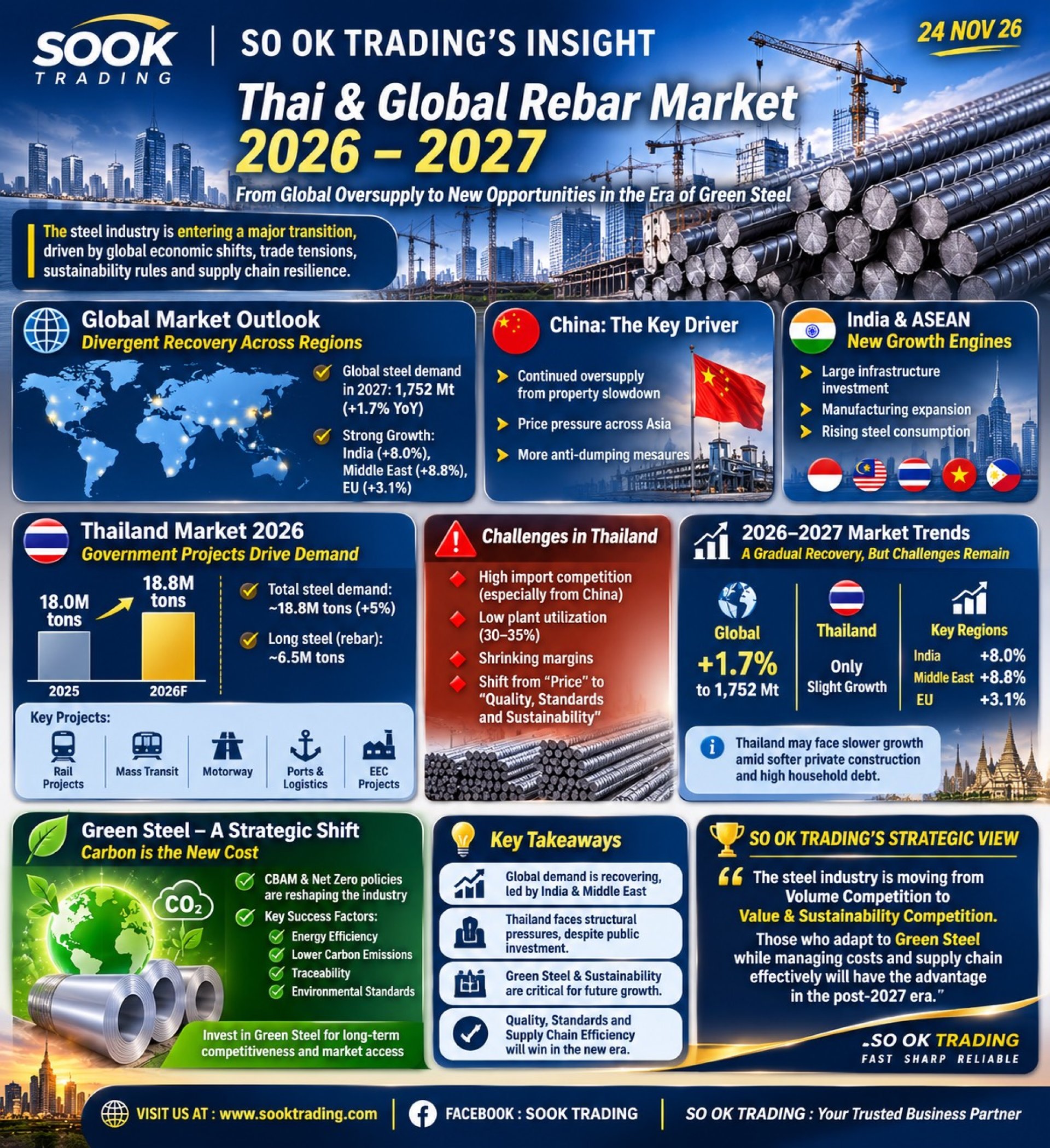
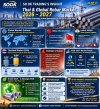
Thailand Construction Rebar Market Overview (2026)
Government Investment Remains the Primary Demand Driver
Thailand's steel demand is expected to record modest growth in 2026, supported primarily by public infrastructure projects and large-scale developments within the Eastern Economic Corridor (EEC).
Total steel demand is projected to reach approximately 18.8 million tonnes, representing growth of around 5% year-over-year, while demand for long steel products, including construction rebar, is expected to reach approximately 6.5 million tonnes.
Major projects driving steel consumption include:
Double-track railway projects
Urban rail transit systems
Expressways and motorways
Port and logistics infrastructure
Industrial developments within the EEC
Nevertheless, recovery in Thailand's private real estate sector remains gradual. Elevated household debt levels, constrained purchasing power, and a high-interest-rate environment continue to limit overall market expansion.
Structural Challenges Facing Thailand's Steel Industry
Despite signs of demand recovery, Thai steel producers continue to face significant competitive pressure from regional and international suppliers.
Thailand remains heavily dependent on imported steel and raw materials, particularly from China, which continues to be the world's largest steel exporter.
The consequences include:
Domestic capacity utilization rates of only 30-35%
Continued margin compression for manufacturers and traders
Limited pricing power within the domestic market
Increased pressure from low-cost imported steel products
As a result, Thailand's steel industry is gradually shifting away from competing primarily on price and moving toward competition based on quality, standards, and sustainability.
Global Steel Market 2026
When Oversupply Becomes a Global Challenge
The global steel industry continues to face the challenge of Global Steel Oversupply throughout 2026.
Although worldwide steel demand is expected to remain around 1.722 billion tonnes, slower-than-expected recoveries in construction and real estate sectors across many economies continue to create a persistent imbalance between supply and demand.
China: The Key Driver of Global Steel Market Direction
China remains the single most influential factor shaping the future of the global steel industry.
The continued weakness of China's real estate sector has resulted in significant excess production capacity being redirected toward export markets.
Consequently:
Steel prices across Asia remain under pressure
Price competition continues to intensify
Producers in emerging economies face increasing margin pressure
Anti-Dumping (AD) measures are being expanded globally
Although China's property market has shown signs of stabilization, excess production capacity remains elevated, suggesting continued pressure on Asian steel markets through 2027.
India and ASEAN:
The New Growth Engines of the Global Steel Industry
As China enters a phase of structural adjustment, India is rapidly emerging as the world's new steel growth engine.
Key growth drivers include:
Massive infrastructure investments
Expansion of the manufacturing sector
Urbanization and city development
Strong real estate activity
Supply chain relocation under the China+1 strategy
At the same time, ASEAN-5 economies continue to benefit from foreign direct investment inflows and accelerating infrastructure development, positioning the region as one of the fastest-growing steel-consuming markets globally.
Outlook for 2027:
Global Recovery Gains Momentum While Thailand Faces Structural Pressures
The outlook for 2027 signals a clearer recovery in the global economy.
Global steel demand is expected to grow by approximately 1.7%, reaching 1.752 billion tonnes.
The strongest-performing regions are projected to be:
India (+8.0%)
Middle East (+8.8%)
European Union (+3.1%)
Thailand, however, may experience a different trajectory.
Slower public-sector investment growth and a still-recovering real estate market are expected to limit domestic steel demand growth, even as the global economy gains strength.
On the positive side, stricter industrial standards and measures aimed at restricting low-quality imports could help create a fairer competitive environment for domestic manufacturers over the longer term.
Green Steel:
A Strategic Turning Point for the Global Steel Industry
Beyond pricing and production capacity, sustainability considerations are becoming central to long-term competitiveness in the steel sector.
The European Union's Carbon Border Adjustment Mechanism (CBAM) and Net Zero policies worldwide are transforming carbon emissions into a critical business cost that can no longer be ignored.
Future competitiveness will increasingly be evaluated based on:
Energy efficiency
Greenhouse gas emissions
Raw material traceability
Environmental certification and sustainability standards
Consequently, investment in Green Steel is no longer simply an ESG initiative. It has become a strategic requirement for maintaining market access and long-term competitiveness in the global steel industry.
The Steel Industry Is Entering a New Era
The global steel industry is transitioning from an era defined primarily by production volumes and pricing to one driven by value creation and sustainability.
In the short term, China's surplus production capacity will likely continue to pressure global markets, while Thailand faces challenges from imported steel products and sluggish private-sector construction activity.
However, in the medium to long term, growing infrastructure investments across India, ASEAN, and the Middle East, combined with the global transition toward a low-carbon economy, are creating new opportunities for growth.
For Thai businesses, future success will depend not simply on competing on price, but on strengthening:
Quality. Standards. Sustainability. And Supply Chain Excellence.
SO OK TRADING'S STRATEGIC VIEW
"The global steel industry is transitioning from an era of Volume Competition to an era of Value & Sustainability Competition. Companies that successfully adapt to the Green Steel transition while effectively managing costs and supply chains will be best positioned to thrive in the new global steel landscape beyond 2027."
SO OK TRADING | Your Trusted Business Partner
FAST • SHARP • RELIABLE
WWW.SOOKTRADING.COM
Facebook: SOOK TRADING