SO OK TRADING'S INSIGHT | When the Thai Baht Hits a 19-Month Low: Is the Dollar Index Signaling a Warning, or Is the World Entering a New Strong Dollar Era? | 23 NOV 2026
SO OK TRADING'S INSIGHT
When the Thai Baht Hits a 19-Month Low and the Dollar Index Holds Above 103: A Warning Signal or a Turning Point for Global Financial Markets?
23 NOV 2026
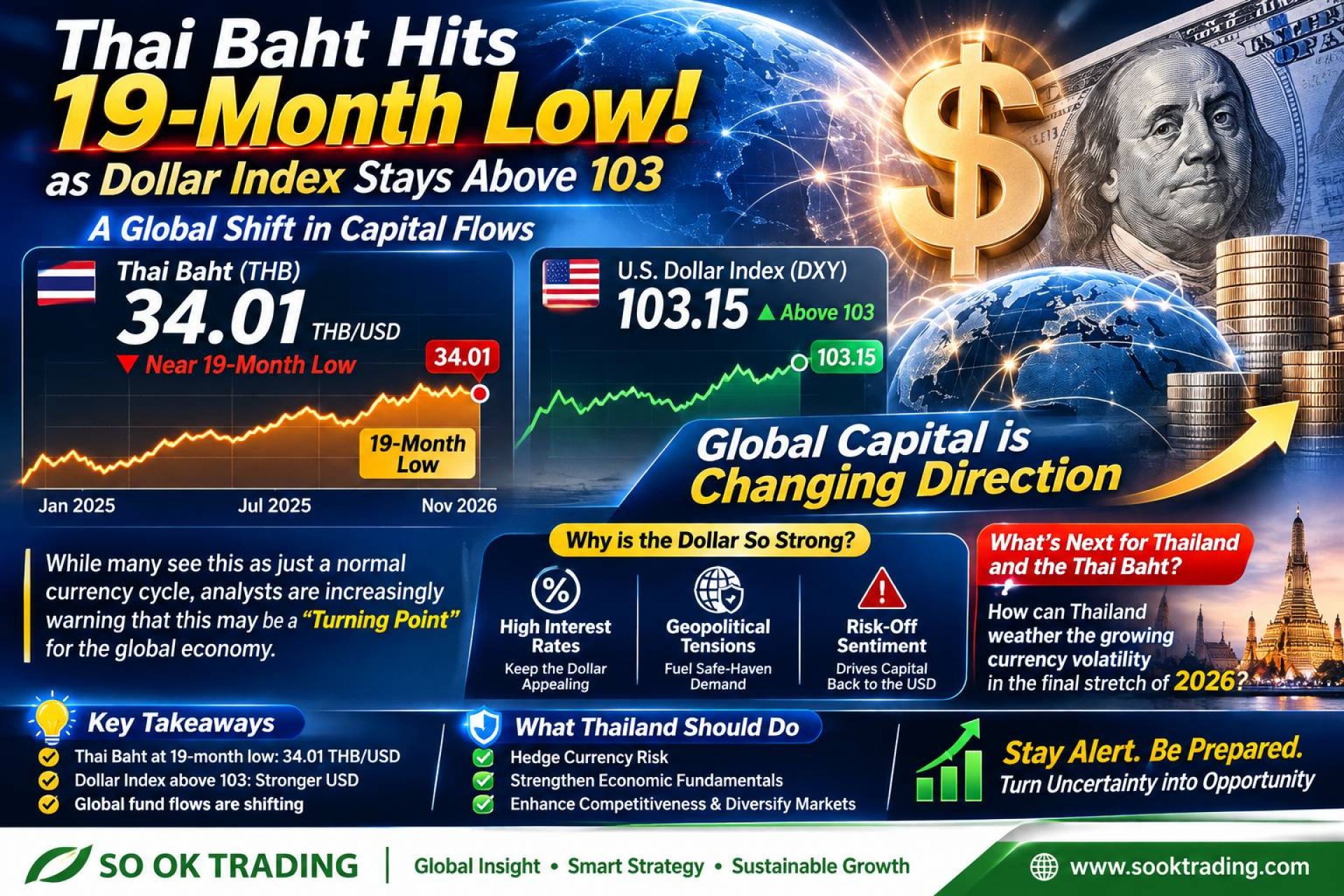
On the morning of November 23, 2026, global financial markets are once again closely watching currency movements. The Thai Baht weakened to around 33.95–33.99 per U.S. dollar, marking its weakest level in approximately 19 months. Meanwhile, the U.S. Dollar Index (DXY) continues to trade above the 103 level, hovering near its highest range in several months.
At first glance, this may appear to be nothing more than a stronger U.S. dollar and a weaker Thai Baht. In reality, however, it reflects a much broader shift in the global financial landscape, driven by interest rate expectations, capital flows, demand for safe-haven assets, and geopolitical uncertainties that continue to influence investor sentiment worldwide.
What makes this period particularly significant is that the decisions made by the U.S. Federal Reserve (Fed) over the coming weeks could play a decisive role in shaping currency markets and global capital flows throughout 2027.
Why Is the Thai Baht Weakening So Rapidly?
The recent depreciation of the Thai Baht is not the result of a single factor. Instead, it is the combination of several powerful market forces converging at the same time.
The first factor is the ongoing strength of the U.S. dollar, supported by market expectations that the Fed may not yet be ready to bring its tightening cycle to an end.
The second factor is the continued movement of global capital away from emerging markets and into safe-haven assets, particularly U.S. Treasury bonds, which continue to offer attractive yields.
The third factor is the volatility in global gold prices. Thailand is one of Asia's key gold trading hubs, and fluctuations in gold prices often have a meaningful impact on the value of the Baht.
As a result of these three forces acting simultaneously, the Thai Baht has weakened more rapidly than many other Asian currencies.
What Is the Dollar Index Telling Us?
The Dollar Index, which measures the strength of the U.S. dollar against a basket of major global currencies, remains firmly above the 103 level.
Its ability to maintain levels near 104 suggests that investors continue to believe:
The U.S. economy remains stronger than many of its global peers.
Inflation has not yet fallen enough to justify a significant policy pivot by the Fed.
The U.S. dollar remains one of the world's preferred safe-haven assets.
Should U.S. economic data exceed expectations this week, the Dollar Index could once again challenge the 104 level or potentially move even higher.
What Is the Market Watching This Week?
Investors worldwide are closely monitoring several key U.S. economic indicators.
October PCE Inflation
The Personal Consumption Expenditures (PCE) Index is the inflation measure most closely watched by the Federal Reserve.
If inflation remains elevated, markets may interpret it as a sign that interest rates will need to remain higher for longer.
Manufacturing and Services PMI
The Purchasing Managers' Index (PMI) will provide insight into whether the U.S. economy remains resilient or is beginning to slow.
Stronger-than-expected figures would likely provide additional support for the U.S. dollar.
The Fed Beige Book
The Beige Book offers valuable insight into how the Federal Reserve views current economic conditions, business activity, and inflation pressures across different regions of the United States.
Meanwhile, in Thailand, investors are awaiting the latest export and import figures alongside foreign fund flow data, all of which could have a significant impact on the direction of the Thai Baht.
How Far Could the Thai Baht Move?
Based on current fundamentals and market sentiment, the Thai Baht is expected to trade within a range of approximately 33.80–34.10 per U.S. dollar this week.
If Thailand's economic data outperform expectations and global gold prices recover, the Baht could strengthen back toward the 33.80 level.
However, if U.S. inflation remains stubbornly high or the Federal Reserve adopts a more hawkish stance than anticipated, the Baht could weaken beyond 34.10 and potentially test the 34.20–34.30 range in the short term.
At present, the most likely average trading zone remains around 33.95–34.00 per dollar, reflecting a balance between persistent demand for dollars and support from domestic economic factors.
Global Currency Outlook: Winners and Losers
While the U.S. dollar has emerged as the strongest performer in the current environment, other major currencies continue to face their own unique challenges.
The Euro (EUR) remains under pressure as Europe's economic recovery continues to lag behind that of the United States, limiting its upside potential.
The British Pound (GBP) remains one of the strongest developed-market currencies, supported by relatively high interest rates and resilient economic activity.
The Japanese Yen (JPY) continues to weaken and is approaching the critical psychological level of 160 yen per U.S. dollar, increasing market speculation about potential intervention by Japanese authorities.
The Chinese Yuan (CNY) has remained relatively stable, supported by active management from the People's Bank of China (PBOC).
For Thai investors, one notable observation is that while many currencies have weakened against the U.S. dollar, they have actually strengthened against the Thai Baht, highlighting the Baht's relative underperformance within the region.
Could 2027 Be a Turning Point for Global Currency Markets?
Although the U.S. dollar remains strong in the short term, a growing number of global research institutions believe the Federal Reserve is approaching the end of its interest rate tightening cycle.
If the Fed eventually pauses further rate hikes and inflation begins to move closer to its target, the currency landscape in 2027 could look very different from what we see today.
Under such a scenario:
The U.S. dollar could gradually enter a weakening cycle.
Asian currencies could begin to recover.
Global capital may return to emerging markets.
The Thai Baht could strengthen back into the 33.00–33.80 range.
This recovery could be supported by Thailand's tourism sector, export growth, and increasing investment in technology-related industries, including electronics manufacturing and the rapidly expanding Data Center ecosystem across Asia.
SO OK TRADING'S STRATEGIC VIEW
What is happening today may be more than just another episode of Baht depreciation.
It could represent one of the first signs that the major U.S. dollar strength cycle, which began in 2025, is approaching its later stages.
In the short term, businesses and investors should remain vigilant and actively manage their currency exposure, particularly if the Thai Baht once again tests the psychologically important 34.00 level.
However, from a medium- to long-term perspective, the more important question may not be:
"How much further can the U.S. dollar rise?"
Instead, investors should be asking:
"Is the world moving from an era of Dollar Strength toward a new era of Asian Currency Recovery?"
The answer may begin to emerge through the market movements unfolding this very week.
SO OK TRADING
Your Business Partner
SO OK TRADING : FAST • SHARP • RELIABLE
VISIT US AT: www.sooktrading.com
FACEBOOK: SOOK TRADING
Delivering Global Market Insights. Creating Opportunities. Building Partnerships.