SO OK TRADING'S INSIGHT | When Carbon Becomes the New Cost of Global Competition: Solar Cell, Wood Pellet and RDF-3 as the Three Pillars Shaping Thailand’s Industrial Future in the Era of Net Zero and CBAM | 20 NOV 2026
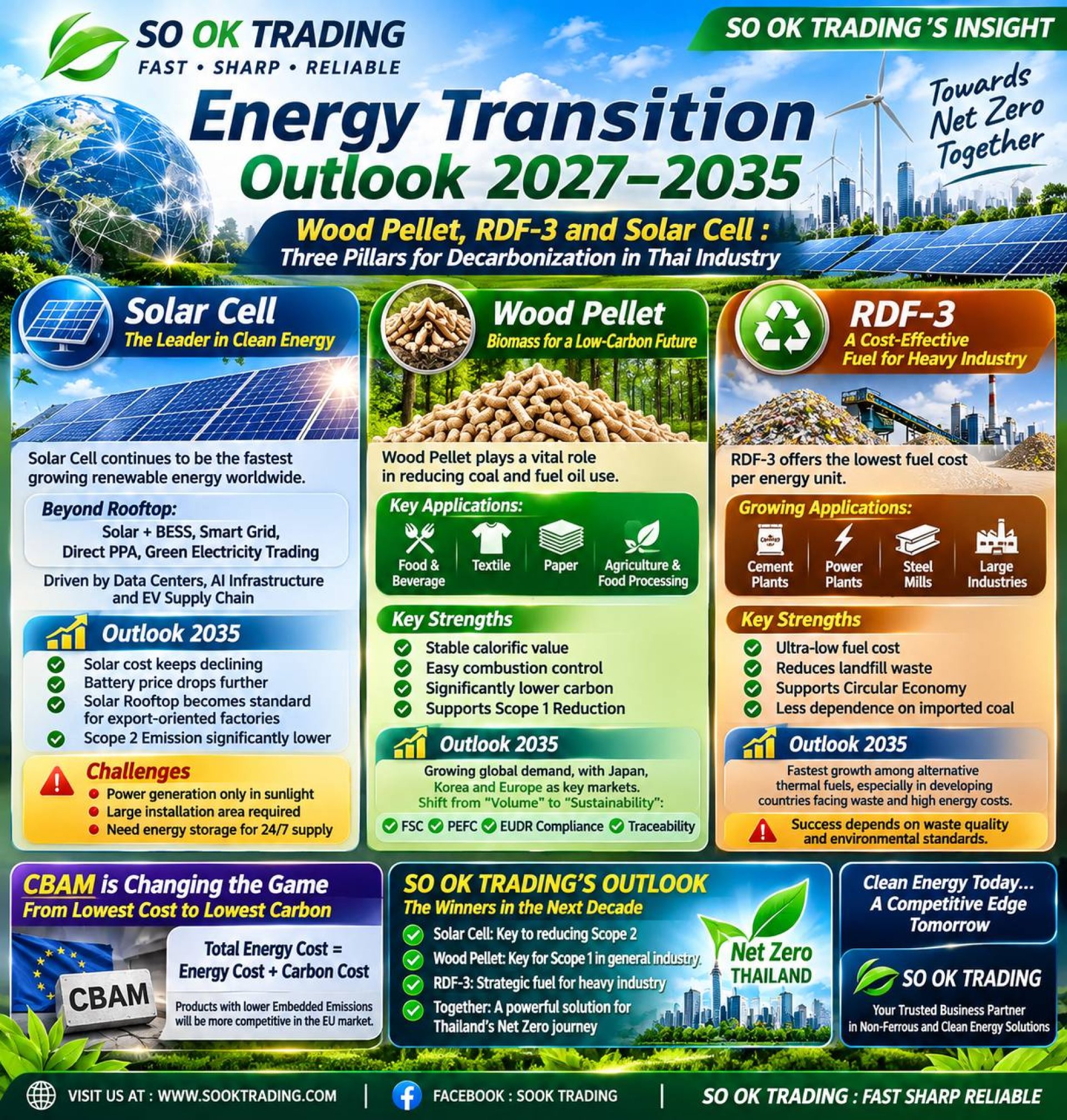
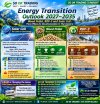
SO OK TRADING'S INSIGHT : Energy Transition Outlook 2027–2035 | 20 NOV 2026
Wood Pellet, RDF-3 and Solar Cell:
The Three Pillars of Decarbonizing Thailand’s Industrial Sector
Over the next decade, the world is entering an era where carbon cost will be just as important as, if not more important than, energy cost. The implementation of the European Union’s Carbon Border Adjustment Mechanism (CBAM), the expansion of carbon markets, and the Net Zero commitments of countries worldwide are transforming renewable energy from an “option” into a “strategic necessity.”
For Thailand’s industrial sector, Wood Pellet, RDF-3, and Solar Cell technologies are becoming essential tools for reducing greenhouse gas emissions while enhancing competitiveness in global markets.
1. Solar Cell:
Leading the Transition in Electrical Energy
Solar Cell technology remains the fastest-growing renewable energy source in the world.
What was once primarily an investment in Solar Rooftop systems to reduce electricity bills has now expanded into broader areas, including:
• Solar + BESS (Battery Energy Storage System)
• Smart Grid
• Direct PPA
• Green Electricity Trading
This trend is being driven by the rapid growth of Data Centers, AI Infrastructure, and EV Supply Chains, all of which require reliable access to clean electricity around the clock.
Outlook 2035
✅ Continued decline in solar panel costs
✅ Falling battery storage costs
✅ Solar Rooftop becoming the new standard for export-oriented factories
✅ Significant reductions in Scope 2 emissions
Challenges
⚠️ Electricity generation depends on sunlight availability
⚠️ Large installation areas are required
⚠️ Energy storage systems are necessary to support 24-hour operations
2. Wood Pellet:
Biomass Energy Powering a Low-Carbon Economy
Wood Pellet continues to play a vital role in reducing coal and fuel oil consumption across industrial sectors.
It is particularly well-suited for industries such as:
• Food and Beverage
• Textiles
• Paper Manufacturing
• Agricultural Processing
These sectors rely heavily on boilers for thermal energy production.
Key Advantages
✅ Consistent heating value
✅ Easy combustion control
✅ Significantly lower carbon emissions than coal
✅ Highly effective for reducing Scope 1 emissions
Outlook 2035
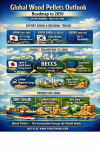
The global Wood Pellet market is expected to continue expanding, with Japan, South Korea, and Europe remaining the primary consumers.
However, market dynamics are shifting from a focus on volume to a focus on sustainability and compliance, including:
• Sustainability Certification
• FSC Certification
• PEFC Certification
• EUDR Compliance
• Traceability
Manufacturers capable of providing transparent and verifiable sourcing information will gain a competitive advantage.
3. RDF-3:
The Rising Star of Cost-Efficient Fuel for Heavy Industry
When considering fuel cost per unit of energy, RDF-3 is among the most competitive alternative fuels available today.
Its cost can be significantly lower than that of Wood Pellet, making it increasingly attractive for:
• Cement Plants
• Power Plants
• Steel Mills
• Large-Scale Industrial Facilities
Key Advantages
✅ Extremely low fuel costs
✅ Reduces landfill waste
✅ Supports the Circular Economy concept
✅ Lowers dependence on imported coal
Outlook 2035
RDF-3 is expected to become one of the fastest-growing alternative thermal fuels globally.
Its growth is particularly attractive for developing countries facing:
• Increasing municipal waste volumes
• Rising energy costs
• Greater pressure to reduce carbon emissions
However, the long-term success of RDF markets will depend heavily on waste separation quality and strict environmental compliance standards.
CBAM Is Reshaping Energy Decision-Making
In the past, factories typically selected energy sources based on one simple criterion:
“The Lowest Cost”
However, in the CBAM era, the calculation is changing to:
Total Energy Cost = Energy Cost + Carbon Cost
Manufacturers that successfully reduce the Embedded Emissions of their products will benefit from lower carbon-related export costs and stronger competitiveness in European markets.
As a result, Wood Pellet and RDF-3 are no longer merely alternative fuels, and Solar Cell is no longer just an electricity-saving solution.
All three are becoming strategic assets for organizations seeking to maintain competitiveness in the low-carbon economy.
SO OK TRADING'S OUTLOOK
The winners of the next decade will not be the factories that consume the cheapest energy.
They will be the factories capable of producing goods with the lowest carbon footprint while maintaining competitive costs.
Solar Cell will become the cornerstone of Scope 2 emission reduction.
Wood Pellet will remain a key solution for reducing Scope 1 emissions across a wide range of industries.
Meanwhile, RDF-3 will serve as a powerful tool for heavy industries seeking to optimize fuel costs while advancing decarbonization efforts.
When these three technologies are integrated effectively, Thailand’s industrial sector will be well-positioned to accelerate its transition toward Net Zero, adapt to emerging global trade regulations, and transform the challenges posed by CBAM into long-term competitive advantages.
SO OK TRADING
Your Trusted Business Partner
SO OK TRADING : FAST • SHARP • RELIABLE
VISIT US AT: www.sooktrading.com
FACEBOOK: SOOK TRADING
Interested in Wood Pellet, RDF-3, or Solar Cell Solutions?
Contact us today.
SO OK TRADING is ready to support your organization’s decarbonization journey, energy transition strategy, and sustainable growth objectives in the Net Zero era.