SO OK TRADING'S INSIGHT | Battery Recycling: From a Waste Management Business to the “Mine of the Future” How EV Battery Waste Is Reshaping the Global Resource Landscape | 17 NOV 2026
SO OK TRADING'S INSIGHT
Battery Recycling: From a Waste Management Business to the "Mine of the Future"
How End-of-Life EV Batteries Are Reshaping the Global Resource Landscape
From Waste Management to a Strategic Industry
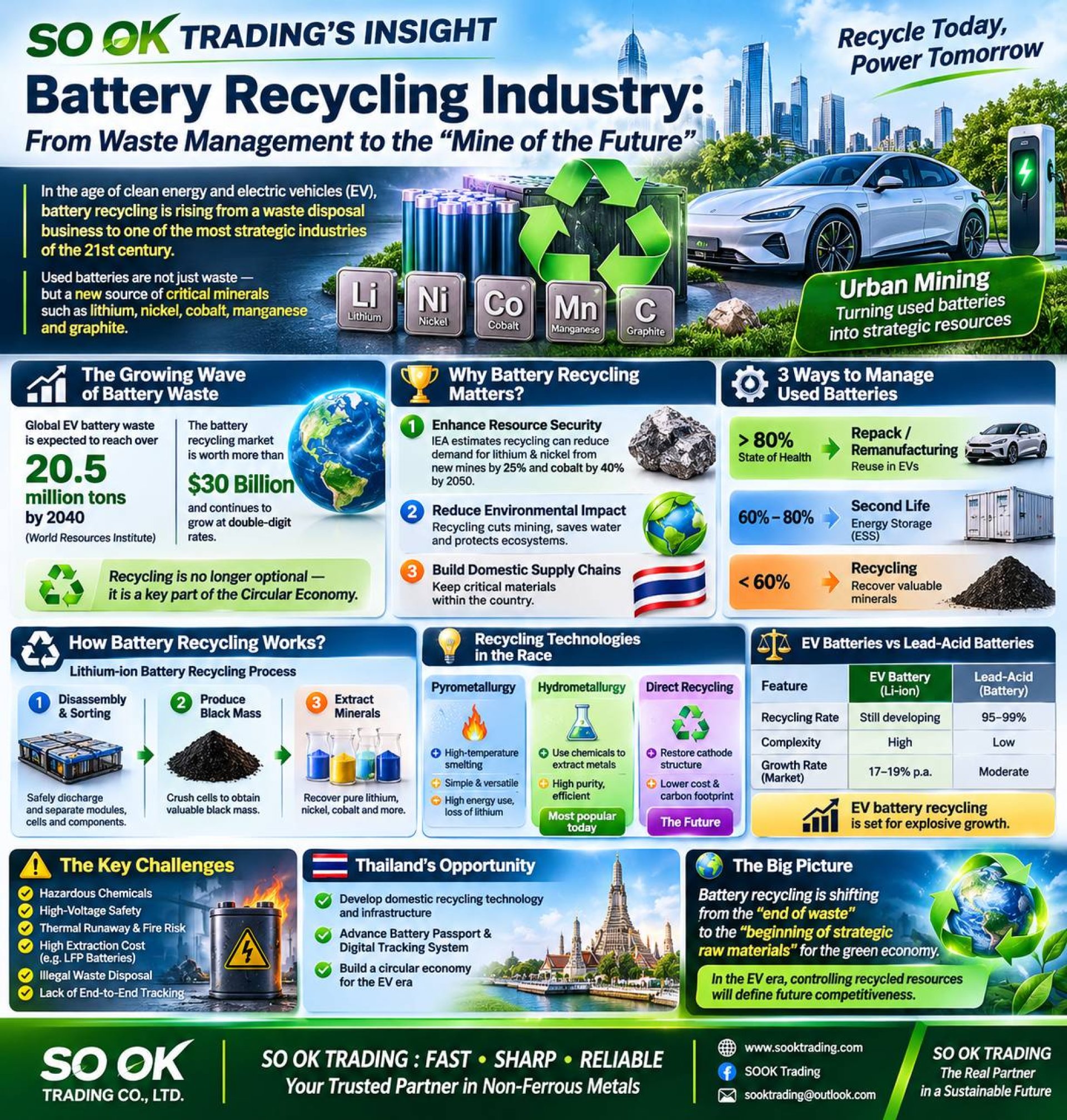
As the world accelerates its transition toward clean energy and electric vehicles (EVs), the Battery Recycling Industry is rapidly evolving from a traditional waste management business into one of the most strategically important industries of the 21st century.
The significance of battery recycling extends far beyond hazardous waste management. End-of-life batteries contain valuable critical minerals such as lithium, nickel, cobalt, manganese, and graphite, all of which are essential for the global energy and technology sectors.
As a result, many countries are beginning to view used batteries not as waste, but as "Urban Mines" capable of reducing supply chain risks and decreasing dependence on conventional mining activities.
The Battery Waste Wave Is Coming
The rapid expansion of the EV market over the past several years is leading to a significant increase in the number of batteries reaching the end of their useful lives.
The World Resources Institute projects that global EV battery waste will exceed 20.5 million tons by 2040. Meanwhile, the global battery recycling market is already valued at more than USD 30 billion and is expected to continue growing at a double-digit annual rate.
Battery recycling is therefore no longer optional. It has become a critical pillar of the Circular Economy in the clean energy era.
Why Battery Recycling Matters
1. Strengthening Resource Security
Critical minerals such as lithium, nickel, and cobalt are concentrated in only a handful of countries, exposing global supply chains to geopolitical risks and procurement challenges.
According to the International Energy Agency (IEA), battery recycling could reduce demand for newly mined lithium and nickel by up to 25% and cobalt by up to 40% by 2050.
2. Reducing Environmental Impact
Mining new minerals requires significant amounts of energy and water while causing environmental disruption.
Recovering materials from used batteries can significantly reduce the environmental footprint associated with traditional resource extraction.
3. Building Domestic Supply Chains
Many countries are rapidly developing their own battery recycling ecosystems to ensure that valuable materials can be circulated and reused within national manufacturing systems.
Three Pathways for Used EV Batteries
Before entering the recycling stream, batteries are typically evaluated based on their remaining performance level, commonly referred to as the State of Health (SOH).
More Than 80% Remaining Capacity
Repack / Remanufacturing
High-performing batteries can be repaired, refurbished, and returned to service in electric vehicles.
60% – 80% Remaining Capacity
Second Life Applications
Batteries can be repurposed for stationary energy storage systems (ESS), including:
Solar farms
Commercial buildings
Industrial facilities
Backup power systems
Grid-support applications
Less Than 60% Remaining Capacity
Recycling
Batteries are processed to recover critical minerals and convert them into raw materials for new battery production.
How Lithium-Ion Battery Recycling Works
Recycling EV batteries is considerably more complex than recycling conventional batteries due to their high voltage, large size, and diverse chemical compositions.
Step 1: Disassembly and Sorting
Battery packs are safely discharged before modules, cells, aluminum structures, cooling systems, and electronic components are separated.
Step 2: Black Mass Production
Battery cells are shredded under controlled conditions to produce a concentrated black powder known as Black Mass, which contains valuable recoverable materials.
Step 3: Material Recovery
Advanced technologies are used to extract and purify lithium, nickel, cobalt, and other minerals to battery-grade specifications suitable for reuse in manufacturing.
The Technologies Driving Battery Recycling
1. Pyrometallurgy
A high-temperature smelting process used to recover metals from spent batteries.
Advantages
Compatible with multiple battery chemistries
Proven industrial technology
Limitations
High energy consumption
Partial loss of lithium during processing
2. Hydrometallurgy
A chemical extraction process that recovers metals from Black Mass.
Advantages
High recovery efficiency
High-purity output
Lower energy requirements
Hydrometallurgy is currently the most widely adopted battery recycling technology worldwide.
3. Direct Recycling
An emerging technology that restores cathode materials directly without breaking them down into individual elements.
Key Benefits
Lower processing costs
Reduced energy consumption
Lower carbon emissions
Many experts consider Direct Recycling to be the future of battery recycling.
EV Batteries vs. Lead-Acid Batteries
Although both battery types can be recycled, the complexity of the recycling process differs significantly.
Lead-acid batteries benefit from a mature recycling infrastructure developed over several decades. Today, recycling rates exceed 95-99%, making them one of the most successful examples of a circular economy.
In contrast, lithium-ion EV batteries involve more complex chemistries and require advanced technologies for material recovery. Despite these challenges, the sector is growing rapidly and is expected to expand at an annual growth rate of approximately 17-19% over the next decade.
Key Challenges Facing the Battery Recycling Industry
Despite its enormous potential, the industry must overcome several critical challenges:
Hazardous chemical management
High-voltage safety risks
Thermal runaway and fire prevention
High processing costs, particularly for LFP batteries
Illegal disposal of industrial waste
Lack of comprehensive battery traceability systems
Thailand's Emerging Opportunity
Thailand stands at a crucial stage in building the infrastructure necessary to manage the rapidly growing volume of end-of-life EV batteries expected in the coming years.
Government agencies, private companies, and academic institutions are working together to develop lithium-ion battery recycling technologies and establish a fully integrated circular economy ecosystem.
In addition, initiatives such as Battery Passports and Digital Tracking Systems are being promoted to enhance traceability and prevent improper handling of hazardous waste materials.
Conclusion
The battery recycling industry is transforming from the "end point of waste" into the "starting point of strategic resources" for the future energy economy.
As the world enters the era of mass EV adoption, competition will extend beyond battery manufacturing itself to include control over recycled raw materials and the ability to create efficient circular resource systems.
Organizations and nations capable of transforming battery waste into high-value minerals efficiently will secure a position within one of the most important value chains of the 21st-century green economy.
SO OK TRADING
Your Business Partner
FAST • SHARP • RELIABLE
www.sooktrading.com
Facebook: SO OK TRADING
Thailand's Trusted Expert in the Non-Ferrous Metals Industry
SO OK TRADING