SO OK TRADING INSIGHT | Rethinking Cyber Threats: From Attacks to Business Resilience Strategies in Thailand – Cyber Resilience as the New Shield for Digital-Era Enterprises (11 NOV 2026)
SO OK TRADING’S INSIGHT
Global and Thailand Cybersecurity Landscape – 11 NOV 2026
Global Cyber Threats: Structural Transformation
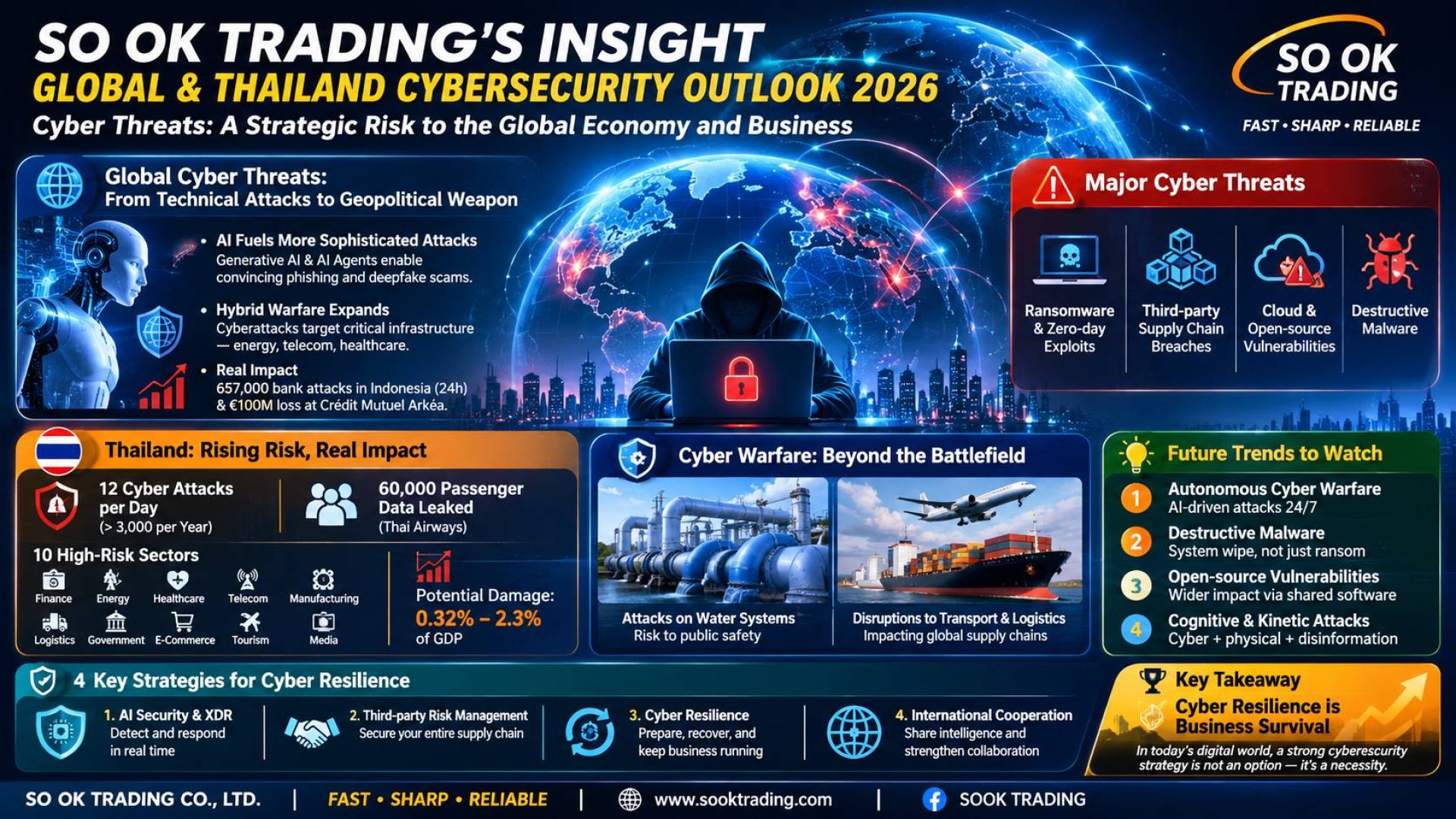
Cyber threats today are no longer just technical attacks; they have evolved into strategic instruments intertwined with economics, politics, and international security.
AI as an Attack Accelerator Hackers now leverage Generative AI and AI Agents to automate sophisticated attacks, such as undetectable phishing emails and deepfake identities used for fraudulent transactions. → Business Impact: The financial and fintech sectors in Asia face heightened risks, particularly in customer data breaches and loss of consumer trust.
Hybrid Warfare Attacks on critical infrastructure — energy, telecommunications, and healthcare — are not only financially motivated but also serve geopolitical pressure. → Economic Impact: Indonesia recorded over 657,000 banking attacks in 24 hours, while France’s Crédit Mutuel Arkéa suffered losses of €100 million, demonstrating how cyber threats can destabilize macroeconomic systems.
Key Threat Vectors
Ransomware & Zero-day Exploits
Third-party Supply Chain Breaches (e.g., Qantas and Thai Airways passenger data leaks) → Business Lesson: Risks extend beyond the organization itself to partners and the entire supply chain.
Thailand’s Cybersecurity Landscape: Systemic Risks
Thailand ranks among ASEAN’s most targeted countries, alongside Singapore and the Philippines.
Attack Statistics: An average of 12 attacks per day, totaling over 3,000 annually → Business Impact: High frequency highlights threats to Business Continuity and rising defense costs
Data Breach Case: Over 60,000 Thai Airways passenger records leaked via an external reservation system → Academic Insight: A clear example of Third-party Risk
Top 10 At-Risk Industries: Finance, Energy, Healthcare, Telecommunications, Manufacturing, Logistics, Government, E-commerce, Tourism, Media → Economic Impact: Potential losses of 0.32%–2.3% of GDP, equivalent to hundreds of billions of baht
⚔️ Offensive Cyber Warfare: From Battlefield to Civilian Systems
Case studies from Europe and the U.S. show cyber warfare expanding into civilian infrastructure.
U.S. Water Systems Attack: Iranian hackers infiltrated over 100 facilities, reducing water pressure and raising contamination risks → Business Impact: Water utilities and logistics have become new targets, affecting both civilians and military operations
Transport & Logistics Attacks: Disruptions at ports, airports, and supply chains → Academic Insight: A hybrid of Operational Technology (OT) and Information Warfare, creating both physical and psychological impacts
Future Trends
Autonomous Cyber Warfare: State-backed hackers using AI Agents for 24/7 vulnerability scanning
Destructive Malware: Escalating from disruption to outright system destruction
Open-source & Third-party Vulnerabilities: Exploiting foundational software and cloud platforms
Cognitive & Kinetic Attacks: Combining physical infrastructure sabotage with disinformation campaigns
️ Defense Strategies: Lessons for Thai Enterprises
Deploy XDR & AI Security for real-time detection and response
Strengthen Third-party Risk Management with partner security standards
Invest in Cyber Resilience to ensure business recovery post-attack
Enhance International Cooperation for threat intelligence sharing and joint response
Conclusion
Cyber threats today are not merely technical issues but strategic risks impacting economies, national security, and public trust. Thailand and global enterprises must urgently adapt, focusing on Cyber Resilience and systemic risk management to remain competitive in an increasingly hostile cyber environment.
FAST • SHARP • RELIABLE Your trusted business partner in a rapidly changing digital world www.sooktrading.com Facebook: SO OK TRADING