SO OK TRADING’s INSIGHT: Strait of Hormuz 2026 – Global Energy Shock and the World Economy in the Shadow of Uncertainty (9 NOV 2026)
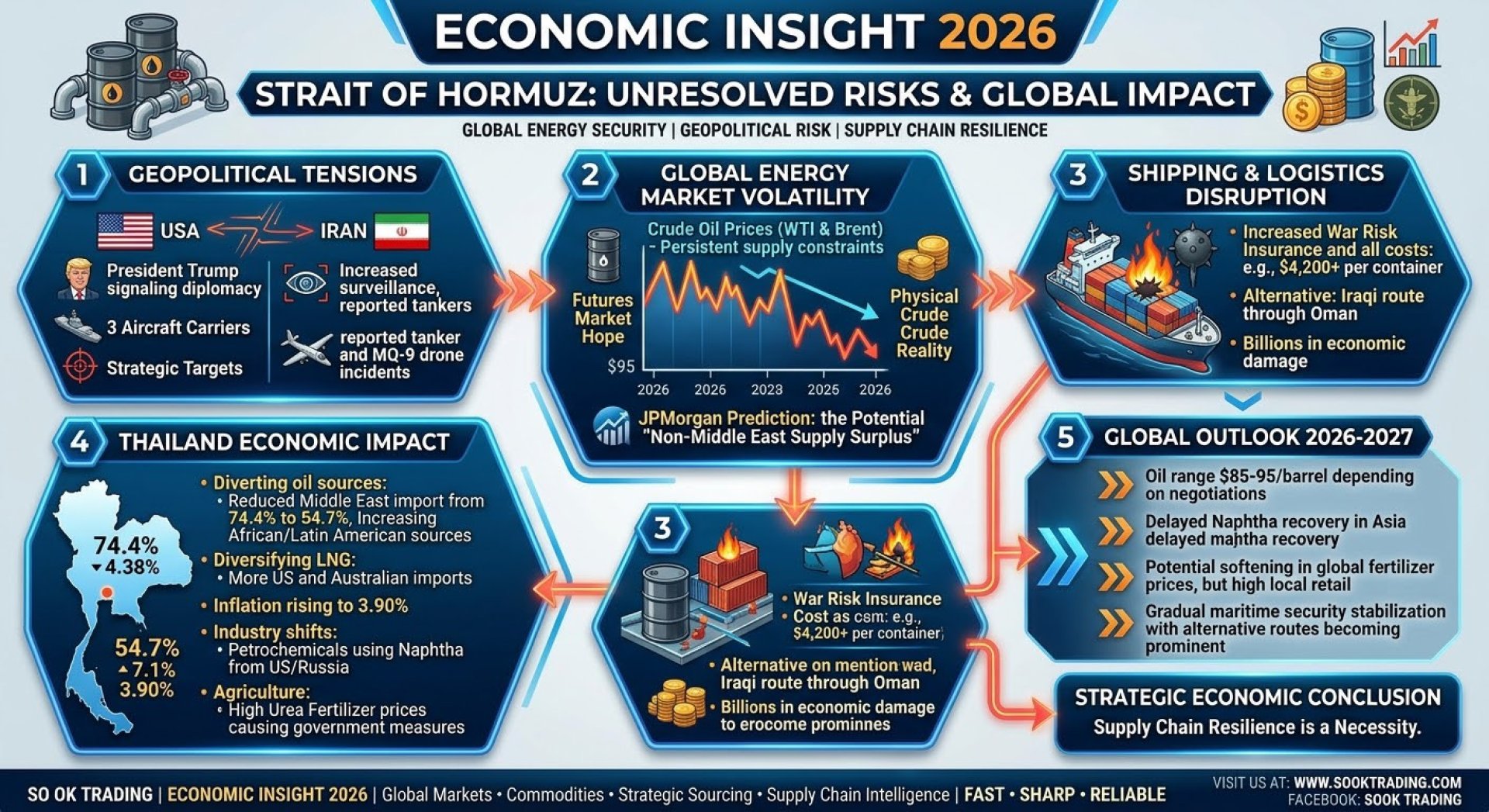
ECONOMIC INSIGHT 2026
Strait of Hormuz: Unresolved Risks and Shocks to the Global Economy
Global Energy Security | Geopolitical Risk | Supply Chain Resilience
1. Geopolitical Tensions
The Strait of Hormuz is one of the most critical strategic maritime routes for the global economy, with more than 20% of the world’s oil consumption passing through it.
In 2026, tensions between the United States and Iran created significant ripple effects across energy systems, international trade, and global supply chains.
United States
President Donald Trump signaled a de-escalation, prioritizing diplomatic negotiations.
At the same time, the U.S. maintained military leverage, deploying three aircraft carriers and identifying 38 strategic targets in Iran.
Iran
Iran expressed willingness to halt attacks if the U.S. did the same.
However, strict control over navigation in the Strait of Hormuz remained, amid reports of tanker attacks and the downing of a U.S. MQ-9 drone.
This situation shows that while diplomacy may reduce the risk of full-scale war, geopolitical uncertainty remains a critical factor that global markets cannot ignore.
2. Global Energy Market
Oil markets reacted swiftly to signs of de-escalation, with WTI and Brent crude prices dropping by about 13–15%, to $95.59 and $94.64 per barrel respectively.
Yet, the decline in futures prices does not necessarily mean the physical oil market has stabilized.
Market Differences
Futures Market: Investors responded positively to hopes of negotiation progress and reduced war risk.
Physical Crude Market: Actual oil trade still faced transport constraints, especially Murban crude, which remained tight due to shipping risks.
JPMorgan projected that global oil supply may move toward surplus as production outside the Middle East increases, easing supply concerns. However, transport, insurance, and geopolitical risks continue to hinder full recovery.
3. Shipping & Logistics Disruption
The Strait of Hormuz remains a high-risk zone, with reports of tankers igniting after hitting naval mines.
Iraq negotiated alternative shipping routes via Oman to mitigate economic losses exceeding $60 billion.
Rising Logistics Costs
War risk insurance and freight costs surged significantly.
Container shipping costs rose from $1,899 to over $4,200 per unit.
Impacts include higher international shipping costs, elevated insurance premiums, uncertain transit times, shipping companies avoiding the route, and importers/exporters adjusting inventory and sourcing strategies.
This is not just a maritime issue but a hidden cost fueling global inflationary pressures.
4. Thailand Economic Impact
Thailand, heavily reliant on energy and raw material imports, must manage risks carefully.
Energy: Reduced crude oil imports from the Middle East from 74.4% to 54.7%, diversifying with Africa and Latin America.
LNG: Lowered dependence on Qatar, increasing imports from the U.S. (29.9%), Australia, and Myanmar.
Inflation: Rising energy and transport costs pushed general inflation to 3.90%.
Petrochemicals: Shifted naphtha sourcing to the U.S. and Russia, though accumulated costs and supply constraints pressured competitiveness.
Agriculture: Urea fertilizer prices surged, prompting government measures to stabilize prices and promote organic alternatives.
5. Global Economic Outlook 2026–2027
Crude Oil: Expected to move within $85–95 per barrel if diplomacy continues; could rebound to $100 if talks fail or new clashes occur.
Naphtha: Supply recovery will be slow, forcing Asian petrochemical plants to manage production cautiously and diversify sourcing.
Fertilizers: Global prices may soften, but domestic retail prices remain high due to legacy inventory costs.
Maritime Security: Shipping may gradually stabilize, but war risk insurance premiums remain elevated. Alternative routes via Oman and land pipelines will gain importance.
6. Strategic Economic Conclusion
The Strait of Hormuz crisis demonstrates how geopolitical conflicts can impact the global economy far beyond the region of origin.
The effects are not limited to oil prices but extend to shipping costs, industrial raw materials, petrochemicals, fertilizers, manufacturing, and overall business competitiveness.
Diplomacy may ease short-term tensions, but restoring market confidence and supply chain stability will take time.
Key Lesson for Thailand and Global Businesses Risk diversification is no longer optional — it is a fundamental pillar of long-term competitiveness. Nations and companies that can flexibly manage energy sources, raw materials, transport routes, and supplier networks will hold the advantage in a world where uncertainty has become permanent.
“In today’s global economy, supply chain resilience is no longer an advantage. It is a necessity.”
SO OK TRADING | Economic Insight 2026 Global Markets • Commodities • Strategic Sourcing • Supply Chain Intelligence FAST • SHARP • RELIABLE
VISIT US AT : WWW.SOOKTRADING.COM FACEBOOK : SOOK TRADING