SO OK TRADING Insight: Biomass Transforming Thai Industry — Driving the Transition to a Low-Carbon Future with Net Zero & CBAM
SO OK TRADING Insight
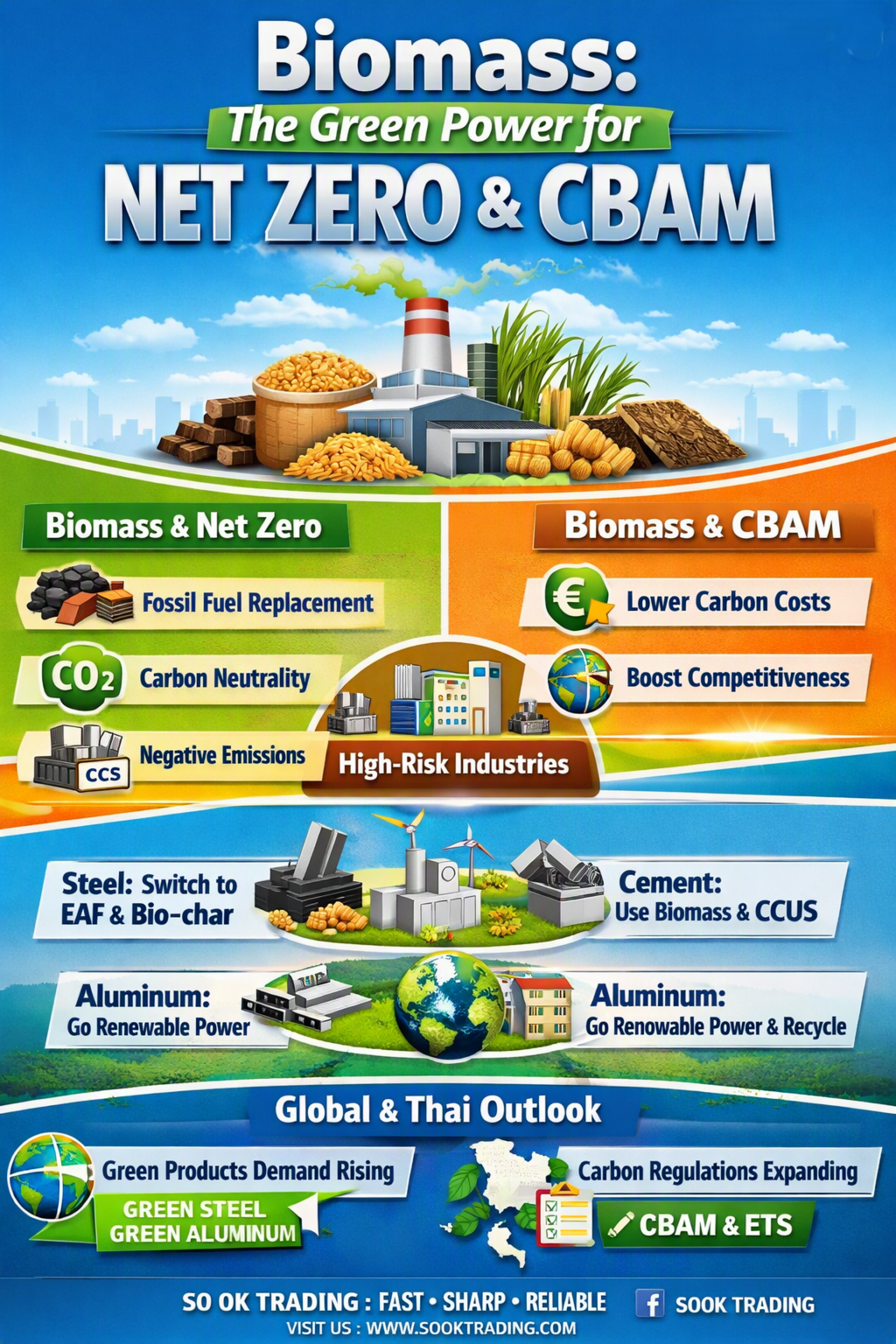
Biomass: The Green Energy Transforming Net Zero and CBAM
As the world accelerates toward a low‑carbon economy, biomass is emerging as a renewable energy source with a crucial role in Thailand’s industrial sector. It not only drives the achievement of Net Zero Emissions but also serves as a strategic tool to cope with the EU’s Carbon Border Adjustment Mechanism (CBAM), which is reshaping global trade.
Biomass and Net Zero
Replacing fossil fuels such as coal, fuel oil, or natural gas with biomass directly reduces greenhouse gas emissions. The carbon released from biomass combustion is considered “recycled carbon” that plants absorbed during growth, meaning it does not add new burdens to the atmosphere. This differs fundamentally from fossil fuels, which release carbon stored underground.
Factories that use biomass in boilers or heat‑production processes can significantly cut direct emissions (Scope 1). In the future, combining biomass with carbon capture and storage (CCS) could make production “carbon‑negative,” a key to offsetting emissions from other sectors and achieving Net Zero.
Biomass and CBAM
CBAM requires imports such as steel, cement, aluminum, fertilizers, electricity, and hydrogen to report and pay for embedded carbon emissions. Thai producers who switch from fossil fuels to biomass can lower the carbon intensity of their products, reduce CBAM costs, and strengthen competitiveness in global markets.
However, biomass use must be certified sustainable (e.g., FSC or RSPO) to ensure it does not come from deforestation. Supply chain management is also critical, as long‑distance transport of biomass may inadvertently increase the carbon footprint.
Three High‑Risk Industries
Steel Industry Steel is among the highest emitters of greenhouse gases, especially traditional coke‑based smelting. Without adaptation, CBAM costs will be enormous. Solutions include shifting to electric arc furnaces (EAF) using recycled scrap, partially replacing coal with bio‑char, and developing green hydrogen for direct reduced iron (DRI) with near‑zero emissions.
Cement Industry Most cement emissions come from the chemical reaction of calcining limestone to produce clinker, accounting for 60–70% of total emissions. Using biomass and refuse‑derived fuel (RDF) in clinker kilns can cut coal use by 30–50%. Reducing clinker content with fly ash or steel slag also helps produce low‑carbon cement. Yet unavoidable “process emissions” mean the industry must rely on CCUS in the long term.
Aluminum Industry Aluminum is often called “electricity in metallic form” due to its massive power demand. If electricity comes from coal, CBAM penalties are severe. The solution is renewable power sources such as hydro, wind, or solar, and increasing recycled aluminum content. Recycling uses 95% less energy compared to producing new aluminum from ore.
Outlook: Global and Thailand
Globally, CBAM is expanding to chemicals and plastics. Competition is shifting from “lowest price” to “lowest carbon footprint.” Products like Green Steel and Green Aluminum are becoming premium commodities with high demand.
In Thailand, steel and aluminum industries are directly affected. Although exports to Europe are limited, Asian partners re‑exporting to Europe are pressuring Thai producers to report emissions under international standards. Meanwhile, Thailand is advancing carbon tax and emissions trading systems (ETS), giving local businesses tools to compete and reduce CBAM burdens.
Conclusion
Biomass is not just an alternative fuel—it is a strategic instrument enabling Thai industries to achieve Net Zero and overcome CBAM barriers. When applied with sustainability standards and modern technologies, biomass becomes a “passport” for Thai products to remain competitive in the global low‑carbon economy.
SO OK TRADING: Your Business Partner SO OK TRADING: FAST SHARP RELIABLE
VISIT US AT : WWW.SOOKTRADING.COM FACEBOOK : SOOK TRADING