SO OK TRADING’S INSIGHT: Thailand’s Sugar Industry Strong Recovery — Entering the Sustainable Green Sugar Era, Deep Dive into Global Trends and Export Opportunities 2026–2027
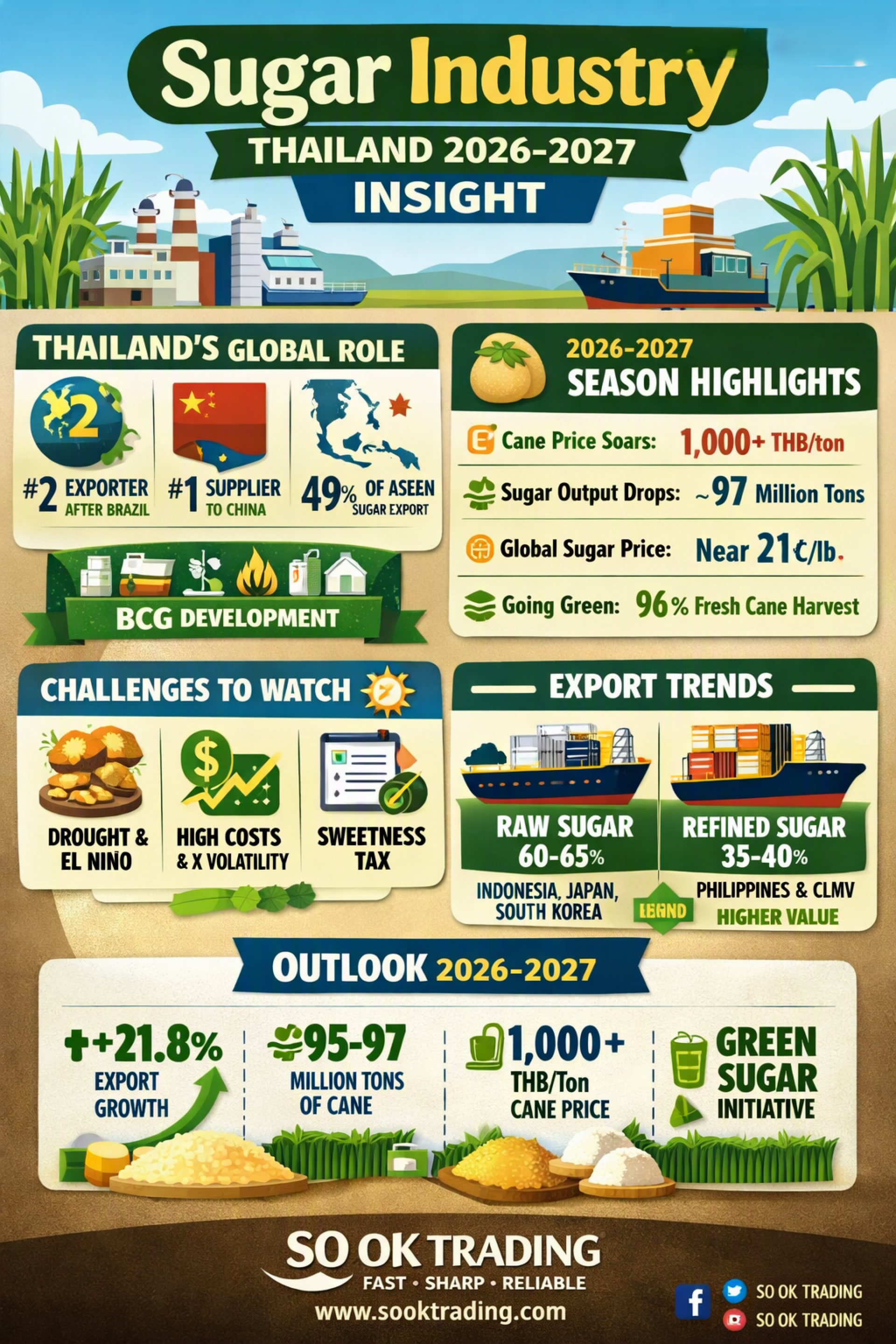
SO OK TRADING’S INSIGHT: Analysis of Thailand’s Sugar Industry, Season 2026–2027
Thailand continues to play a vital role as one of the world’s leading sugar exporters. In the 2026–2027 season, the Thai sugar industry has strongly rebounded in terms of export value, driven by soaring global sugar prices despite challenges from drought and global economic volatility. High international sugar prices have become a key support, enabling Thailand to firmly maintain its position as the world’s third-largest sugar exporter, while advancing toward sustainable and environmentally friendly production standards.
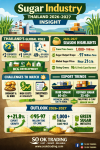
Thailand’s Role in the Global Market
Ranked as the world’s second-largest sugar exporter (after Brazil).
The number one supplier of refined sugar to China.
Holds 49% of ASEAN’s refined sugar export share.
Sugar mills have expanded into renewable energy businesses such as ethanol from molasses, biomass power from bagasse, and biogas, aligning with the Bio-Circular-Green (BCG) Economy Model.
Latest Developments in the 2026–2027 Season
Cane price surge: Expected to exceed 1,000 THB/ton (up from 890 THB/ton).
Tighter supply: Cane crushing volume drops to ~97 million tons (from 105.86 million tons last season), due to drought and El Niño.
Global sugar price recovery: Rising to nearly 21¢/lb (from 15–16¢), driven by India restricting exports and shifting to ethanol production.
Exports remain strong: Thailand retains its position as the world’s third-largest exporter, with key markets in Indonesia, the Philippines, and South Korea.
Green Sugar policy: Over 96% of cane harvested fresh, reducing PM 2.5 and meeting ESG standards.
⚠️ Challenges to Watch
Drought and El Niño: Continued impact on cane yields.
Logistics costs and currency volatility: Affect competitiveness and net profit.
Domestic sugar tax: Dampens local demand.
Non-tariff trade barriers: Without rapid adoption of Green Sugar, Thailand risks losing premium markets.
Export Trends
Thailand’s sugar exports are divided into two main categories: Raw Sugar and Refined Sugar, each with distinct markets and value.
Raw Sugar: Accounts for 60–65% of exports. Brownish crystals with high moisture, not immediately consumable. Main buyers are refineries in Indonesia, Japan, and South Korea. Transported in bulk cargo, with lower margins as it is a commodity product.
Refined Sugar: Accounts for 35–40% of exports. White, clean crystals with high purity. Main buyers are food, beverage, and bakery industries, especially in the Philippines and CLMV countries. Transported in bags and containers. Smaller volume but higher margins.
Trend: Raw Sugar remains dominant due to Indonesia’s refinery demand, while Refined Sugar is growing in neighboring markets lacking large-scale refineries and trusting Thai quality standards.
Global and Thai Outlook
Global Market: Supply deficit from drought and ethanol diversion. Raw sugar prices expected to stay high at ~21¢/lb throughout 2027.
Thailand:
Export value projected to grow +21.8% YoY despite lower volume.
Cane output expected at ~95–97 million tons.
Farmers benefit from cane prices exceeding 1,000 THB/ton, offsetting higher costs.
Government pushes Green Sugar production to meet international standards and secure premium markets.
⚖️ Summary
The 2026–2027 season marks a strong recovery in Thailand’s sugar industry in terms of value, supported by high global prices. Despite reduced output from drought, Thailand remains firmly the world’s third-largest exporter. Transitioning to Green Sugar and value-added products such as Premium Refined, Organic Sugar, and Low GI Sugar will be key to strengthening competitiveness and ensuring sustainable growth in the global market.
SO OK TRADING: Your Trusted Business Partner SO OK TRADING — FAST • SHARP • RELIABLE www.sooktrading.com sooktrading@sooktrading.com | sooktrading@outlook.com WeChat / WhatsApp: +66955564255 Facebook: SO OK TRADING