Share

SO OK TRADING INSIGHT | Blue Wave 2026: Global Game-Changer, Shaking the Economy and Middle East Conflict, Towards a New World Balance
Last updated: 6 Nov 2026
72 Views

 SO OK TRADING’S INSIGHT
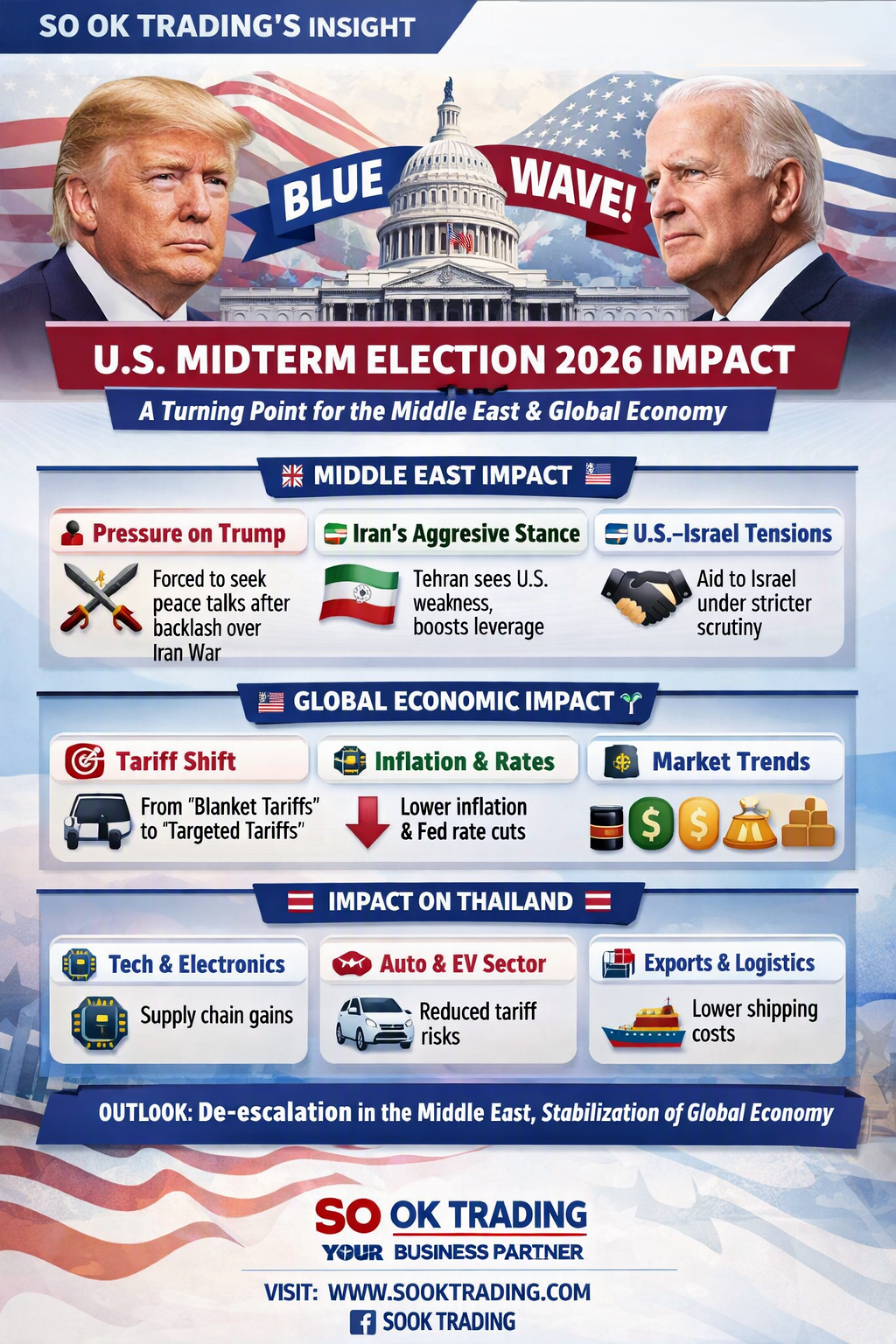
U.S. Midterm Election 2026: A Turning Point for the Middle East Conflict and Global Economy
The U.S. midterm election on November 3, 2026, sent shockwaves across the global political stage. The Democratic Party reclaimed the majority in both the House of Representatives and the Senate (the “Blue Wave”), dramatically shifting the balance of power in Congress. This transformation not only challenges President Donald Trump’s authority but may also mark the beginning of easing tensions in the Middle East and redirecting the global economy toward a new phase of stability.

 
1. Impact on the Middle East Conflict
Pressure on the Trump Administration The White House admitted that the “Iran War” was a major factor behind the Republican defeat. Rising living costs and surging oil prices fueled public discontent, forcing Trump to pivot from aggressive military policies toward peace negotiations to regain domestic support.

Iran’s Tougher Stance Tehran interprets the Democratic victory as a sign of U.S. weakness, strengthening its bargaining position. However, if Iran miscalculates and escalates military action, it risks triggering renewed conflict.

U.S.–Israel Rift With Democrats controlling Congress, military aid and arms sales to Israel face stricter scrutiny. Prime Minister Benjamin Netanyahu’s military operations are constrained, while Israel’s domestic political stability is shaken by the loss of bipartisan support from the U.S.

 
2. Impact on the Global Economy
Tariff Policy Curbed Trump’s plan for “blanket tariffs” (10–20% on all countries, 60% on China) is blocked by Democratic oversight. Future measures are expected to shift toward “targeted tariffs” on specific goods.

Inflation and Interest Rates With reduced inflation risks, the Federal Reserve (Fed) gains flexibility to cut interest rates, boosting liquidity in emerging markets.

Markets and Commodities

Weaker Dollar → Capital flows back to emerging markets
Oil Prices Down → Geopolitical risk premium reduced
Gold and Agricultural Commodities Steady → Lower shipping costs
 
3. Impact on Thailand’s Economy
Electronics & Computer Components: Benefit most from stable global supply chains
Automotive & Parts: Lower tariff risks, though U.S. EV policies remain a factor to watch
Rubber Products & Construction Materials: Gain competitiveness from reduced shipping costs
Additionally, the Thai baht is expected to strengthen in the short term, while lower oil and transport costs ease business expenses.

 
Conclusion and Outlook
The Democratic victory in 2026 marks a decisive constraint on Trump’s aggressive policies. The outlook points toward de-escalation in the Middle East conflict and more systematic economic policies.

For Thailand, this represents an opportunity to enhance export competitiveness and reduce business costs, as the global economy transitions into a phase of stabilization.

 
✨ FAST · SHARP · RELIABLE SO OK TRADING — Your Business Partner WWW.SOOKTRADING.COM Facebook: SOOK TRADING
Related Content
Currency & Gold Outlook Heats Up: Election Week Meets Lunar New Year — USD Weakens, Gold Nears $5,000, and Must-Know Strategies for Investors — Market Insights by SO OK TRADING
This post summarizes the currency and gold market outlook for February 9–16, 2026 — a week when global markets are closely watching both the results of Thailand’s general election (Feb. 8) and the release of key U.S. economic data. These events are expected to directly impact the U.S. dollar and gold prices. The analysis highlights strategies investors should know, while also introducing SO OK TRADING as a trusted global brand partner.
8 Feb 2026
ALUMINUM PRICE TREND 2026
An analysis of the aluminum market in 2026 indicates a likely continued market deficit and upward price pressure, driven by constrained supply and resilient demand from green energy sectors. However, significant volatility is expected due to policy uncertainties and the potential for new Indonesian supply to eventually balance the market. Key Drivers and Projections for 2026 Supply Side Analysis Capacity Constraints: China's primary aluminum output is approaching its self-imposed 45 million-tonne capacity cap, limiting global supply growth. Power Challenges: Smelters outside of China face intense competition for power from energy-intensive sectors like AI data centers, which are willing to pay higher prices for long-term contracts. This has kept significant capacity offline in Europe and the US. Production Disruptions: Outages and potential shutdowns at existing smelters in Iceland and Mozambique further tighten the market. Scrap Supply Pressure: The EU's planned implementation of the Carbon Border Adjustment Mechanism (CBAM) and potential scrap export tariffs in spring 2026 are expected to impact global scrap flows, creating regional shortages and price volatility. New Capacity: Indonesia is a key source of new supply, with several projects in the pipeline. However, analysts suggest the pace of the ramp-up may be slower than expected due to infrastructure and policy challenges, meaning it is unlikely to fully offset near-term tightness. Demand Side Analysis Green Transition Demand: Demand from "green" sectors such as solar panels, new energy vehicles, and energy transition infrastructure remains strong, providing fundamental support for the market. Substitution Effect: Aluminum's wide price discount relative to copper has encouraged substitution in electrical applications, acting as a tailwind for demand and prices. Construction and Automotive: The construction and automotive industries continue to be major consumers, with growing demand for lightweight, low-carbon aluminum products. Price Forecasts and Volatility The market is expected to remain in a deficit in 2026, with estimates ranging from 200,000 to 600,000 tonnes. This structural tightness is leading most analysts to forecast sustained or rising prices. Bullish Views: Analysts at Bank of America project prices of $3,000/tonne as early as 2026. J.P. Morgan also expects prices to approach $3,000/tonne in Q1 2026. ING forecasts an average price of $2,900/tonne for the year. Bearish/Conservative Views: Goldman Sachs is an outlier, forecasting prices to decline to $2,350/tonne by Q4 2026, anticipating a market surplus later in the year. SMM forecasts a "high first, then lower" pattern, with prices finding equilibrium in the $2,700–$2,800/tonne range by year-end. Premiums: Regional premiums, particularly the US Midwest premium, are expected to remain high and volatile due to tariffs and regional supply dynamics, creating a disconnect from the LME benchmark price. In essence, 2026 is projected to be a year of high volatility where participants need to focus on scenario readiness rather than relying on a single price forecast, as geopolitical and energy policies significantly influence regional supply and costs
31 Dec 2025
“Middle East–Africa Economy 2026: Golden Opportunities Amidst Overlapping Crises”   SO OK TRADING|4 SEP 2026
Middle East–Africa Economy 2026: Golden Opportunities Amidst Overlapping Crises SO OK TRADING|4 SEP 2026 ✨ Introduction & Outlook The year 2026 marks a turning point for the Middle East and Africa, as global economic volatility intensifies due to war and geopolitical tensions. The Strait of Hormuz blockade and attacks have sent oil prices soaring to USD 120–150 per barrel, shaking global supply chains. MENA (Middle East & North Africa): Growth slows sharply to 1.8% (down from 4%). Africa: Maintains solid growth at 4.2–4.3%, supported by the fastest-expanding workforce in the world despite inflation and rising energy costs. ⚡ Key Economic Drivers GCC (Saudi Arabia, UAE, Qatar): Leveraging “windfall gains” from high oil prices to accelerate investments in AI, digital infrastructure, healthcare, and food security. Africa: Emerging markets such as Nigeria, Kenya, and Ethiopia are driving growth through agriculture and rising domestic consumption.
4 Sept 2026
This website uses cookies for best user experience, to find out more you can go to our Privacy Policy and Cookies Policy
Powered By MakeWebEasy Logo MakeWebEasy