Share

SO OK TRADING INSIGHT: From the Persian Gulf to Global Markets — Price Surge, Supply Shortage, Logistics Shift, and Aluminum’s Recovery from Crisis to Opportunity October 28, 2026
Last updated: 28 Oct 2026
82 Views

The Middle East and the Global Aluminum Battlefield: Supply Crisis, Recovery, and Future Outlook (2026–2027)
SO OK TRADING’S INSIGHT | October 28, 2026

Introduction
The Middle East is one of the world’s largest aluminum-producing and exporting regions, particularly the Gulf Cooperation Council (GCC) countries, which benefit from low energy costs and strategic geographic positioning that connects both European and Asian markets. Aluminum from this region serves as a vital artery for global industries, ranging from electric vehicles (EVs) and aerospace to solar energy and packaging.

However, 2026 has become a year of challenges. Geopolitical conflicts and aerial attacks disrupted production capacity across the region, severely impacting global market prices and supply chains.

 
Major Producers in the Middle East
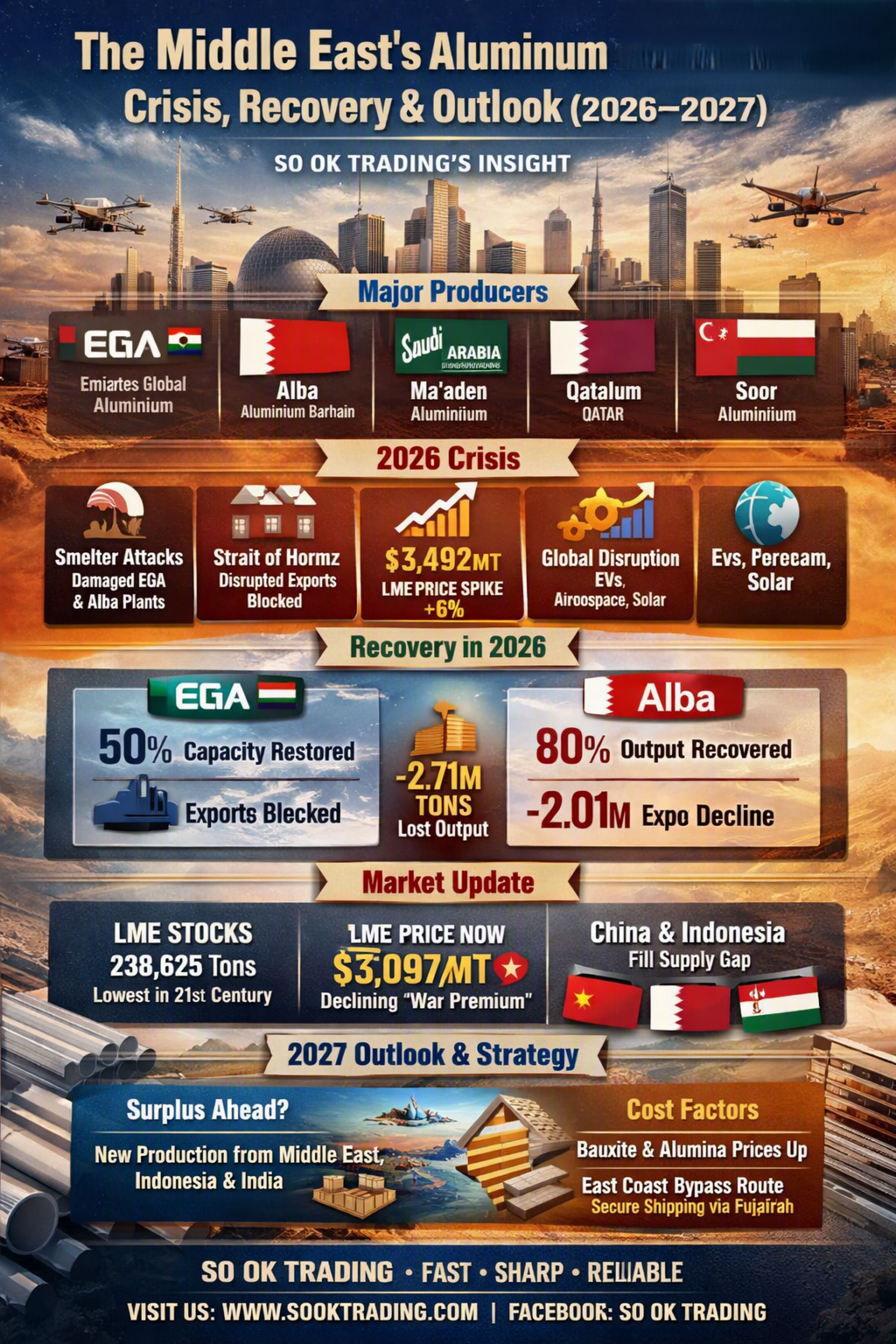
Emirates Global Aluminium (EGA) – UAE: The largest aluminum producer in the region and a global leader.
Aluminium Bahrain (Alba) – Bahrain: One of the world’s largest single-site smelters outside China.
Ma’aden Aluminium – Saudi Arabia: A fully integrated national mining and metals company, from bauxite mining to finished products.
Qatalum – Qatar: A joint venture producing high-quality aluminum for export.
Soor Aluminium – Oman: A key supplier focused on regional industries and exports.
 
The 2026 Crisis
Smelter Attacks: EGA and Alba facilities were damaged by airstrikes and drone attacks, forcing declarations of Force Majeure.
Strait of Hormuz Disruption: Shipping routes were blocked, halting exports.
Price Surge: LME aluminum prices spiked to $3,492/ton (+6%), the highest in years.
Global Impact: EVs, power grids, aerospace, and solar industries faced soaring costs and raw material shortages.
 
Recovery and Current Situation (October 2026)
EGA (UAE): Al Taweelah smelter has restored 50% of capacity, aiming for full recovery by Q1 2027.
Alba (Bahrain): Output has recovered to about 80% of pre-crisis levels.
Supply Impact: Despite recovery, over 2.71 million tons of aluminum were lost, reducing exports by 2.01 million tons in 2026.
 
Market Mechanisms and Global Pricing
War Premium Decline: LME 3M prices fell from $3,250 to around $3,097–$3,100/ton.
Record-Low LME Stocks: Inventories dropped to 238,625 tons, the lowest in the 21st century.
China & Indonesia Substitution: Producers from these countries filled the global supply gap.
 
Outlook for 2027
Analysts expect the global aluminum market to remain in a “tight balance” through the end of 2026. However, with new production from Indonesia, India, and full recovery in the Middle East, the market may shift into surplus in 2027.

 
Cost Drivers and Procurement Strategy
Raw Materials: Bauxite and alumina prices surged past $390/ton; carbon anode costs rose alongside oil prices and EU’s CBAM carbon tax.
New Logistics Routes: UAE developed the Fujairah East Coast Bypass to reduce Hormuz risks, with EGA rerouting over 250,000 tons via Gulftainer.
Strategic Procurement (Q1 2027):

Layered Hedging: Lock in prices at $3,000–$3,050/ton for base demand.
Long-Term Contracts: Reference LME 3M with fixed freight formulas to mitigate logistics premium volatility.
 
Conclusion
The Middle East remains the heartbeat of the global aluminum market. Despite supply shocks from geopolitical conflicts, recovery efforts by major producers and new logistics strategies are easing market tensions. By 2027, the industry may transition from shortage to surplus, reshaping both pricing and procurement strategies worldwide.

 
✨ FAST • SHARP • RELIABLE SO OK TRADING — The true force in Non-Ferrous Metals from Thailand www.sooktrading.com | Facebook: SO OK TRADING


Related Content
“Middle East in Turmoil: Prolonged Conflict Shakes the World, Hits Thailand — Oil Prices Surge, Global Economy Trembles” SO OK TRADING’s Insight | 11 October 2026
Middle East in Turmoil: Prolonged Stalemate Shakes Global & Thai Economies SO OK TRADING | 11 October 2026 The Middle East crisis is reaching a new boiling point — from military clashes in Yemen and Saudi Arabia, to the maritime disruption in the Strait of Hormuz, and the tense standoff between the United States and Iran. Together, these events reflect a “Prolonged Stalemate of Attrition” where no side gains decisive ground, yet the shockwaves reverberate across the global economy. Oil prices have surged past $104 per barrel, global trade routes are being rerouted, and Thailand, as a major oil importer, faces mounting pressure from rising energy costs, higher living expenses, and disrupted exports. This article dives deep into the battlefronts, economic impacts, and ripple effects — revealing the full scope of a crisis shaking the world, and exploring how Thailand must prepare to navigate this era of uncertainty.
11 Oct 2026
“China Transforms the World, Thailand Reshapes the Economy – Mid‑2026 From the World’s Factory to the Innovation Hub, New Opportunities Await Thailand and the Global Stage”
China’s Role in the Global Economy & Thailand – Mid‑2026: The Crossroads of Global Shifts and New Opportunities Article by SO OK TRADING : June 21, 2026 In the second half of 2026, the world is closely watching China’s economic transformation — from being “the world’s factory” to becoming “a hub of innovation and advanced technology.” For the first time in three decades, China has lowered its GDP growth target below 5%, signaling a clear shift from quantity-driven growth to quality-driven development, with a strong focus on AI, clean energy, and future industries. China’s stable slowdown does not mean stagnation, but rather a recalibration of the global economy. While facing tariff pressures from the U.S. and Europe, China is strengthening ties with ASEAN and the Global South, building new trade networks under the Belt & Road Initiative (BRI). For Thailand, this moment represents a strategic global connection point and a golden opportunity: Expanding premium agricultural exports Integrating into high‑tech supply chains Attracting Chinese investment into the Eastern Economic Corridor (EEC) At the same time, Thailand must prepare for challenges such as the influx of low‑cost Chinese goods, currency volatility, and rising competition in advanced technologies. China is transforming the world — Thailand must reshape its economic game to keep pace! Read the full analysis in the complete article by SO OK TRADING. SO OK TRADING : FAST • SHARP • RELIABLE
21 Jun 2026
SO OK TRADING Insight: Global Gold Market 2026 – From the Sell-Off Below $4,000 to the Golden Opportunity of 2027
SO OK TRADING’s INSIGHT | Global Gold Market Analysis – Late October 2026 Gold prices (Gold Spot) slipped below the psychological threshold of $4,000 per ounce, closing the week in the range of $3,978 – $3,995. This reflects persistent sell-offs from institutional investors amid concerns over inflation, U.S. interest rates, and a stronger dollar. Despite these pressures, gold continues to find support from geopolitical tensions in the Middle East and market uncertainty ahead of the upcoming Federal Reserve meeting and the U.S. presidential election. These factors have kept gold trading within a narrow band as investors await clarity. In Thailand, 96.5% gold bars closed the week at Sell: 64,100 THB / Buy: 63,900 THB, down 250 THB from the previous day, directly mirroring global market weakness. Looking ahead to October 26–30, 2026, global gold prices are expected to fluctuate between $3,900 – $4,050, with key support at $3,920 and resistance at $4,030. Thai gold prices are projected to move within 63,000 – 65,500 THB. Investment Strategy: Avoid chasing prices higher in the short term. Consider gradual accumulation (DCA) around the support zone of $3,950 – $3,920 (Thai gold: 63,500 – 63,700 THB). Closely monitor external factors such as U.S. economic data, Middle East developments, and election-related volatility. Outlook 2026–2027: Global financial institutions remain long-term bullish on gold, projecting a potential rally toward $5,000 per ounce by 2027. J.P. Morgan sees an average target of $6,300. Goldman Sachs forecasts $5,600. Morgan Stanley expects prices above $5,000. HSBC projects an average of $4,925, with potential to reach $5,025. Bank of America anticipates $4,813 on average, with highs up to $6,000. Key Drivers: Strong central bank demand (China, Poland, Turkey, India). Anticipated Fed rate cuts in 2027. Geopolitical risks and U.S. debt concerns. Risks: A renewed surge in inflation forcing further Fed rate hikes. ETF outflows if equity markets rebound strongly. ✅ Conclusion: Gold’s dip below $4,000 in late 2026 represents a strategic accumulation zone for long-term investors, particularly those deploying patient capital. The broader trend remains upward, with 2027 poised to deliver significant opportunities. SO OK TRADING: FAST • SHARP • RELIABLE Your trusted partner in global trade and investment.
24 Oct 2026
This website uses cookies for best user experience, to find out more you can go to our Privacy Policy and Cookies Policy
Powered By MakeWebEasy Logo MakeWebEasy