“ASEAN 2027 Outlook: Transforming Regional Economies Through Digital Innovation — Vietnam Rising Fast, Thailand Facing Urgent Reforms”
Last updated: 23 Oct 2026
143 Views
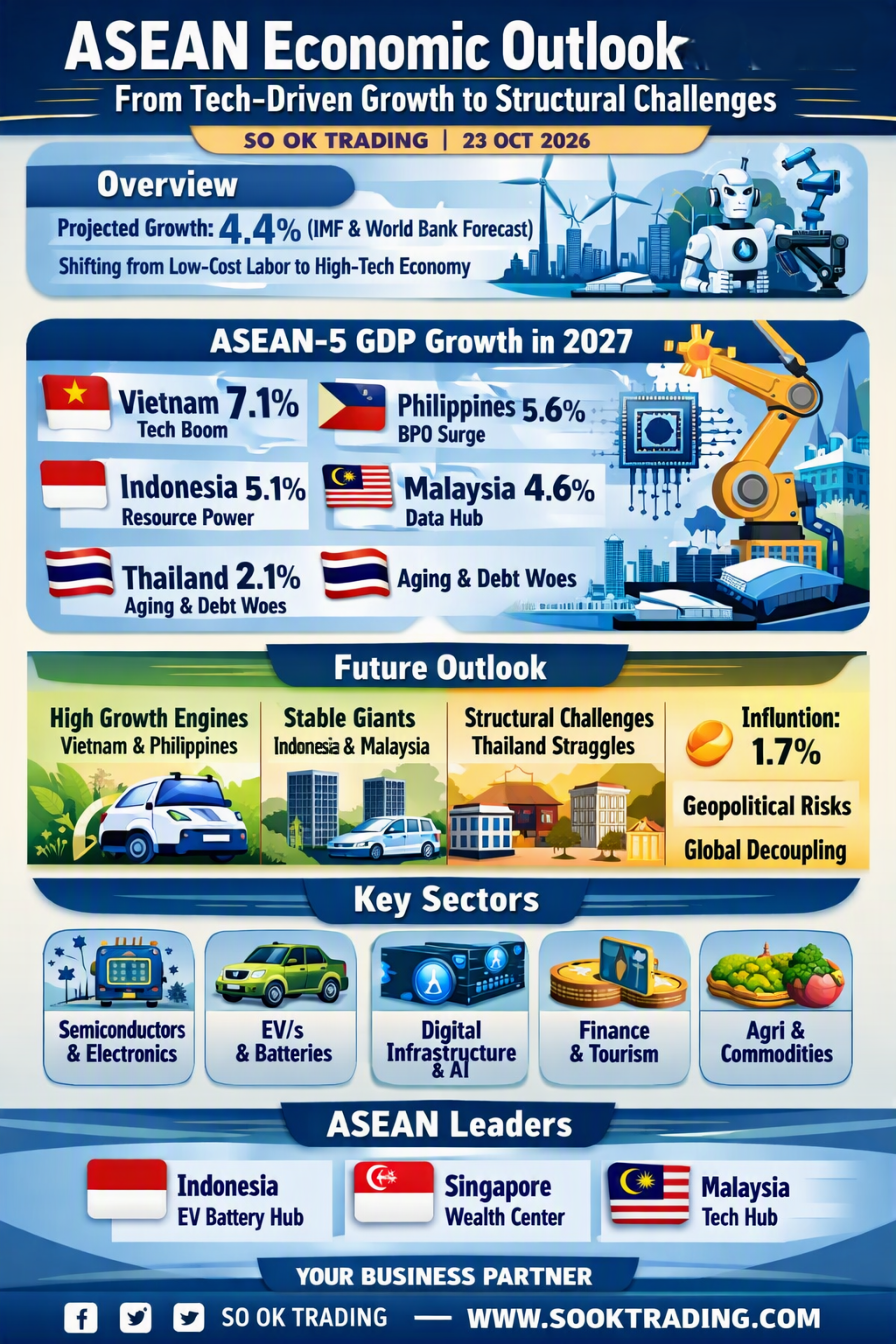
ASEAN Economic Outlook 2027: From Tech-Driven Growth to Structural Challenges
SO OK TRADING | 23 OCT 2026
✨ Introduction The year 2027 marks a pivotal transition for ASEAN economies — shifting away from reliance on low-cost labor and agriculture toward digital economies, advanced technologies, and sustainability. According to the World Economic Outlook by the IMF and World Bank (October 2026), ASEAN is expected to maintain an average growth rate of 4.4%, though disparities among member countries will become increasingly evident. Some nations will surge ahead through foreign investment (FDI) and innovation, while others remain constrained by structural challenges.
ASEAN-5 Economic Overview for 2027
Vietnam (7.1%): Fastest-growing economy in the region, driven by high-tech manufacturing relocation and semiconductor exports.
Philippines (5.6%): Supported by strong domestic consumption and outsourcing (BPO) industries.
Indonesia (5.1%): Stable growth from its large economy and downstream mineral processing policies.
Malaysia (4.6%): Slight slowdown from 2026, yet remains a hub for data centers and AI infrastructure.
Thailand (2.1%): Lowest growth among ASEAN-5, hindered by aging demographics, household debt, and declining competitiveness.
Outlook and Future Directions
High Growth Engines – Vietnam and the Philippines will continue to lead growth, fueled by FDI and domestic demand.
Stable Giants – Indonesia and Malaysia will sustain resilience through strong domestic markets and advanced infrastructure.
Structural Challenges – Thailand must accelerate economic restructuring to remain competitive.
Inflation Stability – Regional inflation is expected to average around 1.7%, remaining under control.
Geopolitical Risks – Global decoupling and conflicts may disrupt trade, making stronger intra-ASEAN cooperation essential.
Key Trends and Flagship Industries
Semiconductors & Advanced Electronics – Malaysia, Vietnam, Singapore
Electric Vehicles & Batteries – Thailand, Indonesia
Digital Infrastructure, Cloud & AI – Malaysia, Singapore
Finance, Services & Tourism – Singapore, Thailand, Philippines, Indonesia
Agribusiness & Commodities – Indonesia, Malaysia, Vietnam, Thailand
Special Roles of Key Countries
Indonesia: Largest economy in ASEAN (population 280 million), global hub for EV battery production.
Singapore: Financial and wealth management center of the region.
Malaysia: ASEAN’s Tech Hub, leading in semiconductors and data center infrastructure.
Conclusion
ASEAN’s economy in 2027 is entering a new era driven by technology and sustainability. Nations with strong demographics and investment appeal, such as Vietnam and Indonesia, will surge ahead. Thailand, however, must urgently restructure to avoid falling behind. The future of competition will no longer be defined by cheap labor, but by innovation capacity and digital infrastructure readiness.
SO OK TRADING — FAST • SHARP • RELIABLE Your trusted partner in global trade and industry transformation www.sooktrading.com Facebook: SOOK TRADING
Related Content
“Global Economy Q4/2026 – When War and Technology Become Headwinds and Tailwinds”
SO OK TRADING | 29 AUG 2026
The global economy is entering a critical turning point in the final quarter of 2026 — with war acting as a headwind and technology serving as a tailwind that reshapes the future of global trade and investment
29 Aug 2026

LME on Fire! Commodities Surge Amid Global Energy Crisis
Global Metals & Energy Market Analysis – March to Q2/2026 by SO OK TRADING
The closure of the Strait of Hormuz and escalating conflicts in the Middle East have pushed oil prices beyond $110 per barrel, triggering one of the most volatile rallies in recent years. Industrial and precious metals are soaring, with copper and aluminum hitting record highs driven by demand from AI and clean energy sectors.
16 Mar 2026
Thai Wood Pellets: Clean Energy from Asia to the Global Stage
23 Mar 2026
