“Palm Kernel Shell Charcoal: Clean Energy Driving the Green Industrial Revolution” SO OK TRADING: 19 OCT 2026
Palm Kernel Shell & PKS Charcoal – From Agricultural Waste to Global Green Energy
SO OK TRADING | 19 OCT 2026
Once considered a worthless by-product of palm oil extraction, Palm Kernel Shell (PKS) has now become a vital biomass fuel in global industry and renewable energy markets. With its outstanding energy properties, clean combustion, and sustainability, PKS has been elevated from “agricultural residue” to a high-value green commodity sought after worldwide.
Properties of Palm Kernel Shell
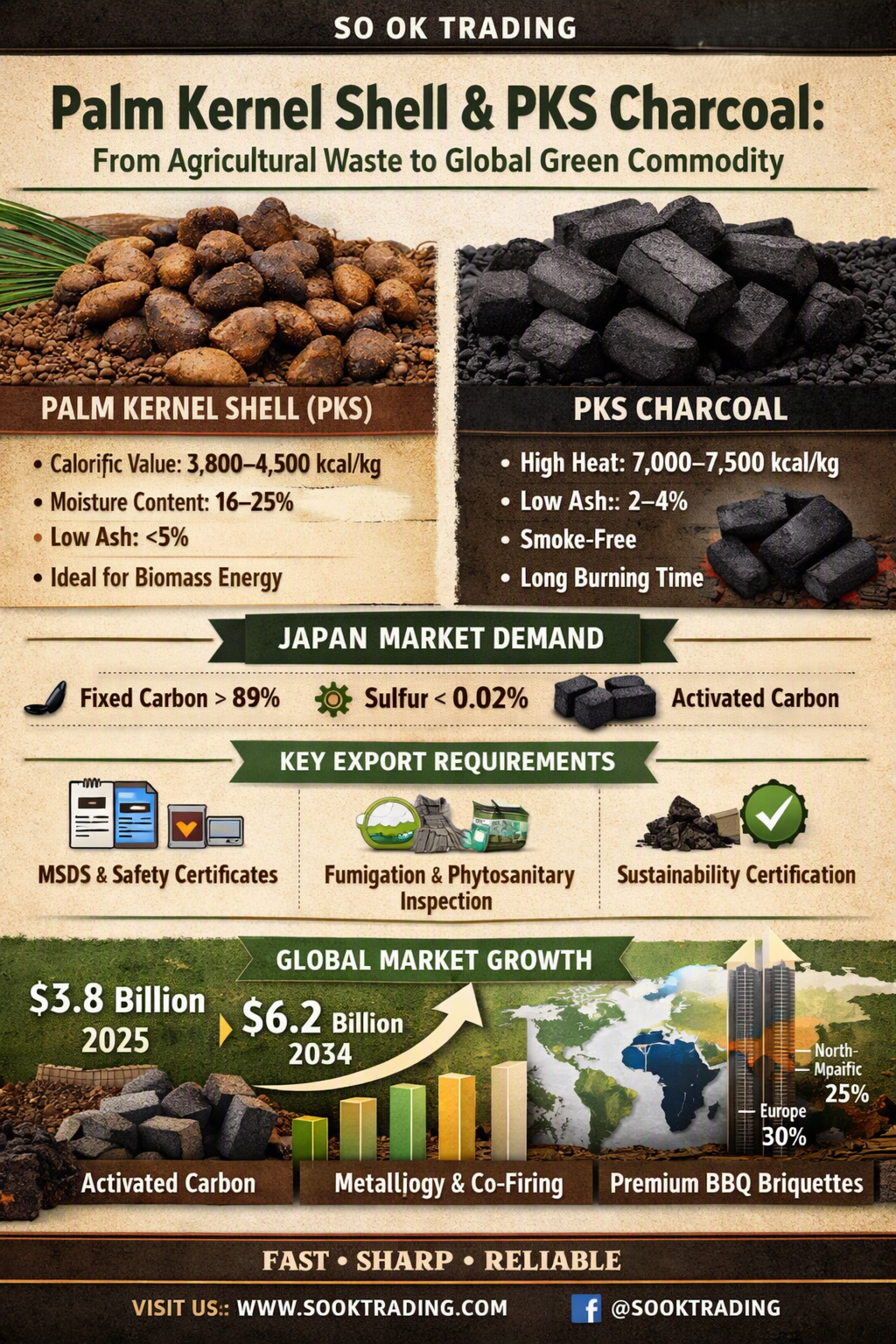
High calorific value: 3,800–4,500 kcal/kg, ensuring consistent energy output
Moderate moisture content: 16–25%
Low ash content: <5%, reducing boiler residue and maintenance issues
Stable combustion: Ideal for industrial boilers and biomass power plants
PKS Charcoal
Through carbonization, PKS transforms into a superior fuel with enhanced performance:
Very high calorific value: 7,000–7,500 kcal/kg (comparable to premium coal)
Clean burning: Smoke-free and odorless
Long-lasting heat: Dense structure, slow-burning, steady output
Minimal ash: Only 2–4%
Key applications include steel smelting and metallurgy, smokeless BBQ briquettes, and as a raw material for activated carbon used in water and air purification.
PKS Charcoal in the Japanese Market
Japan is a major destination for PKS charcoal, especially premium-grade products with Fixed Carbon at 89% and Sulfur as low as 0.02%. These specifications meet the strict requirements of both the steel industry and activated carbon manufacturers, who demand clean, efficient, and environmentally friendly fuels.
Essential Export Documentation for Japan
To ensure smooth export operations, suppliers must prepare:
MSDS & Self-Heating Test Certificates: Confirming safe maritime transport
Phytosanitary & Fumigation Certificates: Guaranteeing pest-free packaging (ISPM 15 compliant)
Sustainability Certifications (e.g., GGL, ISCC): Required for biomass energy projects under Japan’s government programs
Export Price Structure
Standard grade (FC 75–80%): 340–450 USD/Ton
Premium grade (FC 89%): 530–650 USD/Ton (FOB Thailand)
CIF contracts: Additional freight and insurance costs to Japanese ports
Market Outlook for 2026
Japan is stockpiling biomass fuels to strengthen energy security while maintaining a 24 yen/kWh feed-in tariff for biomass electricity. Alongside global decarbonization trends and increased co-firing of biocarbon with coal, demand for high-purity PKS charcoal is expected to rise steadily, particularly in heavy industry and activated carbon production.
Global Market Overview
The PKS biomass market is expanding rapidly, valued at USD 3.8 billion in 2025 and projected to reach USD 6.2 billion by 2034, with a CAGR of 5.8%.
Asia-Pacific (35%): Japan, South Korea, China, India
North America (25%): United States, Canada
Europe (20%): Germany, France, United Kingdom
Major industries driving demand include activated carbon production, metallurgy & co-firing, and premium BBQ briquettes.
✨ Conclusion
Palm Kernel Shell and PKS Charcoal have evolved from agricultural waste into premium biomass fuels and high-value green commodities. With Japan leading demand for high-carbon, low-sulfur grades, and global markets increasingly prioritizing sustainability, PKS charcoal offers exporters in Thailand a strong competitive edge.
SO OK TRADING stands ready as your trusted partner in delivering high-quality biomass energy to the world, built on the principles of FAST • SHARP • RELIABLE — driving the sustainable future of green energy together.