“Biofuels Transforming the Future of Energy – From Waste to Power, Building a Sustainable Economy with SO OK TRADING: FAST | SHARP | RELIABLE”: 17 OCT 2026
Biofuels and the Future of Industry : SO OK TRADING : 17 OCT 2026
Biofuels (Biofuel) are energy sources produced from biomass or organic waste — such as crops, agricultural residues, algae, and animal waste — to replace fossil fuels like oil and coal. They are classified as renewable energy, helping reduce greenhouse gas emissions while supporting the circular economy.
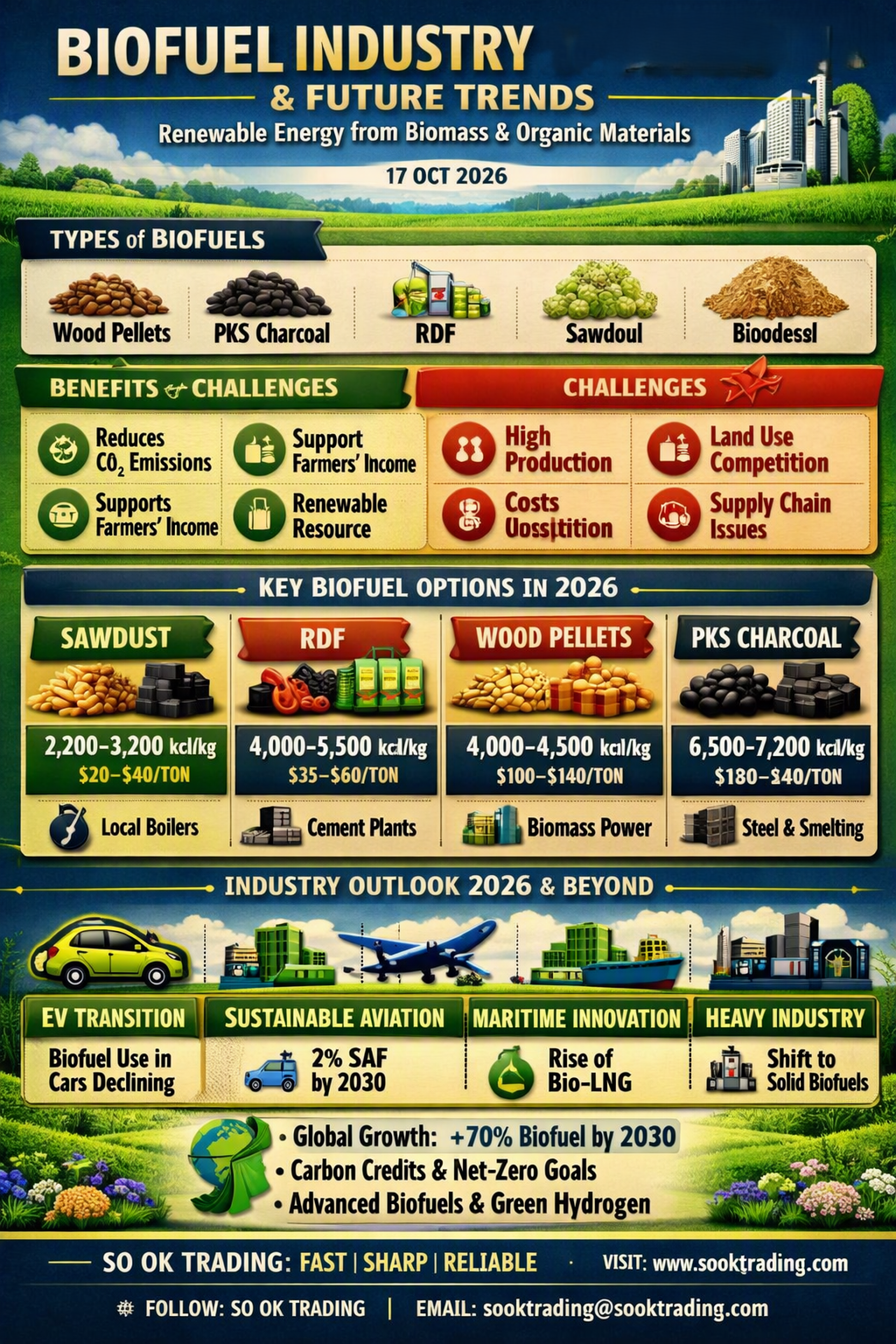
Types of Biofuels
Solid Biofuels: Wood chips, rice straw, bagasse, palm kernel shells, and agricultural residues. Widely used in industrial plants and biomass power stations.
Liquid Biofuels: Ethanol from sugarcane, cassava, and corn; biodiesel from vegetable oils or animal fats; and Sustainable Aviation Fuel (SAF).
Gas Biofuels: Biogas from anaerobic digestion of animal waste or organic wastewater, used for electricity generation and heating.
Advantages and Limitations
Advantages:
Renewable and inexhaustible energy source
Reduces CO₂ emissions and organic waste
Generates income for farmers and local communities
Limitations:
High costs for raw material collection and transportation
Risk of land-use competition with food crops
Some production processes may still impact the environment
Examples of Solid Biofuels & Alternatives
RDF (Refuse Derived Fuel): Derived from municipal solid waste, used in cement kilns and waste-to-energy plants.
Wood Pellets: Compressed sawdust or wood residues, low moisture, easy to transport, ideal for biomass power and industrial boilers.
PKS Charcoal: Palm kernel shells carbonized at high temperatures, delivering high calorific value for steel and metal smelting industries.
Sawdust: By-product of sawmills, used directly in local boilers or as feedstock for wood pellets.
Heating Value & Price Comparison (2026 Estimates)
Sawdust: 2,200–3,200 kcal/kg | 500–1,200 THB/ton → Cheapest, but high moisture content
RDF: 4,000–5,500 kcal/kg | 1,200–2,200 THB/ton → Cost-effective, requires specialized furnaces
Wood Pellets: 4,000–4,500 kcal/kg | 3,800–5,000 THB/ton → Clean, stable, suitable for automated systems
PKS Charcoal: 6,500–7,200 kcal/kg | 6,500–8,500 THB/ton → Highest heat output, ideal for heavy industry
Industry Outlook & Future Directions
Sectoral Transition
Personal Vehicles: Demand for biofuels will decline as EV adoption accelerates.
Aviation & Shipping: SAF expected to reach 2% of global aviation fuel supply by 2030; Bio-LNG adoption rising in maritime transport.
Heavy Industry & Power Generation: Solid biofuels like wood pellets and PKS charcoal will increasingly replace coal in cement, steel, and power plants.
Investment & Policy Trends
Governments worldwide are promoting Carbon Credits and Net-Zero Policies.
Export markets for wood pellets and PKS charcoal are expanding rapidly in East Asia (Japan, South Korea) and Europe.
Technological Innovation
Development of 2nd and 3rd generation biofuels from non-food crops (fast-growing grasses, algae, cellulose residues).
Research into Green Hydrogen and integration with biofuels for sustainable energy systems.
Global Market Outlook
Biofuel production is projected to grow by 70% by 2030 compared to 2025.
Key drivers: energy security concerns, rising crude oil prices, and stricter environmental regulations.
Conclusion
Biofuels are no longer just alternative energy — they are becoming primary energy sources for heavy industry and long-distance transport, sectors that cannot easily transition to electricity. Choosing the right biofuel depends on cost, calorific value, and industrial compatibility:
Sawdust & RDF → Best for cost efficiency
Wood Pellets → Clean, stable, automation-friendly
PKS Charcoal → High heat output for heavy industry
SO OK TRADING: Your Trusted Business Partner FAST | SHARP | RELIABLE
VISIT US: www.sooktrading.com FOLLOW: SO OK TRADING EMAIL: sooktrading@sooktrading.com