“Primary Aluminum Ingot: Global Market Insights on Grades, Standards, and the Driving Force of EV & Green Economy — SO OK INSIGHT”
Primary Aluminum Ingot: Grades, Standards, Applications, and Future Outlook
SO OK TRADING — October 10, 2026
✨ Introduction
Primary Aluminum Ingot is pure aluminum produced directly from bauxite ore (not recycled). It plays a vital role in global industries, from alloy production to applications in electric vehicles (EVs), electronics, and premium packaging.
Understanding its purity grades and functional applications is essential for analyzing the market and anticipating future trends.
1. Purity Grades
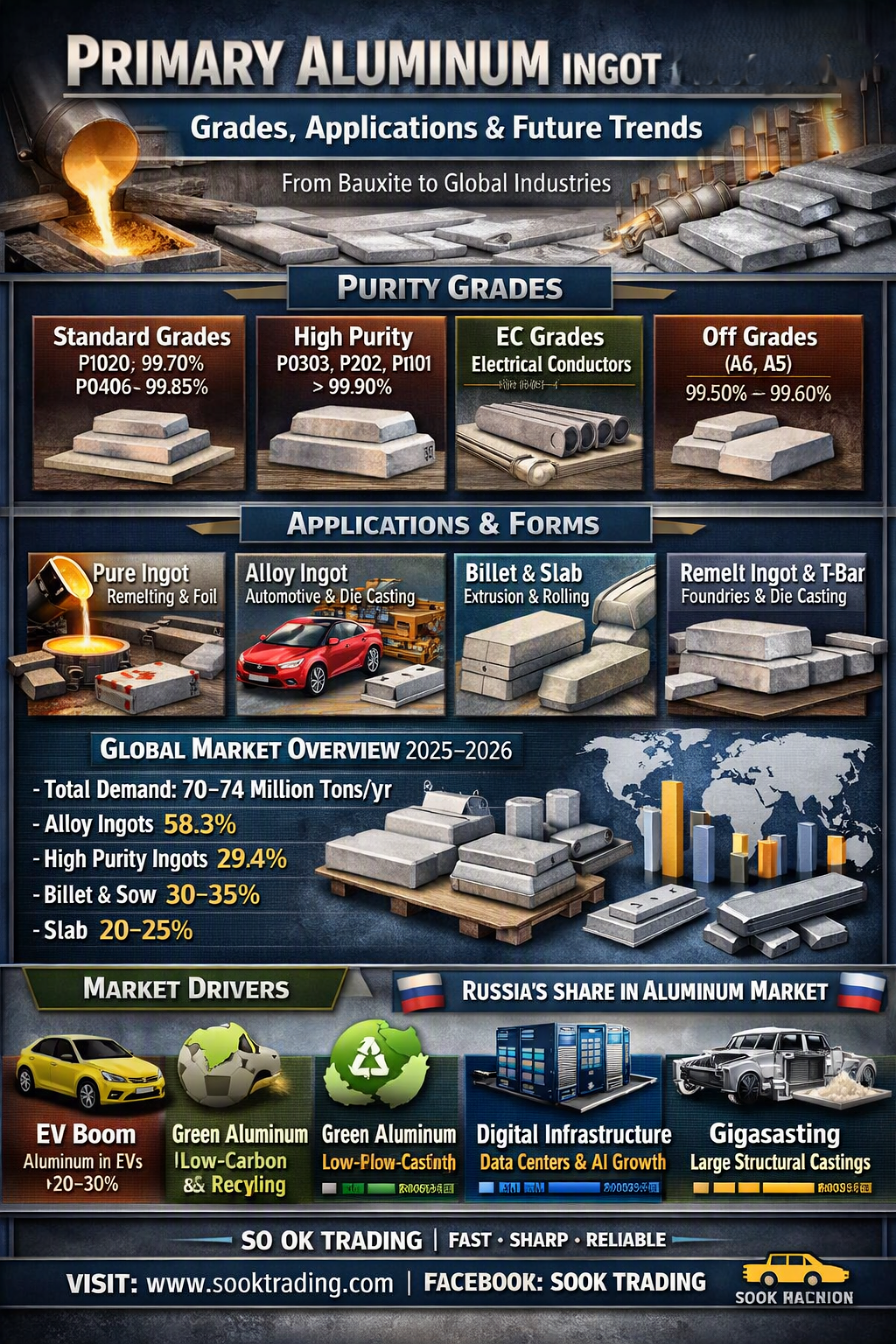
Standard Grades
P1020 (99.70%) → The most widely used grade globally
P0610 (99.80%), P0406 (99.85%) → Stricter impurity control
High Purity Grades (≥99.90%)
P0303, P0202, P0101 → Used in electronics and advanced technologies
EC Grades → For electrical conductors and wiring
Off Grades (99.50–99.60%) → A6, A5, for general applications
2. Functional Types
Pure Aluminum Ingot (Remelting/Base Metal)
Example: P1020 → Remelted for alloying or rolled into sheets, foils, and wires
Alloy Ingot (Foundry/Die Casting)
Mixed with Si, Cu, Mg → Examples: ADC12, A356
Widely used in automotive and general industries
3. Physical Forms
Remelt Ingot → Standard blocks (15–25 kg)
Sow → Large ingots (500 kg–1 ton)
Billet → Cylindrical ingots for extrusion
Slab / Rolling Ingot → Large flat ingots for rolling into sheets/foils
T-Bar → T-shaped ingots designed for easier handling
4. Global Market Statistics (2025–2026)
Total Demand: 70–74 million tons/year
By Chemical Structure
Alloy Ingots → 58.3% (~41–43 million tons)
High Purity Ingots → 29.4% (~21–22 million tons)
Off Grades → 12.3% (~9 million tons)
By Physical Form
Billet → 40–45% (strong growth in Asia)
Remelt & Sow → 30–35% (expansion driven by EVs and gigacasting)
Slab → 20–25% (stable in packaging and premium automotive)
Market Drivers
EV Growth → Aluminum use per EV is 20–30% higher than in combustion vehicles
Green Aluminum → Rising demand for low-carbon and recycled aluminum (CBAM compliance)
Digital Infrastructure → Data centers and AI systems driving demand for high purity grades
Gigacasting → Trend toward large-scale automotive structural castings
⚖️ Standards Comparison (Russia GOST vs International LME/ASTM/EN)
P1020 (LME) ↔ A7 (GOST) → Global trade standard
Ultra-High Purity: A995 (99.995%) ↔ Al99.995
High Purity: A99 (99.99%) ↔ Grade 4N
Commercial Pure: A0 (99.00%) ↔ 1000 Series
Note: GOST may allow different impurity levels compared to ASTM/EN → MTC verification required
Russia’s Market Share
Global Production Share: ~5.4–5.5% (3.8–3.9 million tons/year)
LME Warehouse Share: 70–93% (driven by geopolitical factors)
RUSAL ranks as the world’s third-largest producer, playing a key role in the global aluminum market
Outlook
EV demand will continue to boost aluminum consumption
Green Aluminum is becoming the new global standard
High Purity Grades will be increasingly vital in electronics and digital infrastructure
Billet and Alloy Ingots are expected to be the fastest-growing segments
Conclusion
Primary Aluminum Ingot is a cornerstone material connecting EVs, packaging, electronics, and digital infrastructure. Billet and Alloy Ingots will lead future growth, while Green Aluminum and High Purity Grades are emerging as new global benchmarks.
SO OK TRADING — FAST • SHARP • RELIABLE
Your trusted partner in Non‑Ferrous Metals and Aluminum Packaging www.sooktrading.com Facebook: SO OK TRADING