Share

“SO OK TRADING Analysis: Middle East Crisis OCT 2026 — From Ceasefire Rejection to Energy War and Global Economic Shockwaves in Oil, Gold, and Logistics”
Last updated: 5 Oct 2026
69 Views

Middle East Crisis 2026: From Ceasefire Rejection to Full-Scale War Risk and Global Economic Shockwaves
 
✨ Introduction As of October 5, 2026, the Middle East is entering one of its most critical turning points in decades. The United States, under President Donald Trump, has rejected Iran’s proposed 7‑day ceasefire plan, rapidly escalating tensions across diplomatic, military, and economic dimensions.

This confrontation between two major powers in the region not only threatens political stability but also sends shockwaves through oil prices, gold markets, and international logistics systems. Global markets are already reacting to the rising uncertainty day by day.

At a time when the world is closely watching the Strait of Hormuz — the vital artery of global energy trade — U.S. and allied maneuvers, along with Iran’s and the Houthis’ responses in Yemen, are becoming decisive factors for the global economy in the final quarter of 2026.

 
⚔️ Current Situation

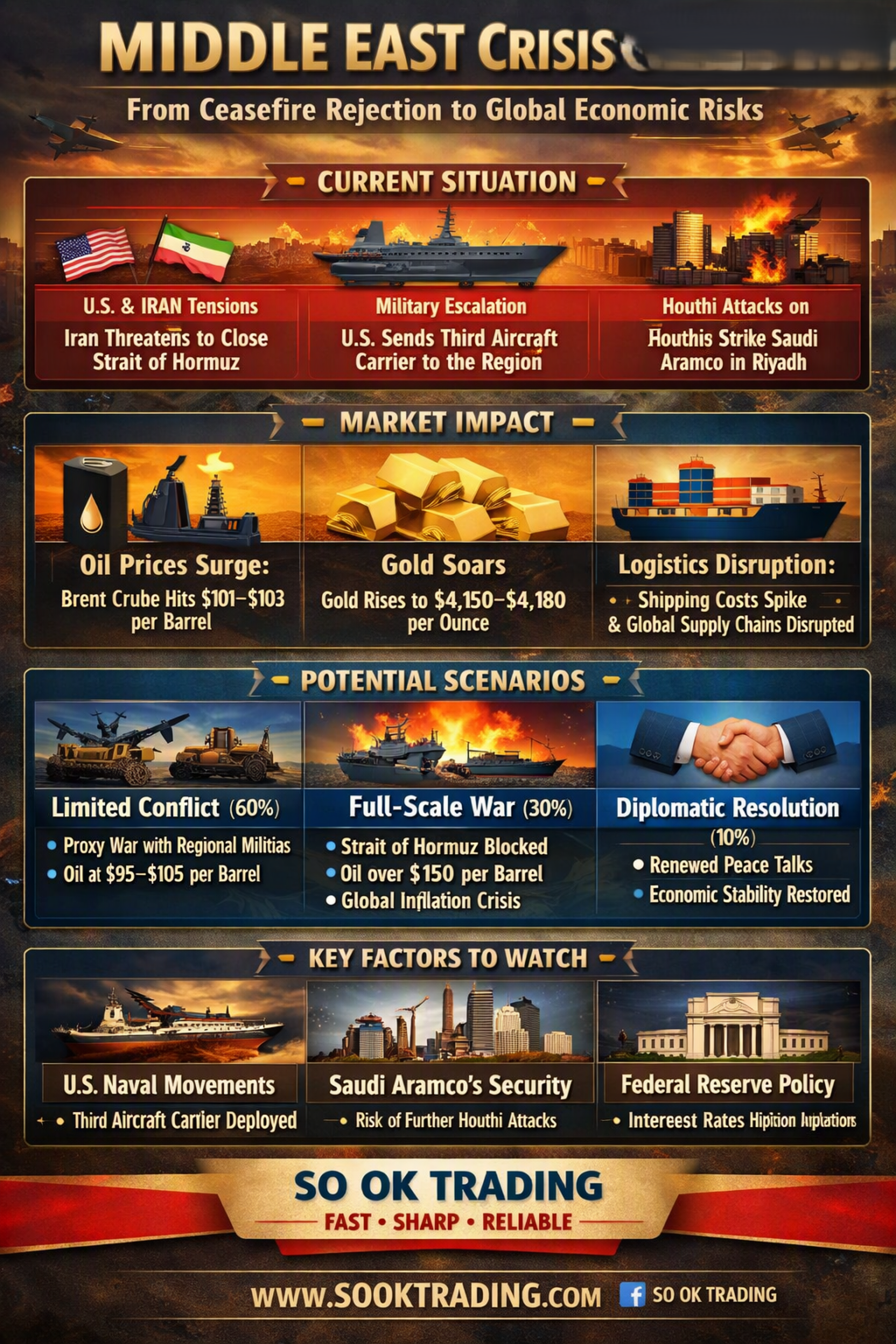
U.S.–Iran Diplomatic Breakdown: Iran has threatened to close the Strait of Hormuz if the U.S. continues military operations, a move widely seen as a declaration of “full‑scale war.”
U.S. Military Deployment: Vice President J.D. Vance convened an emergency meeting at Camp David, preparing to deploy a third aircraft carrier to the region by November.
Houthi–Saudi Arabia Frontline: Houthi rebels attacked Saudi Aramco’s refinery in Riyadh for the first time in four years. Saudi forces retaliated immediately, shaking energy security across the Arabian Peninsula.
 
⛽ Oil and Global Energy Markets

Brent Crude Surge: Prices rebounded above $100 per barrel (range $101–$103) despite G7’s emergency oil release.
Logistics Costs Rising: Exports through the Strait of Hormuz recovered to 18.5 million barrels/day, but insurance and freight premiums rose more than tenfold.
Supply Constraints: OPEC+ maintained production targets, while China temporarily halted refined‑oil exports.
Impact on Thailand: The Fuel Fund Committee raised domestic fuel prices by 0.75 baht per liter.



Related Content
“Copper Cathode 2026–2030: The Strategic Metal of the AI Era and Clean Energy”   BY SO OK TRADING|1 MAY 2026
Copper Cathode is transforming from a traditional industrial metal into a “strategic metal of the AI era and clean energy.” Between 2026–2030, the world is entering a critical turning point — as data centers, EVs, and renewable energy demand copper at unprecedented levels. Meanwhile, global supply remains tight, copper prices surge to historic highs, and “Green Copper” is emerging as the new industry standard. SO OK TRADING analyzes global copper market trends and highlights Thailand’s role as ASEAN’s PCB manufacturing base and EV hub. How will this strategic metal drive the digital economy and clean energy future? — Discover the full insights in our article.
1 May 2026
HNY 2026 with a First Analysis on Thai Baht Value
he Thai baht in Q1 2026 is expected to strengthen against the US dollar, driven primarily by a weaker dollar globally, a seasonal tourism boost, and expectations of US Federal Reserve rate cuts. This strength is occurring despite a weak domestic economic outlook and the Bank of Thailand's (BoT) likely continued easing of its policy rate. Exchange Rate Drivers and Forecast External Factors: The primary driver for the strengthening baht is external, mainly the broad weakness of the US dollar as global markets price in expected Fed rate cuts. The baht is also correlated with global gold prices, which have been climbing. Tourism High Season: The period extending into Q1 2026 is the high season for tourism, which typically brings in foreign currency and supports the baht's value. Policy Divergence: The BoT is expected to continue its easing cycle, potentially cutting the policy rate further to 1.00% by Q1 2026 to stimulate the sluggish domestic economy. This divergence from a potentially less aggressive US Fed in Q1 could support the baht in the short term, though some analysts warn the currency could weaken later in 2026. Forecasts: Projections for 2026 generally place the baht in a range of 30.80–33.00 per US dollar. Some models estimate it could trade around 31.06 by the end of Q1. A persistently strong baht below 31 per US$ is seen as a significant risk to the Thai export and tourism sectors. Key Economic Context Weak Growth: Thailand's economy is expected to slow down to a 5-year low growth rate of around 1.6-1.8% in 2026, pressured by US tariffs, global trade tensions, and high household debt. The central bank chief expects an improvement in Q1 2026 after a weak second half of 2025. Political Uncertainty: A general election expected in February 2026 could also introduce volatility, though some historical trends suggest the baht may strengthen following the formation of a new government. Low Inflation: Headline inflation is projected to remain subdued or even negative, providing the central bank with justification for further rate cuts to stimulate demand. In summary, Q1 2026 is characterized by a strong and volatile baht driven by external factors, contrasting sharply with a weak domestic economy and accommodative monetary policy.
1 Jan 2026
This website uses cookies for best user experience, to find out more you can go to our Privacy Policy and Cookies Policy
Powered By MakeWebEasy Logo MakeWebEasy