“LME vs ShFE: Bridging the Global Metals Market — From London to Shanghai, The Birth of World Standard Pricing” SO OK TRADING : October 4, 2026
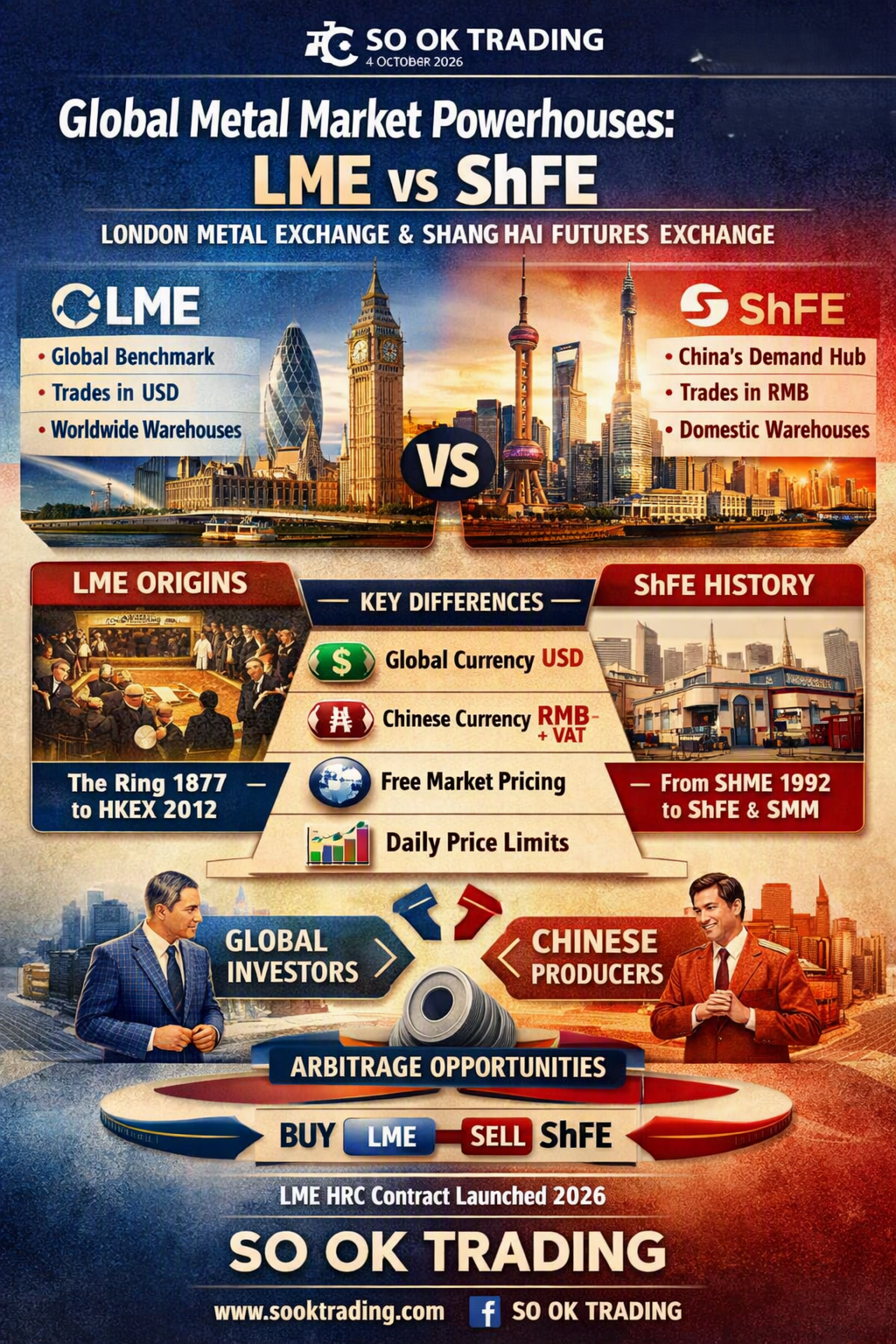
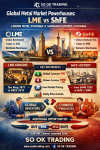
Global Metal Market Powerhouses: LME vs ShFE
(London Metal Exchange & Shanghai Futures Exchange) SO OK TRADING : October 4, 2026
Introduction
The global non-ferrous metals market is driven by two dominant exchanges: the London Metal Exchange (LME) and the Shanghai Futures Exchange (ShFE). Both play crucial roles in setting benchmark prices worldwide, yet their focus differs significantly — LME serves as the global reference market, while ShFE reflects China’s domestic supply and demand, the largest consumer of metals in the world.
Market Overview
LME (London): A highly international marketplace, trading primarily in US dollars (USD). Recognized as the “Global Benchmark” for industrial metals, with a worldwide network of approved warehouses. Prices are determined by free market mechanisms without daily limits. Its participants are mainly global institutions and traders.
ShFE (Shanghai): China’s leading futures market, trading in renminbi (RMB) with value-added tax (VAT) included. Warehouses are located exclusively within China, and daily price limits are imposed to manage volatility. Its participants are primarily Chinese producers and industrial enterprises.
London Metal Exchange (LME)
Origins (16th–19th Century): Emerged from London’s Jerusalem Coffee House, where merchants traded metals by shouting bids inside a chalk-drawn circle — the origin of “The Ring”.
Formal Establishment (1877): Founded as the London Metal Market and Exchange Company, introducing the three-month contract based on average shipping times from Chile or Singapore to London.
Global Expansion: Added copper, tin, aluminium, and nickel to its portfolio, while building a worldwide warehouse network to support physical delivery.
Modern Era: Acquired by the Hong Kong Exchanges and Clearing (HKEX) in 2012 for £1.4 billion, linking Asian capital with European markets. Today, LME controls over 98% of global non-ferrous metal pricing, maintaining both The Ring and electronic trading via LME Select.
Shanghai Futures Exchange (ShFE)
Experimental Phase (1990s): Following China’s economic reforms, multiple local commodity markets emerged. The Shanghai Metal Exchange (SHME) was established in 1992.
Official Formation (1999): The government consolidated three major markets into ShFE, alongside the creation of the Shanghai Metals Market (SMM) to provide spot pricing.
Growth Era (2000–2010): China’s rapid industrialization made it the world’s largest consumer of copper, aluminium, and zinc. ShFE expanded to include rubber, fuel oil, gold, and nickel contracts.
Global Integration (Present): Through the Shanghai International Energy Exchange (INE), foreign investors can trade select commodities. ShFE and SMM prices are now closely monitored worldwide alongside LME benchmarks.
Roles and Interconnection
LME remains the global reference price used in international contracts and settlements.
ShFE commands massive trading volumes, reflecting China’s industrial demand.
Arbitrage Opportunities: Traders exploit price gaps between LME and ShFE — buying from LME and selling in China when domestic prices are higher.
Recent Collaboration: In 2026, LME launched a Hot Rolled Coil (HRC) futures contract referencing ShFE’s pricing, marking a milestone in East–West market integration.
Current Outlook
Global Demand Rising: The transition to clean energy and electric vehicles (EVs) continues to drive demand for copper, nickel, and aluminium.
China’s Dominance: With over 50% of global consumption, ShFE’s pricing increasingly influences global sentiment.
Convergence Trend: LME and ShFE are moving toward deeper cooperation, bridging Western financial systems with Eastern industrial realities.
Conclusion
The London Metal Exchange (LME) and the Shanghai Futures Exchange (ShFE) represent two pillars of the global metals market.
LME defines international benchmarks in USD, ensuring transparency and liquidity.
ShFE mirrors China’s industrial pulse, capturing domestic supply-demand dynamics in RMB.
Together, they connect global investors and industrial producers, shaping the future of metal pricing, trade, and sustainability across continents.
SO OK TRADING Your trusted partner in NON-FERROUS METALS from Thailand FAST • SHARP • RELIABLE www.sooktrading.com Facebook: SO OK TRADING